

Index Summary
Front Matter
- 1 Introduction & General Information
- 2 Abbreviations and Acronyms
Part A — General Overview
- 3 Message from the Council Chairperson
- 4 Accounting Officer's Foreword
- 5 Statement of Responsibility & Accuracy
- 6 Legislation and Other Directives
Part B — Governance
- 7 Report of the Council Chairperson
- 7.1 Constitution of Council & Governance Structures
- 7.2 Reports by Committees of Council
- 7.3 Academic Board Report
- 7.4 Student Representative Council Report
- 7.5 College Council Minutes
Part C — Performance Information
- 8 Principal's Report on Management & Administration
- 9 College Performance & Organisational Environment
- 10 Performance Reporting
Part D — Financial Information
- 11 Financial Reporting
1. Introduction
1. General Information
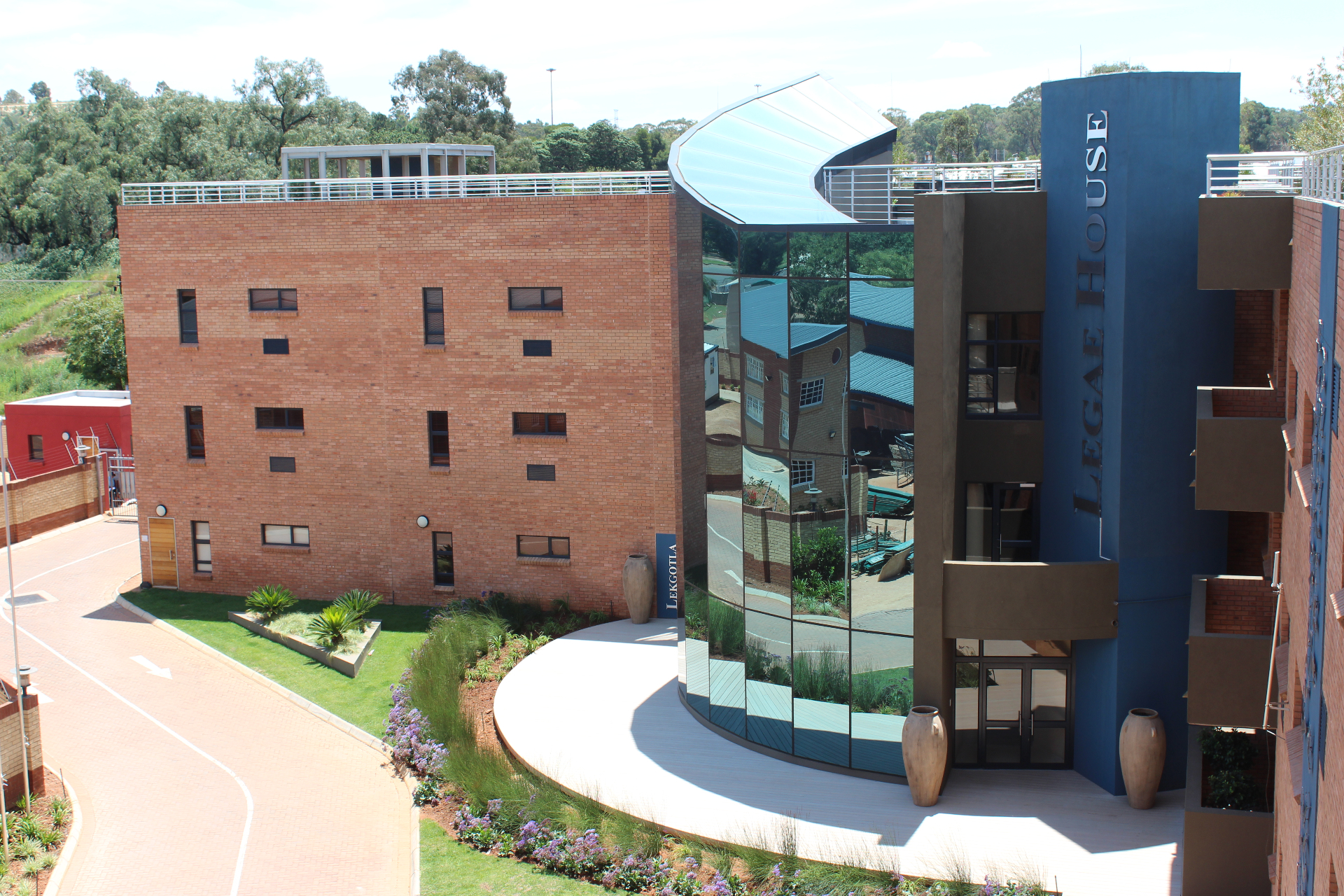
Ekurhuleni West TVET College (“EWC”) head office is located in the Gauteng Province, in the city of Ekurhuleni. The College consists of the following Six Campuses in the following areas, Alberton, Boksburg, Germiston, Kathorus, Tembisa and Kempton
The EWC head office Contact Details are as follows:
Address: Cnr. Flag and Rose Innes Germiston
Head Office: Driehoek, Germiston
Tel: 011 323 1600
Fax: 011 323 1601
Email: info@ewc.edu.za
Website: www.ewc.edu.za
Executive Management
In terms of the current institutional configuration, the contact details of the executive management team of the College is reflected below:
Mr. M.I Mabe
Principal
Tel: 066 186 7085
Email: molifim@ewc.edu.za
Mr. P.W Kgorutle
Deputy Principal: Finance
Tel: 076 519 9682
Email: peterk@ewc.edu.za
Mrs M.C.N Dangazele
Deputy Principal: Corporate Services
Tel: 082 308 8694
Email: ntombizodwa@ewc.edu.za
Mr M. Chukudu
Acting Deputy Principal: Academic Services
Tel: 082 529 4965
Email: madimetsac@ewc.edu.za
Mr. F.S Duarte
Acting Deputy Principal: Registrar
Tel: 082 410 3383
Email: frankd@ewc.edu.za
2. Abbreviations and Acronyms
APP - Annual Performance Plan
CoE – City of Ekurhuleni
COS - Centre of Specialisation
DHET - Department of Higher Education and Training
EWC – Ekurhuleni West TVET College
HRDS-SA - Human Resource Development Strategy for South Africa
ISAT - Integrated Summative Assessment Task
ICASS - Internal Continuous Assessment
M&E - Monitoring and Evaluation
MTEF - Medium Term Expenditure Framework
MTSF - Medium Term Strategic Framework
NDP - National Development Plan
NEET - Not in Employment, Education or Training (youth)
NSDS - National Skills Development Strategy
NSF - National Skills Fund
NSFAS - National Student Financial Aid Scheme
OPS - Operational Plans
PESTEL – Political, Economic, Social, Technological, Environmental, Legal
PQM - Programme Qualification Mix
PSET - Post-School Education and Training
RPL – Recognition of Prior Learning
SETA - Sector Education and Training Authority
SNE - Special Needs Education
SRC - Student Representative Council
SSP - Sector Skills Plan
SWOT - Strengths, weaknesses, opportunities, threats
TVET - Technical and Vocational Education and Training
W&RSETA – Wholesale and Retail Sector Education and Training Authority
WBE - Work Based Experience
WIL - Work Integrated Learning
WPBL - Workplace-based Learning
Foundational Statements
Vision - Empowering leaders who drive progress for their communities and fuel the nation's economy.
Mission - We lead, set trends, and provide quality, industry-relevant education that equips students with practical and innovative competencies. We empower our people and stakeholders in line with our shared mindset.
Values – At, EWC we are guided by the following values which are important to us as an organization:
Ethical Leadership and Integrity - We lead with honesty, transparency, and accountability.
Uncompromising Quality and Excellence - We pursue excellence in all that we do.
Collaborative Teamwork - We achieve more together than alone
Inclusivity, Diversity and Responsiveness - We embrace all and respond to their needs
Shared Mindset - ”Empowering Beyond the Future"
Zero Tolerance - We believe there should be zero tolerance for:
Corruption and Fraud – No financial misconduct of any kind.
Gender-Based Violence (GBV) – No violence or harassment based on gender.
Bullying – No intimidation, harassment, or abuse in any form
PART A: GENERAL OVERVIEW
3. Message from the Council Chairperson

In accordance with Section 10(2)(a) of the Continuing Education and Training Act, No. 16 of 2006, as amended, the Council of Ekurhuleni West TVET College (EWC), a public TVET college, hereby submits the Annual Performance Report for the year ended 31 December 2025 to the Minister of Higher Education and Training (DHET).
This plan has been developed in alignment with the National Development Plan (NDP), the Post-School Education and Training (PSET) Plan, and all relevant legislative mandates. It is a strategic response to the dynamic environment in which we operate, shaped by the imperatives of the Fourth Industrial Revolution (4IR), the national prioritization of artisan and intermediate skills development, and the socio-economic realities of our society as reflected in the Integrated Development Plan (IDP) of the CoE and the National Budget Speech. This plan positions EWC to navigate these factors—turning challenges into opportunities, minimizing our weaknesses and leveraging our institutional strengths to maximise positive impact.
A Transformational Strategic Planning Process
This strategic plan represents more than a policy document—it is the product of deep deliberations, collaborative engagements, and solemn commitment by the Council. The Council ratified the strategy during the intensive strategic planning session held from 16-18 January 2026, at Rosemary Hill Farm in Pretoria, facilitated by Magagula Dynasty Strategic Planning Consultants.
Over the two transformational days, we interrogated our core purpose, defined our legacy vision, strengthened our governance framework through the King V Report on Corporate Governance, principles, and emerged as a unified strategic leadership team.
The Council Commitment
Our commitment is firmly centred on contributing to the DHET’s strategic sub-outcomes and thereby contribute to producing competent graduates that will contribute to the economic growth of SA and beyond. While our core focus remains on expanding access and success in occupational programmes (Sub-Outcome 2 and 4), this plan prioritises a holistic approach to institutional excellence by targeting:
Sub-Outcome 1: Improved Student Access and Success through enhanced foundational support, career guidance, and robust student support systems to increase retention and throughput rates.
Sub-Outcome 5: Improved Quality of PSET Provisioning by continuously enhancing our teaching and learning methods, digital infrastructure, and quality assurance mechanisms.
Sub-Outcome 6: A Highly Capable and Professional Staff Cohort by investing in ongoing academic and professional development for our lecturers and support staff.
Progress and Forward Vision
I am pleased to report substantial progress under our previous strategic plan. We embraced digitalisation to modernise our governance and academic systems, leading to expanded programme offerings, streamlined digital admissions, and enhanced student support. Our commitment to quality and good governance is demonstrated by consistent unqualified audit opinions and the re-certification of our quality management systems against four ISO standards
Our efforts for the next five years are determined by a drive to instill an organisational culture of excellence and accountability. In this regard, we are guided by our unified purpose embedded in our vision: to transform raw potential into tangible progress, empowering leaders who drive progress for their communities and fuel the nation’s economy
We have established rigorous governance oversight through the 13 principles King V Report on Corporate Governance and have developed Key Performance Areas (KPAs), with measurable Key Performance Indicators (KPIs) and quarterly monitoring measures to ensure strategy execution translates into reality.
This plan is our covenant with the youth of Ekurhuleni, the communities we serve, and the nation we pledge to build. We are stewards of socio-economic transformation, and we will lead with courage, integrity, and purpose.
Ms. A. Visagie
Chairperson, EWC Council
January 2026
4. Foreword from The Accounting Officer

Principal & Accounting Officer
EWC stands at a pivotal moment in our institutional history, as we embark on this five-year strategic journey. The strategic planning session held in January 2026 marked a watershed moment in Council-Management collaboration, resulting in a strategy that is not merely aspirational but actionable, measurable, and transformational.
The Context: Why This Strategy Matters
South Africa faces a critical skills crisis. With youth unemployment exceeding 60% for ages 15-24, and national unemployment rate hovering around 33%. In this regard, the country cannot afford the underperformance of TVET colleges. The persistent challenges of Poverty, Inequality, and Unemployment (PI&U), which is compounded by Fraud and Corruption (F&C), demands that we rise to our mandate and commitment with urgency and excellence to avert the acceleration of these social ills getting out of control.
Located in the economic heart of Gauteng, in Ekurhuleni Metropolitan Municipality, EWC operates six strategically positioned campuses serving communities from Alberton to Tembisa, Germiston to Kempton Park. Our footprint places us at the center of critical economic sectors of which, amongst others are: aviation, manufacturing, logistics, mining support services, construction, hospitality, banking and emerging industries like renewable energy, logistics, Artificial Intelligence (AI), Data Centres.
The Strategy: Empowering Beyond the Future
This strategic plan is anchored on five strategic pillars:
Drive Economic Alignment and Graduate Employability – Ensuring our graduates are not just qualified, but either employable or entrepreneurial.
Champion Inclusive Access and Student Success – Expanding student access while maintaining 80%+ pass rates.
Lead in Digital Innovation and Future Competencies – Preparing students for 4IR and beyond.
Ensure Institutional Sustainability Through Partnerships – Building authentic and deep industry collaborations.
Strengthen Governance and Operational Excellence – Maintaining unqualified audits and ethical culture.
Each pillar is supported by detailed action plans, Key Performance Indicators (KPIs), and clear accountability structures. Council’s governance oversight through the six of the King V Report on Corporate Governance principles ensures that management is held to the highest standards of performance and ethics.
The Commitment: Measurable Impact
We commit to:
95% graduate employability within one year of completion
80%+ pass rates maintained consistently across all programs
Zero tolerance for Corruption, Fraud, Gender-Based Violence, and Bullying
Modern infrastructure with smart classrooms and digital labs across all campuses
Authentic partnerships enabling 100% work-based experience placement
Ethical culture embedded in every decision and action we take
The Partnership: A United Team
The January 2026 session demonstrated the power of unified leadership. The deep engagement by the council in the articulated “WHY” and the defined legacy vision provide the strategic direction EWC and its stakeholders so desires. Management expertise, operational capacity, and commitment to excellence provide the execution engine. Together, we move from solo performance to symphonic collaboration.
This strategy is our roadmap, it is ambitious yes and yet it’s achievable. It requires sustained focus, adaptive management, and collective accountability. With Council oversight and governance, management execution and continual evaluation, staff dedication, and student commitment, we will transform EWC into the benchmark TVET college in South Africa.
From raw potential to tangible progress. From vision to legacy.
Mr. M.I. Mabe
Principal
Ekurhuleni West TVET College
January 2026
5. Statement of Responsibility and Confirmation of Accuracy
To the best of my knowledge and belief, I confirm the following:
All information and amounts disclosed throughout the annual report are consistent.
The annual report has been prepared in accordance with the guidelines issued by the Department of Higher Education and Training.
The annual financial statements have been prepared in accordance with the relevant standards, frameworks and guidelines issued by National Treasury.
The accounting officer, i.e. the principal, is responsible for the preparation of the annual financial statements and for the judgements made in this document.
The accounting officer, i.e. the principal, is responsible for establishing and implementing a system of internal control that has been designed to provide reasonable assurance as to the integrity and reliability of the performance information, the human resources information and the annual financial statements.
The Auditor-General and/or external auditors express an independent opinion on the annual financial statements.
Declaration signed by:
Mr. M.I Mabe on 30 June 2026
Principal
Ekurhuleni West TVET College
6. Legislation and other Directives
6.1 Legislative Framework
Ekurhuleni West TVET College (“EWC”) is enjoined by Section 44(3) of the Act, read in conjunction with section 25(3) of the same Act to prepare and submit to the Minister for Higher Education and Training, an Annual Report. In terms of Sections 25(3) and 25(4) of the Continuing Education and Training Act, No. 16 of 2006, public technical and vocational education and training (TVET) colleges are required to produce annual financial reports and to comply with any reasonable additional reporting requirement established by the Minister. Moreover, Section 44 of the Act requires colleges to annually report to the Minister in respect of its performance and its use of available resources. In addition, the above-mentioned pieces of legislation govern and steer the College in terms of achievement of its strategic and performance objectives.
6.2 Legislative and Other Mandates
In terms of Sections 25(3) and 25(4) of the Continuing Education and Training (CET) Colleges Act, No 16 of 2006 (as amended), public technical and vocational education and training (TVET) colleges are required to produce annual financial reports and to comply with any reasonable additional reporting requirement established by the Minister. Moreover, Section 44 of the Act requires colleges to annually report to the Minister in respect of its performance and its use of available resources. In addition, these pieces of legislation govern and steer the college in terms of achievement of its strategic and performance objectives.
The Constitution of the Republic of South Africa (Act No. 108 of 1996) at Section 29(1)-(4)) provides for the right of basic and further education to everyone in the official language of their choice provided equity, redress and practicability are taken into account. In addition, the CET Act provides for the regulation of continuing and further education and training through the establishment, governance and funding of public technical and vocational education and training (TVET) colleges and the promotion of quality in continuing and further education and training.
The Constitution of the Republic of South Africa (Act No. 108 of 1996) at Section 29(1)-(4)) provides for the right of basic and further education to everyone in the official language of their choice provided equity, redress and practicability are taken into account. In addition, the CET Act provides for the regulation of continuing and further education and training through the establishment, governance and funding of public technical and vocational education and training (TVET) colleges and the promotion of quality in continuing and further education and training.
Further sets of legislation that impact on the TVET colleges sector and its strategic and national imperatives are listed below:
• National Qualifications Framework Act, No.67 of 2008;
• Higher Education Act, No.101 of 1997;
• Skills Development Act, No.97 of 1998;
• Skills Development Levies Act, No.9 of 1999; and
• General and Further Education and Training Quality Assurance Act, No.58 of 2001;
• Auditor General Act, No.12 of 1999.
In addition, the White Paper for Post-School Education and Training mandates delivery and strategic priorities in the TVET colleges sector. Other policy mandates include:
• National Trade Testing Regulations;
• SETA Grant Regulations;
• National Skills Development Strategy;
• Public TVET College Attendance and Punctuality Policy; and
• Policy on the Conduct of National Examinations and Assessment.
PART B: governance
7. REPORT OF COUNCIL CHAIRPERSON
The College Council of Ekurhuleni West TVET College (EWC) continued to exercise its oversight responsibility over governance, academic, financial, risk and student affairs throughout the 2025 reporting period, guided by the Continuing Education and Training Act, No. 16 of 2006 (as amended) (the CET Act), the King IV/King V principles of corporate governance, and the College's Council Charter and sub-committee structures.
The period under review was characterised by significant strengthening of the College's governance architecture. Following the finalisation of Ministerial appointments, the College Council became fully constituted with effect from 1 June 2025, enabling all statutory governance structures, including the Audit and Risk Committee, the Human Resource Committee, the Planning and Resource Committee, and the Academic Board, to operate at full capacity for the greater part of the year. This development directly addressed prior-year audit findings (COMAF 2.1, 2.2 and 3) raised by the Auditor-General of South Africa (AGSA) relating to the College Council not being fully established and the absence of a functional Audit Committee and internal audit function. Management has confirmed, and AGSA has accepted, that these matters are now closed.
During the year, Council, together with College Management, undertook the EWC Annual Strategic Planning process, culminating in a College Council Strategic Planning Session held from 16 to 18 January 2026, which built on the senior management strategic planning session of 29 to 31 October 2025. The session resulted in the refinement of the College's strategic pledge, strategic objectives and outcome focus areas in line with the EWC 2025 - 2030 "Empowering Beyond the Future" Strategic Plan, and incorporated a governance framework aligned to the King V Report on Corporate Governance principles. The Council further appointed an additional Independent Council Member, Mr Vuledzani Floyd Mathavha, in terms of section 12(1)(b) of the CET Act, to serve on the Audit and Risk Committee.
Council exercised oversight over the College's financial governance through its engagement with the Auditor-General of South Africa (AGSA), which commenced the external audit for the 2025/26 financial year on 3 January 2026. AGSA tabled its Audit Strategy and Engagement Letter for the 2025 financial year (dated 6 March 2026) for Council's consideration and approval, with a budgeted audit fee of R2 377 608 (excluding VAT) for 2 469 audit hours. Council also received and considered the findings of the AGSA review of the College's Audit Action Plan, which reflected that 9 of the 44 audit action plan items from the 2024/2025 financial year had been closed, with the remaining 35 items in progress.
Council, through its sub-committees, continued to monitor the College's institutional risk profile, human resource management, infrastructure projects (including the Tembisa Campus Boardroom, Auditorium and Student Support Services construction project, and the Germiston Skills Training Centre), academic performance, examinations integrity, and student governance and support. Matters of concern reported to Council during the year included:
an ongoing investigation into the leakage of examination question papers at Kathorus Campus,
several legal disputes involving service providers and former contractors, and
the eviction of illegal occupants from College-owned residential property at Villa Bianca.
Notwithstanding these challenges, the College recorded notable achievements during the year, including strong performance in the November 2025 National Examinations, with EWC ranked 3rd nationally in Report 191 Engineering Studies and 5th nationally in Report 191 Business Studies (1st regionally in both), an enrolment of 12 154 students against a target of 9 228, and continued participation in international partnership programmes with institutions in China.
Council records its appreciation to Management, staff and students for their contribution to these outcomes, and remains committed to strengthening governance and accountability across the College in the year ahead.
7.1 Constitution of the College Council and Governance Structures
This section reports on the composition of the College Council, appointments made during the year in terms of sections 10(4) and 10(6) of the CET Act, the number and purpose of Council meetings held during 2025, and the Council's performance of its statutory functions in terms of section 10(1)-(3) of the CET Act.
7.1.1 Composition of Council and Designated Functions
The table below sets out the composition of the College Council as at the adoption of this report, reflecting the Chairperson, ex officio members (College executive management), Section 10(4) appointees, internal co-opted members, and student representatives, together with their designated functions/portfolios and the basis of appointment in terms of the CET Act.
| Name | Position | Appointment Under |
|---|---|---|
| Ms Alison Visagie | Interim Chairperson (Acting from 1 October 2024) | Section 10(6) appointed May 2024 |
| Mr Molifi Mabe | Principal and Accounting Officer (ex officio member) | - |
| Mr Peter Kgorutle | Deputy Principal: Finance (ex officio member) | - |
| Ms M.C.N. Dangazele | Deputy Principal: Corporate Services (ex officio member) | - |
| Mr M. Chukudu | Acting Deputy Principal: Academic Services (ex officio member) | - |
| Mr F.S. Duarte | Acting Deputy Principal: Registrar (ex officio member) | - |
| Mr S.P. Mothelesi | Council Member: Finance Portfolio | Section 10(4) appointee, May 2025 |
| Ms M.C. Thibela | Council Member: Human Resources Portfolio | Section 10(4) appointee, May 2025 |
| Ms N. Maliseha | Council Member: Legal Portfolio | Section 10(4) appointee, May 2025 |
| Mr G.M. Mogodi | Council Member: ICT & Infrastructure Portfolio | Section 10(4) appointee, May 2025 |
| Dr Vuyelwa Nhlapo | Academic Board Representative (internal co-opted member) | - |
| Ms N. Dickenson | Support Staff Representative (internal co-opted member) | - |
| Mr X. Mguni | SRC President (student representative) | Elected March 2024 |
| Ms Y. Zulu | SRC Secretary (student representative) | Elected March 2024 |
7.1.2 Appointments Made During the Year (Sections 10(4) and 10(6) of the CET Act)
During the period under review, the Office of the Principal continued to engage the Department of Higher Education and Training (DHET) regarding the finalisation of outstanding Council appointments. The Minister of Higher Education and Training appointed the remaining Council members with effect from 1 June 2025, thereby rendering the College Council fully constituted and operational for the remainder of the 2025 reporting period. This appointment directly resolved a prior-year non-compliance finding regarding the College Council not being fully established in terms of the CET Act.
Following the constitution of Council, the newly appointed Council established the Audit and Risk Committee, which became fully functional with effect from 1 January 2025, and which subsequently embarked on the establishment of an internal audit function for the College.
During the period 1 November 2025 to March 2026, the College further appointed Mr Vuledzani Floyd Mathavha as an Independent Council Member in terms of section 12(1)(b) of the CET Act, who will serve on the Audit and Risk Committee. The Office of the Principal continues to follow up with DHET regarding the appointment of the remaining section 10(6) members; as at the date of compilation of this report, the College's submission in this regard remains with the Minister for approval.
The table below sets out the full composition of Council sub-committees as constituted for the 2024–2029 term, reflecting the membership and portfolio allocations approved by Council.
Executive Committee of Council (EXCO)
| Name | Role / Portfolio |
|---|---|
| Alison Visagie | Chairperson of Council (External) |
| Maliseha Ndamane | Deputy Chairperson of Council (External) |
| MI Mabe | Principal (Internal) |
| Chabalala Ronald | Secretary of Council (Internal) |
| DPC / DPR / DPF / DPA | Invitees |
Audit and Risk Committee (ARC)
| Name | Role / Portfolio |
|---|---|
| Dr Masegare | Chairperson (External) |
| M Mogodi | External Member |
| Maliseha N | External Member (Risk Management expertise) |
| Floyd Mathavha | Principal Member (Independent – s12(1)(b) CET Act) |
| MI Mabe | Principal (Member) |
| DP: Finance | Member |
| Internal Auditors / Auditor-General (SA) | Invitees |
Finance Committee (FINCO)
| Name | Role / Portfolio |
|---|---|
| Mogaladi T | Chairperson (External) |
| Mongale T | External Member |
| Dr V Nhlapo | External Member |
| MI Mabe | Principal (Member) |
| DP: Finance | Member |
| ASD: Financial Manager | Invitee |
Strategic Planning and Resources Committee
| Name | Role / Portfolio |
|---|---|
| Mogodi GM | Chairperson (External) |
| Thibela M | External Member |
| Mogaladi T | External Member |
| Mabe MI | Principal (Internal Member) |
| DP: Corporate Services / DP: Registrar | Internal Members |
| ASD: Project Manager | Invitee |
ICT and Innovation Committee
| Name | Role / Portfolio |
|---|---|
| Maliseha N | Chairperson (External) |
| Mogodi GM | External Member |
| Dr Masegare | External Member |
| MI Mabe | Principal (Internal Member) |
| P Nkhumane | ICT Expert (Internal Member) |
| DP: Corporate Services / ASD: IT Managers | Internal Member / Invitees |
Human Resources and Remuneration Committee
| Name | Role / Portfolio |
|---|---|
| Thibela M | Chairperson (External – HR Expert) |
| Nhlapo V | External Member |
| Dr Masegare | External Member |
| MI Mabe | Principal (Internal Member) |
| DP: Corporate Services / ASD: HR Manager | Internal Member / Invitee |
Student Support Services Committee (SSS)
| Name | Role / Portfolio |
|---|---|
| Nhlapo V | Chairperson (External Member) |
| Visagie A | External Member |
| Chabalala NR | Internal Member |
| Mabe MI | Principal (Internal Member) |
| DP: Registrar / SRC President & Secretary | Internal Members |
| ASD: SSS Manager | Invitee |
Centre for Entrepreneurship Advisory Board
| Name | Role / Portfolio |
|---|---|
| N Mongale | Chairperson (External) |
| Chabalala R | Business Studies Lecturer (Internal Member) |
| P Nkhumane | IT Expert (Internal Member) |
| MI Mabe | Principal (Invitee) |
| DPA / DPR / ASD: Occupational Programmes & Partnerships | Standing Invitees |
The Academic Board composition is set out in section 7.3 of this report.
7.1.3 Number of Council Meetings Held and Purpose
The College Council held a Strategic Planning Session with Council members and Management from 16 to 18 January 2026, building on the Annual Strategic Planning Session held from 29 to 31 October 2025. These sessions focused on the finalisation of the EWC 2025-2030 "Empowering Beyond the Future" Strategic Plan, including the College's strategic pledge, strategic objectives, outcome focus areas, and a Governance Framework aligned to the King V Report on Corporate Governance principles. The Student Representative Council (SRC) participated in the senior management and Council Strategic Planning Sessions held in October 2025 and January 2026.
The sub-committees of Council convened on the following confirmed dates during the 2025 reporting period and into the first quarter of 2026:
| Date | Committee / Structure | Purpose / Agenda Focus |
|---|---|---|
| 29–31 October 2025 | Senior Management (with SRC participation) | Annual Strategic Planning Session – foundational statements, objectives, crafting strategy, implementation, monitoring and evaluation for the EWC 2025–2030 Strategic Plan |
| 3 November – 11 December 2025 | Academic Board (Examinations Oversight) | November 2025 National Examination cycle oversight – planning, monitoring and security of examination materials across six campuses |
| September–October 2025 | Audit and Risk Committee (ARC) | Independent Strategic and Operational Risk Assessment workshops; review of institutional risk register and mitigation plans |
| November 2025–January 2026 | HR and Remuneration Committee | Human resource transactions, staff establishment, employment equity, vetting, labour relations, and employee wellness for the period 1 November 2025 to 31 January 2026 |
| 13 February 2026 | Student Support Services Sub-Committee | SRC and CRC report for the period 26 November 2025 to 31 January 2026; student support, registration, sports, arts and culture activities – chaired by Dr V Nhlapo |
| 28 November 2025–25 February 2026 | ICT and Innovation Committee | Academic support systems, LMS implementation, EON-XR digital drive, ICT risks, 2025 ICT workplan review, HR records management, and Teaching and Learning workplan gaps and mitigations |
| 16–18 January 2026 | Council Strategic Planning Session (with SRC participation) | Finalisation of EWC 2025–2030 “Empowering Beyond the Future” Strategic Plan; strategic pledge, objectives, focus areas, and Governance Framework aligned to King V principles |
| 17 March 2026 | Academic Board | Academic performance report for the period January–March 2026; November 2025 examination results, NCV supplementary examinations, curriculum and assessment, occupational programmes, and CFERI report – chaired by Mr M. Chukudu |
| 27 March 2025 | 1st Ordinary College Council Meeting of 2025 (Additional Council Members Selection Meeting) | Approval of previous minutes (11 December 2024); update on Section 10(6) Council member appointments; Principal’s Dashboard (Council induction webinars, strategic planning workshops, Beijing delegation, student unrest); Finance Committee report including write-off of old assets (R4.1 million) and opening of subsidy call account; Audit and Risk Committee report; ICT & Innovation Committee report; Student Affairs Committee report; Planning and Resource Committee report (Tembisa construction, Skills Training Centre, strategic planning); HR Advisory Committee report. Chaired by Ms A Visagie. |
| 31 March 2025 | Special College Council Meeting (Virtual, 15:00) | Single agenda item: consideration and approval of the 2024 Annual Financial Statements (AFS) for submission to the Auditor-General. AFS presented by Mr P Kgorutle: asset value R1.6 billion; revenue R634 million; expenses R445 million; surplus R88.9 million; net assets R1.55 billion. Reviewed by ARC and Internal Auditors prior to Council consideration. Council approved the 2024 AFS and resolved to implement joint Finance Committee / ARC sittings for future AFS reviews and to conduct a debtor/creditor data cleansing exercise. Chaired by Ms A Visagie. |
| 26 June 2025 | 2nd Ordinary Council Meeting of 2025 (Virtual via MS Teams, 15:00–18:19) | Approval of previous minutes (27 March 2025); matters arising including Section 10(6) appointments update, National Diploma certificates backlog and provincial partnership; Principal’s Dashboard; Finance Committee report (NSFAS interest transfer, closure of 2023/24 DHET grant account, infrastructure investments); ARC report (Audit Action Plan 2024/25, risk register, fraud and compliance, internal audit, external audit outcome, adjusted 2024 AFS re-approval); Academic Board report; ICT & Innovation Committee report (ICT strategy update, student digital access, cybersecurity); Student Affairs Committee report (SRC elections, sports achievements, student placement); Planning and Resource Committee report (Tembisa construction progress and contractor litigation, Germiston Skills Centre, 2025–2030 Strategic Plan and APP approval by Minister); HR Committee report. Task team established to review Council committee charters and composition. Next meeting scheduled for 23 September 2025. Chaired by Ms A Visagie; minutes issued by Mr Ronald Chabalala. |
| 9 September 2025 | Academic Board Committee Meeting (Virtual, 15:00) | Academic performance review (pass rates, retention, throughput across all campuses and programmes); national rankings (Engineering Studies 2nd nationally / 1st regionally; Business Studies 10th nationally / 3rd regionally); assessments and examinations administration; occupational programmes (120 students enrolled; Apprentice Electrician Programme 100% trade test pass rate); partnerships and SETA funding; Centre for Entrepreneurship activities; Facilities Management report; Finance revenue report per campus; student registration services (Semester 2, 2025). Resolution: approval of implementation of 11 new QCTO Occupational Programmes in 2026. Next meeting scheduled for 11 November 2025. Chaired by Mr M. Chukudu. |
| 18 August 2025 | 1st Special Council Meeting / 3rd Ordinary Council Meeting of 2025 (Virtual via MS Teams, 17:30–20:30) | Single substantive agenda item: Council Committee Composition Realignment – consideration and approval of the Task Team’s Report on the Realignment of Council Committees (Task Team constituted at the 26 June 2025 meeting). Report presented by Mr R Chabalala (Task Team Convener). Key outcomes: committee size capped at 4 Council Members per committee (2 external, 2 internal); no member to serve on more than 3 committees or chair more than 1; Executive Committee formally constituted; Deputy Principals and non-Council management reclassified as “Standing Invitees” without voting rights or quorum standing; Secretary of Council directed to issue formal appointment letters to all committee members and update Charters (Terms of Reference). All resolutions passed unanimously. Approval of minutes of 26 June 2025 meeting (proposed by Mr Mogaladi, seconded by Ms Maliseha). Next ordinary meeting confirmed for 25 September 2025. Chaired by Ms A Visagie; minutes certified 9 September 2025. |
| 4 December 2025 | 4th Ordinary Council Meeting of 2025 (Virtual via MS Teams, 14:00–21:00) | DHET Council Governance Assessment (facilitated by Mr A Garza and Ms N Gela, DHET) covering Council composition, Chairperson and committee structures, meeting conduct, statutes and policies, and governance practice – Council commended by DHET for professionalism and governance maturity. Followed by ordinary Council business: Principal’s Report (EWC top 10 nationally; ISO certification across 4 standards; 2026 enrolment target of 12 000; college closure 15 December 2025); Finance Committee Report (revenue R135 million tuition; cash balance R682 million; subsidy R171 million; audit readiness commenced); block approval of 2026 Budget, Finance/Petty Cash/SCM Policy amendments, write-off of student debt (R17 million), write-off of assets (R495 000) and other debts, 2026 Class Fees (no increase), and procurement of 2026 textbooks in 2025 (R40 million); discretionary staff bonus (2.5%, approx R5 million) approved by non-staff councillors after conflict-of-interest recusal procedure. ARC report deferred. Next meeting tentatively scheduled for 11 December 2025. Chaired by Ms N Maliseha (Deputy Chairperson, in absence of Ms Visagie). Minutes certified 18 March 2026. |
7.1.4 Performance of Statutory Functions (Section 10(1)-(3) of the CET Act)
During the period under review, Council discharged its statutory oversight functions through its sub-committee structure, namely the Audit and Risk Committee, the Human Resource Committee, the Planning and Resource Committee, the Student Support Services Sub-Committee, and the Academic Board. Through these structures, Council:
Approved the College's Annual Strategic Plan and Annual Performance Plan inputs for submission to DHET, and oversaw the College Strategic Planning process for the 2025-2030 cycle;
Exercised oversight of the College's financial management, including engagement with the Auditor-General of South Africa on the 2025/26 Audit Strategy and Engagement Letter, and monitoring of the Audit Action Plan;
Monitored the College's risk management framework through consideration of the institutional risk register and associated mitigation actions;
Exercised oversight of human resource matters, including staff establishment, employment equity, vetting, labour relations, and employee wellness;
Monitored major infrastructure projects, including the Tembisa Campus construction project and the Germiston Skills Training Centre development;
Received and considered reports on academic performance, examinations administration and integrity, and student governance and support.
The following key Council resolutions and decisions are recorded for the 2025 reporting period, as extracted from the sub-committee reports and Council deliberations reflected in this report:
| Resolution No. | Subject | Resolution / Decision |
|---|---|---|
| 1 | Establishment of Audit and Risk Committee | Following full constitution of Council with effect from 1 June 2025, Council established the Audit and Risk Committee, which became fully functional with effect from 1 January 2025, and directed the establishment of an internal audit function for the College. |
| 2 | Appointment of Independent Council Member (s12(1)(b) CET Act) | Council appointed Mr Vuledzani Floyd Mathavha as an Independent Council Member in terms of section 12(1)(b) of the CET Act (period 1 November 2025 to March 2026) to serve on the Audit and Risk Committee. |
| 3 | Approval of EWC 2025–2030 Strategic Plan and Governance Framework | Council approved the “Empowering Beyond the Future” Strategic Plan 2025–2030 inclusive of the College’s strategic pledge, objectives and four Focus Areas, and a Governance Framework aligned to King V Report principles, as refined at the Council Strategic Planning Session of 16–18 January 2026. |
| 4 | Appointment of Khandama Construction – Tembisa Campus Project | Council approved the appointment of Khandama Construction by work order dated 21 November 2025 to a contract value of R52 228 100.94 (VAT inclusive) for the Tembisa Campus Boardroom, Auditorium and Student Support Services construction project. |
| 5 | Approval of Three-Year Internal Audit Plan (2026–2028) | Council tabled and approved the Internal Audit Plan for the 2026–2028 three-year cycle, presented by Bright Ambition Pty Ltd. |
| 6 | AGSA Audit Strategy and Engagement Letter 2025/26 | Council received and considered the AGSA Audit Strategy and Engagement Letter for the 2025 financial year (dated 6 March 2026), with a budgeted audit fee of R2 377 608 (excl. VAT) for 2 469 audit hours. Approval of the Engagement Letter remained a standing matter before Council as at the date of compilation of this report. |
| 7 | Villa Bianca Eviction Order | Following Council’s resolution to convert College-owned flats at Villa Bianca to student accommodation, the College obtained a court eviction order against illegal occupants, with vacation required on or before 30 April 2026. |
| 8 | Approval of 2024 Annual Financial Statements (Special Council Meeting – 31 March 2025) | Council approved the 2024 Annual Financial Statements and their submission to the Auditor-General of South Africa. Proposed by Dr V Nhlapo; confirmed by Ms A Visagie (Chairperson). (Asset value: R1.6 billion; revenue R634 million; expenses R445 million; surplus R88.9 million; net assets R1.55 billion.) |
| 9 | Joint AFS Review Process (31 March 2025) | Council resolved that the College shall implement joint sittings between the Finance Committee and the Audit and Risk Committee for all future financial statement reviews, and that a debtor/creditor data cleansing exercise be conducted to accurately reflect the financial position. |
| 10 | Write-off of Old Assets (27 March 2025) | Council approved the write-off of old assets to the value of R4.1 million, as recommended by the Finance Committee. Proposed by Dr V Nhlapo; seconded by Mr P Nkhumane. |
| 11 | Opening of Subsidy Call Account (27 March 2025) | Council approved the opening of a subsidy call account, as recommended by the Finance Committee. Proposed by Dr V Nhlapo; seconded by Mr P Nkhumane. |
| 12 | Approval of Meeting Agenda – 2nd Ordinary Meeting (26 June 2025) | Council resolved that the meeting agenda be and is hereby approved. Proposed by Dr Nhlapo; seconded by Mr Thibela. |
| 13 | Approval of Previous Council Minutes – 27 March 2025 (26 June 2025) | Council resolved that the minutes of the previous Council meeting held on 27 March 2025 be and are hereby approved as a true record of proceedings. Proposed by Mr Mogaladi; seconded by Ms Maliseha. |
| 14 | Transfer of NSFAS Interest Earnings to Main Account (26 June 2025) | Council resolved that the interest accrued on NSFAS bursary funds held in interest-bearing accounts be transferred to the College’s main account and utilised in accordance with College priorities. |
| 15 | Closure of 2023/24 DHET Grant Account (26 June 2025) | Council resolved that the 2023/24 DHET grant account be closed and any remaining funds consolidated into the College’s main accounts. |
| 16 | Approval of Finance Committee Report (26 June 2025) | Council resolved that the Finance Committee Report be and is hereby approved. |
| 17 | Approval of Adjusted 2024 Annual Financial Statements – Post-Audit (26 June 2025) | Council resolved that the adjusted Annual Financial Statements for the year ended 31 December 2024 be accepted as the final audited statements and that the signed statements be filed with DHET and other stakeholders as required. (The external audit result was unqualified with findings/material adjustments; adjustments were incorporated into the AFS.) |
| 18 | Approval of Final Audit Action Plan and Risk Register (26 June 2025) | Council resolved that the final Audit Action Plan and updated Risk Register be circulated to Council Members once completed and formally presented at the next Council meeting. |
| 19 | Approval of Audit and Risk Committee Report (26 June 2025) | Council resolved that the Audit and Risk Committee’s report be and is hereby approved by Council. |
| 20 | Noting of Academic Board, ICT, Student Affairs, Planning and HR Committee Reports (26 June 2025) | Council resolved to note the reports of the Academic Board, the ICT and Innovation Committee, the Student Affairs Committee, the Planning and Resource Committee, and the HR Committee, each as presented. |
| 21 | Establishment of Task Team to Review Council Committee Charters and Composition (26 June 2025) | Council resolved that: (1) a Task Team be established to review Council Committee charters and composition, including external/internal balance and the Executive Committee structure; (2) the Task Team shall comprise Mr R Chabalala (Convener), Mr Thibela, Mr P Nkhumane, Ms N Maliseha and Ms A Visagie; (3) recommendations must be submitted by the September 2025 Council meeting, coordinated by the Secretary of Council. |
| 22 | Approval of 11 New QCTO Occupational Programmes (Academic Board – 9 September 2025) | The Academic Board resolved that Council approve the implementation of 11 new QCTO Occupational Programmes in 2026, as approved by DHET per approval letter dated 19 August 2025, and that Management be tasked to attend to their implementation. |
| 18 August 2025 – Special Council Meeting (3rd Ordinary Meeting) | Subject | Resolution / Decision |
| 23 | Adoption of Agenda – Special Meeting (18 August 2025) | Council resolved that the agenda for the Special Council Meeting of 18 August 2025 be and is hereby adopted as the official agenda of the meeting. Moved by Dr Nhlapo; seconded by Mr Mogaladi. |
| 24 | Confirmation of Minutes – 26 June 2025 (18 August 2025) | Council resolved that the minutes of the 2nd Ordinary Council Meeting held on 26 June 2025 be confirmed and approved as a true record of that meeting. Proposed by Mr Mogaladi; seconded by Ms Maliseha. |
| 25 | Approval of Task Team Report on Council Committee Composition Realignment (18 August 2025) | Council unanimously resolved that the Task Team’s Report on the Realignment of the Council Committees Composition, as presented on 18 August 2025, be and is hereby approved, including all recommendations regarding committee structures, membership limits, and governance arrangements. |
| 26 | Committee Size, Composition and Membership Limits (18 August 2025) | Council unanimously resolved that: (a) each formal Council Committee shall henceforth consist of no more than four (4) Council Members, comprising an equal number of internal and external members (2 internal and 2 external where practicable), in compliance with the CET Act; (b) no Council Member may serve on more than three (3) Council committees; and (c) no Council Member shall hold more than one (1) committee Chairperson position at any given time, to ensure effective participation and equitable distribution of responsibilities. |
| 27 | Formal Constitution of the Executive Committee (EXCO) (18 August 2025) | Council unanimously resolved that the Executive Committee of Council (EXCO) be formally constituted to comprise: the Council Chairperson, the Council Deputy Chairperson, the Secretary of Council, and the College Principal (ex officio). External Council Members on EXCO shall form a majority. EXCO is empowered to invite other persons (e.g. specific Committee Chairpersons or experts) to attend EXCO meetings in an advisory capacity without voting rights, as required. |
| 28 | Reclassification of Management Officials as Standing Invitees (18 August 2025) | Council unanimously resolved that College management officials who are not Council Members (including Deputy Principals) shall attend Council committee meetings only by invitation, as “Standing Invitees”. Such officials shall not be counted towards quorum nor have voting rights on committees. Their role is to present reports and provide professional input; they shall recuse themselves when committees move to decision-making, as required. |
| 29 | Co-option of External Experts onto Committees (18 August 2025) | Council unanimously resolved that Council may still make use of external experts by formally co-opting them onto committees or inviting them for specific agenda items, in accordance with the CET Act and Council’s needs. Such experts attend without voting rights and in an advisory capacity only. |
| 30 | Issue of Formal Committee Appointment Letters and Update of Charters (18 August 2025) | Council unanimously resolved that: (a) the Secretary of Council is instructed to issue formal appointment letters to all Council Members confirming their appointments as Chairpersons or members of the respective Council committees, effective immediately, such appointments to remain in effect until Council resolves otherwise or until expiry of Council’s term; and (b) the Secretary of Council shall update all official Council Committee Charters (Terms of Reference) and membership lists to reflect these changes and circulate updated documents to all committee members and invitees before the next committee meetings. |
| 4 December 2025 – 4th Ordinary Council Meeting | Subject | Resolution / Decision |
| 31 | Approval of 2026 Budget | Council unanimously approved the College’s 2026 Budget, with slight amendments as presented by the Finance Committee. |
| 32 | Ratification of Finance, Petty Cash and SCM Policy Amendments | Council unanimously ratified amendments to the Finance Policy, Petty Cash Policy, and Supply Chain Management (SCM) Policy as presented by the Finance Committee. |
| 33 | Write-off of Student Debtors (R17 million) | Council unanimously approved the write-off of irrecoverable student debt amounting to R17 million in accordance with the College’s Finance Policy. |
| 34 | Write-off of Assets (approx. R495 000) and Other Debts | Council unanimously approved the write-off of assets valued at approximately R495 000 (noting that assets above R280 000 in value require Ministerial concurrence), together with write-off of untraceable parent overpayments (R200 000), unclear deposits (R77 000), and credit balances of untraceable past students (R1 million). |
| 35 | Approval of 2026 Class Fees (No Fee Increase) | Council unanimously approved the 2026 Class Fees schedule with no fee increase, as recommended by the Finance Committee. |
| 36 | Procurement of 2026 Textbooks During 2025 (R40 million) | Council unanimously approved the early procurement of 2026 textbooks during 2025, at an estimated cost of R40 million, to avoid registration-period delays, price volatility, and student unrest. |
| 37 | Approval of Discretionary Staff Bonus (2.5%, approx. R5 million) | Following a conflict-of-interest recusal procedure (all staff members who stood to benefit were required to recuse themselves), the remaining non-staff Councillors approved a 2.5% discretionary bonus for all permanent staff, estimated at approximately R5 million, consistent with the approach applied in the prior year. Council directed that future bonus proposals be routed jointly through the HR and Finance Committees with a formal policy and procedural framework in place. |
| 38 | DHET Governance Assessment – Governance Self-Improvement Commitments | Following the DHET Council Governance Assessment, Council committed to: compiling a policy register with review dates; establishing a resolution tracking register; recording dissenting views in minutes; developing a strategic monitoring dashboard; and exploring the establishment of a dedicated Council Secretary / company secretary role. DHET commended the Council for its professionalism, governance maturity, and strong internal processes. |
7.2 REPORTS BY COMMITTEES OF COUNCIL
This section presents narrative reports on the activities and performance of the Council's sub-committees during the 2025 reporting period, namely the Audit and Risk Committee, the Human Resource Committee (functioning as the HR Advisory Committee to Council), and the Planning and Resource Committee. A report on the Student Support Services Sub-Committee, which supports the work of the Student Representative Council, is included under section 7.4 of this report.
7.2.1 Audit and Risk Committee
The Audit and Risk Committee (ARC) became fully functional with effect from 1 January 2025, following the constitution of the newly appointed College Council. During the period under review, the ARC provided oversight of the College's audit action plan, internal audit function, external audit process, risk management, legal and compliance matters, and fraud prevention.
(a) Audit Action Plan 2024/2025
During the first quarter of 2026, the Auditor-General of South Africa (AGSA) conducted a high-level review of the College's Audit Action Plan in respect of findings raised for the 2024/2025 financial year. The review found that 9 of the 44 action plan items had been closed, with the remaining 35 items assessed as still in progress. AGSA noted that, while management considered most findings to have been resolved during the audit, the underlying root causes and internal control deficiencies require continued attention to prevent recurrence in the 2025/26 audit cycle.
Findings closed during the period under review include the following:
COMAF 1 (Limitation of scope - non-submission of information): closed following the implementation of a structured information request process aligned to the AGSA information requisition, reconciled weekly during the audit.
COMAF 2.1 (College Council not fully established): closed following the Minister's appointment of the remaining Council members, with the Council fully functional from 1 June 2025 until 2029.
COMAF 2.2 (No Audit Committee in place for the 2024 financial year): closed following the establishment of the Audit and Risk Committee, fully functional from 1 January 2025.
COMAF 3 (No internal audit function in place for the 2024 financial year): closed following the establishment of the internal audit function under the newly constituted Council.
COMAF 5 (Completeness of Council sub-committee minutes): closed, with minutes of Council and sub-committee meetings since 1 June 2025 submitted and available.
COMAF 11 (Misstatement of municipal services): closed, with a monthly municipal rates reconciliation process implemented by the Finance Manager.
COMAF 12 (Incorrect classification of financial leases): closed, with management committing to ongoing review of future contracts to ensure correct classification.
COMAF 25.1 (Source of data for quotations not accurate and reliable): closed following the implementation of a consolidated monthly quotations register.
The remaining 35 action plan items, predominantly relating to annual financial statement disclosures (asset management, work-in-progress, impairments, related parties, contingent liabilities, NSFAS reconciliations, and project liabilities), supply chain management compliance (tender documentation, conflicts of interest, deviations and quotations), and policy review processes, remain in progress and will be verified by AGSA once the 2025/26 annual financial statements have been submitted. A summary of the audit action plan review is attached as Annexure A to this report.
(b) Internal Audit
During the period under review, the College's internal auditors (Bright Ambition Pty Ltd) completed an internal audit on Legislative Compliance Management, covering the period of fieldwork from November 2025 to January 2026. The review covered Human Resources, Occupational Health and Safety (OHS), Facilities, Academic and Examinations compliance areas, and identified 21 findings, of which the majority were rated Moderate or Significant. The internal auditors concluded that the audited areas of the College's legislative compliance control environment are partially ineffective and require strengthening.
Key findings of significant concern included the following:
Leave applications not appearing on the administrator dashboard (Significant);
Non-compliance with the Occupational Health and Safety (OHS) Act relating to First Aid, Safety Health Representatives, and Fire Fighting Certification (Significant);
Non-compliance with the Certificate of Occupancy requirements at Kathorus Campus (Significant);
Non-compliance with Gazette 43972 (Mandatory Energy Certificate for buildings used by an organ of state) (Significant);
Non-compliance with examination conflict of interest requirements (Significant).
Further moderate findings related to examination administration, security and operational preparedness; ICASS guidelines compliance for student Portfolios of Evidence (POE) and lecturer subject files; consistency in the capturing and allocation of marks; and policy cross-referencing and alignment. Management responses and corrective action plans for each finding have been agreed with the internal auditors and will be monitored through the ARC. The Internal Audit Plan for the 2026-2028 three-year cycle was tabled for Council's approval during the period under review.
A separate internal audit on Inventory Management, conducted by Bright Ambition Pty Ltd with fieldwork in September 2025, assessed the College's asset and inventory management controls as partially ineffective overall, with an overall moderate risk rating. Five moderate findings were raised:
the absence of pre-numbered or formally approved inventory count sheets;
inventory counts not performed as blind counts, with counters relying on printed system quantities;
the absence of standard registers recording counters' and supervisors' details; variances between printed and physical quantities arising from delayed or informal recording of stock movements; and
the absence of clearly designated inventory responsibility, which limited cooperation with audit requests for information.
Management was requested to develop standardised, pre-numbered count sheet documentation, implement blind counting methodology with independent supervisory re-checks, introduce a standard counter register, strengthen stock movement recording through regular cycle counts and reconciliations, and formally appoint a responsible Inventory Officer or unit with documented roles and responsibilities.
(c) External Audit
The Auditor-General of South Africa (AGSA) was officially appointed as the external auditor of the College. The external audit for the 2025/26 financial year commenced on 3 January 2026. As part of audit preparation, the College and AGSA conducted a physical stock count across all campuses in December 2025. AGSA completed its audit planning and issued the College with its Audit Strategy and Engagement Letter for the 2025 financial year, dated 6 March 2026, for Council's consideration and approval.
Key elements of the 2025/26 Audit Strategy include:
A budgeted audit fee of R2 377 608 (excluding VAT) / R2 734 249 (including VAT) for 2 469 audit hours, representing an increase of R305 571 over the prior year's actual cost, attributable to a 6% AGSA tariff increase and additional work performed on audit adjustments;
Compliance testing focused on annual financial statements and annual reports, asset management, strategic planning, procurement and contract management, and consequence management, in terms of the CET Act and the Prevention and Combating of Corrupt Activities Act;
Additional focus areas of financial health, procurement and contract management, consequence management, information systems audit (ITS, Persal, SmartGov), and sector themes relating to education, skills and unemployment;
Identification of presumed fraud risk areas in terms of ISA 240/ISAE 1240 relating to revenue from exchange transactions and procurement and contract management, requiring detailed substantive testing by experienced audit staff;
A key audit timetable milestone requiring the College to submit its financial statements and other annual report information to AGSA by 31 March 2026, with the final audit report to be finalised by 31 May 2026.
Management requested the Council's approval of the 2025/26 Audit Strategy and Engagement Letter, which remained a standing approval matter before Council as at the date of compilation of this report.
(d) Risk Management
An independent Strategic and Operational Risk Assessment was facilitated by Bright Ambition Pty Ltd in September and October 2025 through workshops with College executives, management and risk champions, updating the College's strategic and operational risk registers. The assessment placed the College on a medium strategic risk profile, with over half of identified risks assessed as having a high or almost-certain likelihood of occurrence. The highest-rated residual strategic risks identified were Artificial Intelligence (AI) risk and cybersecurity risk, both rated extreme, together with payroll fraud, disruption of teaching and learning, and ineffective leave management at the operational level, also rated extreme. Other significant strategic risks included failure to deliver training meeting industry standards, inability to align programmes with industry needs, and fraud and corruption, all rated medium to extreme on a residual basis. The report recommended a structured risk awareness, skills development and training programme for senior management and operational staff, continued development and quarterly review of the risk registers, and continual monitoring of risk mitigation plans by the Risk Manager and the Audit and Risk Committee, with risk mitigation responsibilities to be incorporated into the Key Performance Indicators (KPIs) of risk owners.
The College maintains a master institutional risk register, which is reviewed regularly by management and discussed monthly at Senior Management level. For the 2025/2026 cycle, management reviewed the risk register and assigned timelines to all identified risks. The Corporate Centre risk register, reviewed on 19 February 2026, identifies fourteen strategic risks, with the highest-rated inherent risks (rated 25, i.e. high impact and high likelihood) relating to disruption of teaching and learning, low throughput rates, poor attraction and retention of students, inadequate government support (particularly NSFAS-related), the quality of annual financial statements, asset management, and review of and adherence to College policies.
Key mitigating controls and action plans reported include:
Disruption of teaching and learning: mitigated through SRC engagement, the textbook procurement cycle, and consultative processes between management and stakeholders; a tender for a panel of textbook and consumable suppliers has been advertised;
Limited/shortage of external funding: mitigated through NSFAS funding for eligible students, enrolment targets, and a developing marketing strategy; the College holds a R32 million balance relating to infrastructure funding;
Insufficient IT support and infrastructure: addressed through implementation of ISO 27001 ISMS, an IT Steering Committee, and a quarterly-updated IT Roadmap reported to the ICT Steering Committee;
Inadequate government support (NSFAS): addressed through ongoing stakeholder engagement with NSFAS on student fee and allowance payments;
Quality of Annual Financial Statements and asset management: addressed through appointment of AFS preparation consultants, general ledger analysis, and implementation of Finance and SCM policies, with monitoring by external consultants;
POPIA compliance: addressed through the ongoing work of the ISMS Committee, with awareness sessions held annually (scheduled for March 2026).
The full Corporate Centre Risk Register, including residual risk ratings, responsible persons and due dates is attached as Annexure B to this report.
(e) Legal and Compliance Matters
The ARC was appraised of the following material legal and compliance matters during the period under review:
MTN (data services contract): MTN issued a letter of demand relating to a student data services contract that ended in 2022. The College disputes the claim, and the matter is with the College's legal team.
Wasteplan (waste management services): Wasteplan issued a letter of demand in April 2025 claiming over R500 000 owed for waste management services. The College disputes the claim. Wasteplan's legal team has engaged the College's legal team, with no further correspondence to date.
VMR v EWC (consulting engineering services - Tembisa Auditorium): VMR, the consulting engineering firm previously overseeing the cancelled Tembisa Auditorium construction project, submitted a letter of demand in April 2025 for R4.5 million relating to work claimed to have been completed. The College's appointed legal representatives, Lebea Inc., are defending the matter; legal costs are not yet known.
VMR v EWC (waste areas construction - standing time dispute): A separate dispute relates to additional standing time charges claimed by VMR, estimated at R300 000, not in line with the original contract. The matter has been handed to the College's legal team for observation and challenge.
Madisha v EWC: A former student instituted action against the College claiming R100 000 in damages, alleging that a SAPS case was unfairly opened against him following disruptive conduct at the College. The matter remains with the College's legal team for further observation.
Title Deed / Land at Kathorus: Conveyancers have been appointed to register, in the College's name, land donated by the Ekurhuleni Municipality, which has since been subdivided and rezoned. Registration was expected to be finalised before the end of March 2026.
EWC v Illegal Occupants at Villa Bianca: Following expiry of staff accommodation contracts and the College's resolution to convert the flats to student accommodation, the College obtained a court eviction order against illegal occupants of College -owned flats at Villa Bianca, with vacation required on or before 30 April 2026.
(f) Fraud and Irregularities
No instances of fraud were detected during the first quarter of 2026. However, the ARC was informed of an ongoing investigation into the leakage of examination question papers at Kathorus Campus. Management has formed an investigation team, supported by the College's external auditors, and the Audit and Risk Committee will be updated on the outcome of this investigation as it concludes. This matter is also reflected as a labour relations matter under section 7.2.2 below, with a related misconduct case under investigation.
7.2.2 Human Resource Committee
The Human Resource Committee, functioning as the HR Advisory Committee to Council, reported on all material human resource transactions at the College for the period 1 November 2025 to 31 January 2026. The Committee confirmed that there were no material changes or challenges at the College during the period under review, while noting that training and development remains a key area requiring continued attention.
(a) Staff Establishment and Expenditure
The College's total staff establishment stood at 554 against an approved Post Provisioning Norms (PPN) structure of 708 posts, representing 153 vacant positions. The total number of PERSAL staff paid in November 2025 was 548 (R22 978 018.49), and in December 2025 was 552 (R25 361 957.53). A further 15 College Council staff were paid each month, at a cost of approximately R486 000. The College's Compensation of Employees (COE) ratio stood at 62.6%, against the 63% threshold, with a new budget allocation expected in March 2026.
(b) Employment Equity and Disability
The College reported its employment equity position against the targets set out in the Departmental Employment Equity Plan (2021-2025). Of the College's 559 educators and support staff combined, the gender split was approximately 45% male and 55% female. The College's disability representation stood at 4% of the total PPN structure of 708 posts, exceeding the national target of 2%. All vacancy advertisements continue to indicate that persons with disabilities are welcome to apply, and the College will be implementing new DHET employment equity targets for the current financial year.
(c) Appointments, Vetting and Staff Movements
During the period under review, 2 new staff members were appointed, 6 interns were appointed, and 5 staff members were promoted. Vetting was conducted for 69 candidates, with all qualification checks returning positive results; of 69 criminal record checks conducted, 68 were positive and 1 was negative. Six staff terminations were processed during the period. The total cost of filling the 13 vacant management and middle-management posts submitted for Director-General approval (including Assistant Director posts across Corporate Centre and campuses) was estimated at R8 499 414.24 per annum, averaging at R653 801 per post. As a prioritisation strategy, HR will advertise all Middle Management (Assistant Director) posts by 30 September 2026.
(d) Conditions of Service, Leave and Training
A total of 49 conditions of service transactions were processed during the period, together with 223 leave applications, 33 conditions of service transactions, 4 appointments and 5 pension documents scanned onto the Next-Generation Network (NGN) system. Sick leave analysis for November and December 2025 reflected a total cost of R240 020.89 (114 employees, 293 days) and R82 713.34 (44 employees, 80 days) respectively, with a notable concentration of leave taken on Mondays and Fridays surrounding long weekends.
During the period, 11 training courses were attended at a cost of R1 226 470.62, averaging approximately R111 500 per course, against an annual training budget of R4 000 000, leaving an available balance of R2 773 529.38. The College paid R924 416.00 for staff training and development in Quarter 3 of 2025/2026 and R120 175.00 in Quarter 4, together with R138 621.00 in staff dependent bursaries. Services SETA awarded 20 bursaries to lecturing staff for the 2025 academic year, totalling R715 000.00, averaging R35 750 per bursar. The Workplace Skills Plan/Annual Training Report (WSP/ATR) was submitted on 7 April 2025 and approved on 28 July 2025. The Performance Management and Development System (PMDS) and the Integrated Quality Management System (IQMS) salary progression for the 2024/2025 performance cycle was paid on 19 December 2025.
(e) Employee Health and Wellness
The Committee received a statistical report on mental health-related cases among staff for November and December 2025, comprising:
two cases of substance abuse (one staff member who was referred for a programme has completed and one staff member is still ongoing the programme),
three cases of life transition and change-related workplace accommodation (ongoing),
one case of trauma counselling (referral for further support identified),
one case of depression management (referred to a psychologist, ongoing), and one case of workplace relationship management (ongoing).
(f) Labour Relations
The Committee reported on the following labour relations matters during the period under review:
Misconduct - violation of procurement policy: An allegation of misconduct against an Assistant Director: Supply Chain Management at the Corporate Centre, relating to tender documents that went missing while in that employee's care. The disciplinary hearing scheduled for 16-17 February 2026 commenced but was postponed.
Misconduct - unauthorised driving (Kempton Campus): Investigated and closed due to insufficient evidence.
Misconduct - instigating an unlawful student protest (Kempton Campus): Investigated and closed due to insufficient evidence.
Misconduct - leaking of examination papers: Under investigation (see also section 7.2.1(f) above).
Grievance - unfair treatment by supervisor: Investigated externally and finalised, with no evidence of unfair treatment found.
Grievances - irregularities in recruitment and selection (Germiston Campus): Two complaints received and under investigation.
The Education Labour Relations Council (ELRC) in South Africa (ELRC) matter - unfair dismissal (section 185 of the LRA): Arbitration concluded in favour of the employee, with the Commissioner ordering reinstatement. The College intends to review the award in the Labour Court.
Appeal - procurement employee dismissal: One appeal remains outstanding, with the College awaiting an outcome from DHET following a sanction of dismissal issued by the Presiding Officer.
7.2.3 Planning and Resource Committee
The Planning and Resource Committee reported on DHET strategic planning processes, the College's own strategic planning cycle, major infrastructure projects, and the College quality management and compliance audit schedules for 2026.
(a) Strategic Planning
As at the date of reporting, the College had not yet received formal written approval from DHET in respect of the Strategic Planning documents submitted in 2025 for the 2026/27 cycle, with a response expected before the end of March 2026. For the 2027/28 planning cycle, the College received the DHET schedule of activities and Planning Standard Operating Procedure (PSOP), with revised planning documents to be shared with colleges on 3 March 2026 for inputs by 10 March 2026, and a virtual debriefing scheduled for 18 March 2026.
The EWC Annual Strategic Planning Session was held with College Council members and Management from 16 to 18 January 2026. The appointed strategic planning facilitators, Magagula Dynasty Strategic Planning Consultants, presented documentation compiled from the Annual Strategic Planning session held with management from 29 to 31 October 2025, including breakaway discussions and governance capacitation. Council members agreed to the documentation and content presented, subject to minor changes. The College Strategic Planning Documentation Review identified the following key terminology and structural alignments to the EWC 2025 - 2030 "Empowering Beyond the Future" Strategic Plan: the term "Anchor" was changed to "Pledge"; "Pillars" was changed to "Objectives" (and subsequently to "Focus Areas", with four Focus Areas identified); "student affairs" was changed to "student support"; and the Council Edition of the Beyond the Future Booklet was supplemented with a Governance Framework based on King V Report principles.
The Strategic Planning documents, incorporating all inputs received, were being finalised for recommendation by the Planning and Resource Committee for ratification by Council at its first meeting of 2026. The roll-out of the new vision, mission, values, strategic pledge and strategic objectives to all campuses commenced on 2 March 2026, with completion targeted for 27 March 2026.
(b) Infrastructure Projects
Tembisa Campus: Boardroom, Auditorium and Student Support Services Construction
Following the termination of the original construction contract with Atile Investments in March 2021 due to non-performance, and settlement of R3 663 714.41 (inclusive of VAT) paid to Atile's attorneys in February 2023, the College appointed new Built Environment Consultants and a new building contractor, Khandama Construction, by work order dated 21 November 2025, to a contract value of R52 228 100.94 (VAT inclusive) - assessed as reasonable against the consultants' (SRS Quantity Surveyors) estimate of up to R62 million.
The contractor took possession of the site on 21 January 2026, in terms of the Joint Building Contracts Committee (JBCC) Site Possession Certificate. The project comprises external works, a Lecture Preparation Room, an Auditorium, Boardroom Facilities, an Administration Building, and associated civil, structural and engineering infrastructure. As at 24 February 2026, the project was at 3% overall completion, progressing in accordance with the approved 10-month construction programme, with no major risks or delays identified. The project remains on schedule and within budget, with quality status flagged as requiring attention through enhanced monitoring measures, and no health and safety incidents recorded to date.
Legal fees incurred to date in respect of outstanding payment matters relating to this project amount to R305 695.65. The College's appointed legal representatives have granted permission for construction works to proceed while these matters are being addressed.
Germiston Skills Training Centre
The College appointed Greenfield Resources as Built Environment Consultants (work allocation letter dated 23 April 2025) to convert a previously purchased tiling factory at Germiston into a Skills Training Centre comprising workshops and Trade Test Centres for Motor Mechanic, Welding and Boiler Making, and other trades. Preliminary designs were tabled with the College in October/November 2025. Consultative engagement with Indlela Trade Test Centre confirmed alignment of the design approach with accreditation requirements, subject to the inclusion of detailed equipment specifications, quantities and spatial positioning in the workshop drawings.
Following a coordination meeting involving the Occupational Programmes and Estate departments and other technical specialists, the equipment specifications and workshop layouts were finalised, and the design development phase was concluded as at 24 February 2026. The project is ready to proceed to the next implementation phase. However, as the project falls within Construction Industry Development Board (CIDB) Grade 8GB, and the College current panel of building contractors is limited to Grade 7GB, a parallel process is underway to onboard Construction Industry Development Board (CIDB) Grade 8GB contractors onto the College's panel before bids can be invited.
(c) Quality Management Systems and Compliance Audits
The College maintains an Integrated Quality Management System covering Academic Affairs, Administration, the Business Unit, the Centre for Entrepreneurship, Environment, Facilities, Finances, Governance, Human Resources, ISMS, IT, Marketing, OH&S, Quality Management, Partnerships and Linkages, the Registrar's office, Student Affairs, Student Support, and Project Management across all campuses and the Corporate Centre.
The College received updated SABS ISO certification during the period under review:
ISO 27001:2022 (Information Security Management System) - updated certificate received;
ISO 45001:2018 (Occupational Health and Safety) - updated certificate received;
ISO 14001:2015 (Environmental Management) - certificate returned for reprinting as it incorrectly reflected only the Corporate Centre rather than all EWC campuses;
ISO 9001:2015 (Quality Management) - current certificate expires in July 2026 and will be re-issued following the April 2026 SABS Surveillance Audits.
The College has submitted an application for accreditation under ISO 21001:2025 (Management Systems for Educational Organizations), with awareness sessions and roll-out planned ahead of SABS accreditation audits anticipated after the November 2026 Management Review. The 2025 OHS Checklists for all campuses have been completed, and all 2025 OHS incidents and non-conformance reports (NCRs) have been closed, with the roll-over to 2026 OHS checklists commencing in February 2026.
SABS external audit dates for 2026 are scheduled as follows (Alberton, Boksburg and Corporate Centre campuses):
ISO 9001:2015 (Quality Management): 28-30 April 2026;
ISO 27001:2022 (Information Security Management): 13-17 April 2026, including penetration testing at Kempton, Tembisa and Corporate Centre from 2-22 February 2026;
ISO 45001:2018 (Occupational Health and Safety) and ISO 14001:2015 (Environmental Management): 26-29 May 2026.
7.2.4 ICT and Innovation Committee
The ICT and Innovation Committee reported on academic support systems, operational efficiency initiatives, ICT-related risks, the 2025 ICT workplan, human resources records management, audit findings relevant to ICT, and the Teaching and Learning workplan, covering the period 28 November 2025 to 25 February 2026.
(a) Academic Support and Online Systems
Registered enrolments for the January-February 2026 application cycle reached 12 266 students, an increase from 11 870 in the corresponding period of 2025, with the 2026 Application Cycle Management Schedule being adhered to. All 12 266 students, including returning students, were allocated Microsoft 365 (M365) licences with Single Sign-On, and all newly registered students received M365 licences as part of onboarding.
(b) Learning Management System and Digital Innovation
The new College Learning Management System (LMS) became operational during the period under review, with refresher training conducted across all campuses for the LMS pilot project and content creation, and bi-monthly stakeholder engagement meetings scheduled to support adoption. Planned activities for February 2026 included integration of all staff and student data, a pilot deployment at one campus, and full deployment across all campuses by early March 2026 upon confirmation that the pilot was successful. A short-to-long-term Moodle LMS rollout plan was approved, covering platform set-up, pilot launch and training in the short term (March 2026 to March 2027), content expansion and system integration with EON-XR in year two, and advanced features including gamification and adaptive learning in year three.
EON-XR (immersive learning): an EON-XR steering committee and Digital Drive Team, comprising IT, Academic, Registrars, Partnerships, Campus Managers, HODs and Champions, was established. The EON-XR project, which provides virtual and augmented reality and immersive simulation technologies, is the subject of an MOU discussion process with MERSETA. Three pilot departments per campus have been identified, 15 modules have been identified for integration into the LMS, and 254 of an allocated 1 000 EON-XR licences have been issued to lecturers and students, with allocation ongoing;
Ikamva Digital (AI skilling platform): the College commenced the rollout of the Microsoft-funded Ikamva Digital platform, offering free Microsoft courses to lecturers and students covering digital literacy, generative AI, cybersecurity, data analytics, software development, cloud computing, content development and AI fluency (AI basics, Copilot and Responsible AI), discussed as a pilot project at Digital Drive Team level.
(c) ICT Risks and Mitigation
The Committee identified and monitored the following ICT-related risks during the period under review:
Internet security and student cybersecurity awareness (medium): mitigated through web control security measures on antivirus and firewall systems restricting access to inappropriate sites, ongoing ISMS monitoring, and refresher cybersecurity awareness sessions, with the matter assessed as interactive and ongoing;
Load shedding (low): mitigated through generators and lithium battery power backup implemented for host server backups, managed jointly by IT and Estates;
Content availability (low): addressed through the new LMS and the use of Microsoft Teams and virtual boards for interactive teaching;
Lack of resources (low): only NSFAS-funded students currently receive gadgets for online learning, managed by the Registration function.
(d) ICT Workplan Review 2025 and Infrastructure Investment
During 2025, the College developed an AI policy framework, currently awaiting approval, conducted ISMS cybersecurity awareness and monitoring to address possible vulnerabilities, implemented the new College LMS, and rolled out CISCO, robotics and coding programmes. Classroom development continued towards smart-classroom environments supporting integrated learning technologies, hybrid modalities and real-time access to services, supported by a network infrastructure revamp and the installation of Wi-Fi boosters in open areas such as boardrooms, corridors and reception areas. A further 50 Idea Hub smart devices were procured, in addition to the 60 previously installed, with virtual boards increasingly utilised by staff and students and enabling subject experts to broadcast to multiple students simultaneously.
(e) Audit Findings Relevant to ICT
The Audit and Risk Committee's review raised two findings relevant to ICT, both rated medium. The first related to the AI Risk and Compliance Management Framework, assessing how artificial intelligence technologies are secured and governed within the College; management's response confirmed that Read Assist, Microsoft Copilot AI, EON-XR and Microsoft Ikamva have been implemented as the College's regulated AI tools, with the action plan assessed as interactive. The second related to biometric security systems not being adequately maintained for controlled physical access and effective monitoring; the action plan provides for implementation of a biometric software module to conduct periodic security audits, and a facial recognition system for all classroom venues to address absenteeism and support web-based audit reporting, targeted for completion by November 2026.
(f) Human Resources Records Management
A total of 125 Human Resources transaction documents were scanned and filed on the DHET NGN online filing system as submitted, in line with the DHET records management requirements.
(g) Teaching and Learning Workplan: Gaps, Mitigations and Policy
The Committee identified the following gaps in the Teaching and Learning workplan: implementation of AI high-specification laboratories, integration with third-party systems, systems compatibility, online resources for distance learning and assessment monitoring, and customisation of the digital drive framework to the College's needs. Identified mitigations include ongoing risk analysis of IT innovation in teaching and learning to identify, assess and mitigate potential negative impacts of technology integration, and the development of an innovation management and implementation review tool. On policy, the AI Policy and Framework has been developed, the IT Strategy was amended for the 2025-2028 period and is pending approval, the IT Roadmap and IT Governance Framework are to be read together with the IT Strategy, and policies continue to be reviewed at suitable intervals. A decision log is maintained as a tracking tool at all ICT and Innovation Committee meetings, as recommended.
7.2.5 Finance Committee
The Finance Committee (FinCom) reported to Council on the College's financial performance and position for the first quarter of 2026 (reporting period ending 28 February 2026), covering revenue from exchange transactions, NSFAS receipts and allocations, subsidy income and expenditure, investments, the statement of financial performance and position, unallocated bank deposits, annual financial statement readiness, the Capital Infrastructure Efficiency Grant (CIEG), and Supply Chain Management activities.
(a) Revenue and NSFAS Funding
Revenue from exchange transactions (tuition fees) for the period totalled R124 967 235, against a budget allocation of R155 224 356, with the R34 million variance attributed to Nated programme registrations being spread across the year on a trimester basis. For the 2025/26 NSFAS cycle, against a budget allocation of R113 954 760, the College claimed R105 365 726, of which R104 452 576 was received, leaving R913 150 outstanding from NSFAS; the R7 million variance between the budget and claimed amounts was attributed to rejections of students who did not qualify for, or under-claimed, bursary funding. For the 2026/27 cycle, against a budget allocation of R122 472 379, R57 110 855 was claimed and R24 138 689.40 received as at 28 February 2026, leaving an expected receipt of R32 972 165.60, with no remittance list yet received for the current year's bursary allocation. The NSFAS control account reconciliation reflected an unallocated liability balance of R58 776 408.61 as at 28 February 2026, accumulated from 2017, while the 2025 remittance list had been fully received and allocated to student accounts. Interest received on NSFAS funds for the year to date totalled R232 455.46, with no bank charges incurred in February 2026.
(b) Subsidy Income and Expenditure
For the 2025/26 financial year, the College's DHET-approved operational subsidy allocation of R171 463 000 (comprising programme funding, SNE, and sports and culture affiliation fees) was fully utilised, with expenditure on goods and services of R161 937 288 and outstanding commitments of R9 525 712, representing 100% spending against budget; DHET paid the final tranche of the 2025/26 grant on 16 February 2026. PERSAL salary payments from 01 April 2025 to 28 February 2026 totalled R258 918 977.43 against an allocation of R284 356 000, equivalent to 91% of the allocation, leaving R25 437 022.57 available to fund March 2026 salaries. Based on actual and estimated salary expenditure for the year, the College's spending against the statutory 63% PERSAL threshold stood at 62.6%. For 2026/27, operational subsidy allocations of R179 318 479 and PERSAL allocations of R304 295 757 will take effect from 1 April 2026.
(c) Financial Position and Cash Resources
As at 28 February 2026, the College held total cash available of R602 614 672.73, comprising reserves of R510 636 347.40 and operational funds of R91 978 325.33. Cash received during the period relating to government subsidy and SETA projects included R24 138 689.40 from DHET NSFAS, R29 683 469.00 from the DHET Grant 2025/26 and SDG, R600 870.00 from NBI, R1 555 521.00 from BANKSETA, and R135 000.00 from NBI Appliance Repairer. For the period, the College recorded total revenue of R174 787 121, comprising DHET PERSAL and subsidy revenue of R46 943 290, student fees of R120 740 459 and other income of R7 103 372, against total expenses of R78 695 808, resulting in a surplus for the year to date of R96 091 312. The statement of financial position reflected total assets of R1 696 576 112, total equity of R1 610 672 182, and total liabilities of R85 903 929. Unallocated bank deposits totalled R1 296 790.32 as at 28 February 2026, spread across all campuses and the Corporate Centre; weekly meetings continue with ABSA to resolve outstanding allocation queries, though the College has experienced challenges obtaining the required information from the bank.
(d) Annual Financial Statements, Capital Infrastructure Efficiency Grant (CIEG) and Title Deeds
Kant Consultants, appointed to assist with the preparation of the 2025 Annual Financial Statements (AFS), had completed 80% of the work as at 28 February 2026, with completion targeted for 20 March 2026, joint sittings of the Audit and Risk Committee and FinCom for AFS approval planned for around 24 March 2026, and distribution of the final AFS set planned for 22 March 2026. On the Capital Infrastructure Efficiency Grant (CIEG), used to fund building renovations, the agreed-upon procedures audit was conducted in September 2025 and submitted to DHET; committed CIEG funds include R21 million for the Kathorus campus roof renovation, R12 million for the Boksburg roof renovation, R5.4 million for electrical work at Kathorus, and R2.2 million for electrical work at Boksburg. The registration of the Kathorus campus land title deed reached its final stage during the period, with the uplifting of the land completed.
(e) Supply Chain Management (SCM)
Total outstanding SCM commitments as at the reporting date amounted to R18 941 995.32, comprising operational commitments of R4 526 077.99, service commitments of R8 360 933.41, and building commitments of R6 054 983.92. During the reporting period, SCM processed one sole supplier procurement and seven exceptional case procurements in line with SCM policy, with a combined value of R380 736.41. The February 2026 Quotation Register reflected 161 quotations processed during the month, with a cumulative value of R33 729 824.90.
7.3 ACADEMIC BOARD REPORT
This section reports on the constitution, activities and performance of the Academic Board for the period January to March 2026, covering the November 2025 examination cycle, curriculum and assessment matters, occupational and partnership programmes, and the activities of the Centre for Entrepreneurship Rapid Incubator (CFERI). The report was presented to the Academic Board under the chairpersonship of Mr M Chukudu, Acting Deputy Principal: Academic Services, on 17 March 2026.
7.3.1 Academic Performance and November 2025 Examination Results
The College's performance in the November 2025 National Examinations reflected strong improvement, with EWC ranked nationally as follows: Report 191 Engineering Studies, 3rd position; Report 191 Business Studies, 5th position; and NC(V), 36th position. Regionally, EWC was ranked 1st in both Report 191 Engineering Studies and Report 191 Business Studies, and 9th in NC(V).
The November 2025 examination cycle commenced on 3 November 2025 and concluded on 11 December 2025 across all six campuses. Planning commenced in October 2025, encompassing submission of the state of readiness, applications for concessions, development of examination timetables, venue preparation, appointment and training of invigilators, and coordination with DHET on examination materials. Examination materials were stored in secured strong rooms with restricted access, with daily reconciliation of question papers and answer scripts conducted throughout the examination period.
Monitoring visits were conducted by College management and DHET officials, with no major non-compliance issues identified. Of the decentralised marking centres monitored, two achieved 100% compliance and one achieved 92% compliance, for which support interventions were implemented. In the subsequent decentralised marking round, four of six marking centres were monitored, with three achieving 100% compliance and one achieving 94.7% compliance, with targeted support provided to address identified gaps.
Results were released in accordance with DHET directives (Memos TE01, TE02 and TE04 for Report 191 Business Studies, Report 191 Engineering Studies, and NC(V) programmes respectively), with results communicated to campuses and the ITS system updated to allow student access. Results for one subject at Tembisa Campus remained outstanding pending administrative verification and marking queries, with verification documents submitted by the campus by the due date of 10 February 2026.
It is recommended that continued training of invigilators, strengthening of examination security, and ongoing monitoring of marking centres be maintained to further improve examination integrity and throughput in future cycles.
7.3.2 NCV Supplementary Examinations 2026
The NC(V) Supplementary Examination cycle commenced on 9 February 2026, conducted in accordance with the approved supplementary examination timetable received from DHET. Registration data was consolidated by TVETMIS and verified by campuses prior to submission to DHET. Planning activities included campus readiness assessments, drafting and approval of timetables and campus management plans, preparation of examination venues and signage, appointment and training of external invigilators, establishment of examination irregularity committees, and appointment of chief invigilators for the 2026 academic year. Daily conduct reports were consolidated and submitted to DHET throughout the supplementary examination period.
7.3.3 Curriculum, Assessment and Certification
The College developed, consulted on and finalised its 2026 College Assessment Schedule in alignment with the TVET academic calendar and ICASS Guidelines, which was distributed to all campuses and uploaded to the Quality Manual. NC(V) Engineering question papers were centrally set at Boksburg Campus from 9 to 16 January 2026, with lecturers trained in developing high-quality examination papers and in secure compilation and submission practices using Microsoft OneDrive, following agreement at a Heads of Department meeting held on 3 February 2026 in response to concerns regarding question paper security.
Following DHET Memo TE36 of 2025 regarding declined National Diplomas and the related appeal procedures, the Examinations Unit conducted campus visits to establish underlying causes, finding that the majority of declines arose from insufficient practical evidence in students' Workplace-Based Experience (WBE) records, often due to students reporting to workplaces without logbooks. To address this, the College will implement campus-level awareness sessions on logbook completion, supported by dedicated WhatsApp communication groups managed by Heads of Department. A diploma application session held in collaboration with the Partnerships unit on 17 February 2026 confirmed the need for these awareness interventions.
7.3.4 Occupational Programmes Partnerships and International experience
The College continued to implement a range of occupational and SETA-funded programmes during the period under review. Under MerSETA, 90 apprentices commenced on 1 September 2025 across Electrical, Fitting and Turning, and Mechatronics programmes, with the first tranche payments received in May and August 2025. The College's Centre for Specialisation programme has 15 Electrician apprentices (5 male, 10 female) in the final stages of completing their knowledge modules, with workplace placement scheduled from 1 April to 11 December 2026. Under the Sector Priority Vocational Training (SPVT) programme, the College has 43 active apprentices, with MerSETA having paid R722 250.00 for Year 1 Milestone 3, PPE and learning tools on 18 December 2025.
FoodBev SETA funded Work-Integrated Learning (WIL) for 45 Business Studies students and a Skills Programme for 15 Assistant Baker students, with the first tranche received on 14 November 2025 and the Assistant Baker programme implemented at Alberton Campus from 1 November 2025. INSETA funded a Cybersecurity short skills programme implemented at CFERI from 1 October 2025 for 12 months. Wholesale and Retail SETA (W&RSETA) paid a first tranche of R1 109 773.00 in December 2025. Services SETA awarded the College a placement of 50 students at R5 000 each.
The College signed 29 Memoranda of Understanding (MoUs) for Work-Integrated Learning, Learnerships and Apprenticeship placements in 2025, with a further 6 signed in 2026 to date. Internationally, the College sent 4 Mechanical students to Beijing Polytechnic College, China, for a 5-month New Energy Vehicle programme (16 September 2025 to 22 January 2026), and 7 Electrical alumni to Wenzhou Polytechnic College for a 12-month Electric Vehicle and Automotive Industry Skills Educational Exchange Programme commencing 19 January 2026. A second cohort of 5 students is being prepared for an Intelligent Robotics and Drone Technology programme in Beijing.
7.3.5 World Skills Competition and Student Achievement
EWC participated in the World Skills Competition held from 13 to 17 October 2025 at Tshwane South and Tshwane North TVET Colleges, fielding 24 competitors across 10 skills trades, including Hairdressing, Cooking, Restaurant Services, Mobile Robotics, Carpentry, Automobile Technology, IT Network System Administration, IT Software for Business Solutions, Welding, and Electrical Installations. The College had the capacity to medal in 7 of the 10 skills trades. Additionally, 5 campuses represented the College in the Samsung Innovation Projects across Electrical and Information Technology disciplines, with 34 students participating in 2025 and a new cohort enrolled for 2026.
7.3.6 Centre for Entrepreneurship Rapid Incubator (CFERI)
The Centre for Entrepreneurship Rapid Incubator (CFERI) reported to the Academic Board on its operational performance, key performance areas and activity management plan for the period under review, including the Cybersecurity short skills programme funded by INSETA referenced under section 7.3.4 above.
The Centre for Entrepreneurship Rapid Incubator (CFERI) reported on the following key activities and performance highlights for the period under review:
The CFERI submitted its required Performance and Training reports to the funding agency on 30 March 2025, achieving 100% of its performance targets for Quarters 1 and 2 of the reporting cycle.
A Cybersecurity short skills programme funded by INSETA commenced at CFERI from 1 October 2025 for a 12-month period, extending the Centre’s occupational programme portfolio.
Self-sustainability initiatives were implemented during the period, including “Sell and Serve” campus market days at all six campuses, an entrepreneurship competition among students, and the Mobile Business Incubator (MBI) programme focusing on township enterprise development.
A new contract with BankSETA via Ekurhuleni Municipality and UJ for entrepreneurship student training was pending signature, building on the ICT Youth Training Project with UJ, whose graduation ceremony was held on 1 April 2025. A total of 140 youth were trained in entrepreneurship mindset under this programme.
The Advisory Board for the CFERI reached the end of its term during the period under review. Council acknowledged this and committed to establishing a refreshed CFERI Advisory Board at a future meeting, once new Section 10(6) Council Members are fully in place.
The full CFERI Activity Management Plan and KPI detail for the 2025 reporting cycle will be incorporated into this section upon receipt of the complete CFERI annual report.
7.4 STUDENT REPRESENTATIVE COUNCIL REPORT
This section reports on the constitution, activities and performance of the Student Representative Council (SRC) and related Class Representative Council (CRC) structures for the period 26 November 2025 to 31 January 2026, as reported to the Student Support Services Council Sub-Committee on 13 February 2026 under the chairpersonship of Dr V Nhlapo.
7.4.1 Constitution and Status of the SRC
As at the date of compilation of this report, the College was in the process of electing new SRC leadership for the 2026 academic year. Class Representative Council (CRC) elections, originally scheduled for 21-28 January 2026, were delayed due to registration challenges, with campuses given until the end of February 2026 to submit final lists of elected class representatives. SRC elections, originally proposed for 2-6 March 2026, were rescheduled to later in March 2026 for the same reason. The Independent Electoral Commission (IEC) was approached to act as the independent electoral body for the SRC elections, with the College awaiting confirmation; the Supply Chain Management unit has been engaged to secure an alternative independent provider should this be required. Pre-election induction on the SRC constitution and election procedures was planned ahead of the elections.
Recognising historically low student participation in SRC elections, the College distributed an SRC Election Interest Survey targeting returning students (NC(V) Levels 3-4 and Report 191 N5-N6) to identify the reasons for poor engagement, with analysis and a full report to follow.
7.4.2 SRC and CRC Activities
Thirty-six (36) SRC/CRC members provided support across all six campuses during the 2026 student registration period, identifiable through corporate wear provided for the purpose. Remuneration processes for these members were underway, with the required documentation issued to campuses for completion.
During the period under review, the SRC participated in the following engagements:
The TVET Academic Conference held from 11 to 15 December 2025, at which two EWC alumni artisans also participated;
The NSFAS 2026 Policy and Process Information Session held in Cape Town on 15 January 2026;
The College Senior Management Strategic Planning Session held from 29 to 31 October 2025, focused on strategic planning, especially the foundational statements, objectives, crafting the strategy, implementation, monitoring and evaluation.
The College Council Strategic Planning Session held from 16 to 18 January 2026, focused on strategic initiatives and institutional growth.
7.4.3 Student Support and Governance Activities
The Student Support Services (SSS) unit facilitated a range of activities supporting student governance and wellbeing during the period under review. All prospective students completed a learner profiler assessment prior to registration for the 2026 academic year, with walk-in support provided for students unable to complete the assessment online. Profiler results were used to refer students whose chosen programmes did not align with their aptitude to specialist guidance, and to identify students with disabilities for verification and support planning in conjunction with TVETMIS data.
The College facilitated the DHET-required 2026 Registration/Enrolment Satisfaction Survey, achieving an overall participation rate of 84.58% (9 052 of 10 702 registered students completed the survey), exceeding the DHET minimum requirement of 70%. Key student-reported challenges identified through the survey included long and poorly managed registration queues, insufficient staff capacity during peak registration periods, a slow online registration system with document upload difficulties, and delays in the release of financial aid results. These findings have been shared with campuses for continuous improvement.
A standardised induction and orientation schedule, aligned to DHET monitoring templates, was implemented across all campuses, with presentations from Occupational Health and Safety, Financial Aid, Examinations, Partnerships, Curriculum Development and Occupational units. Induction presentations will be made available on the College website, with students directed to campus Student Support Service offices for further clarity.
7.4.4 Sports, Arts and Culture
The annual Sports, Arts and Culture (SAC) year planner, aligned to the Council of South African College Sports and Culture Associations (CoSACSA) provincial calendar, was finalised, with the first event - an intercampus athletics meeting - held on 28 February 2026, from which provincial representatives were selected. Campuses were requested to nominate four volunteer SAC mentors each, with five campuses having submitted lists as at the date of reporting; the Student Support Services policy review recommended that mentoring support be expanded. EWC's Acting SAC Coordinator attended the Gauteng CoSACSA Strategic Planning Workshop from 21 to 23 November 2025, and a Conductors' Workshop was held from 30 January to 1 February 2026 to build internal capacity for choir activities.
7.4.5 Academic and Employability Support
The Student Support Services unit commenced analysis of placement test results, focusing on students flagged as "Marginal" or "Reconsider" for targeted intervention, including the integration of student tutors and collaboration between Student Support Services, Academic and Examinations and Assessment units. Campus-identified poor-performing subjects were reviewed, with recommendations submitted to the relevant academic unit.
N6 Trimester 1 student will undergo employability skills training ahead of examinations, including the distribution of flash drives containing guidance on applying for National N Diplomas, employability and workplace readiness information, and logbook guidance. The Diploma Ceremony for 2026 is scheduled for 3-4 September 2026, with campuses to submit lists of Diplomandi and NC(V) Level 4 graduates for recognition.
7.4.6 Alumni Tracking
The Student Support Services unit has tracked alumni employment outcomes for the past three years and is currently tracking and tracing the 2021 graduating cohort, while following up on untraced alumni from the 2022-2024 cohorts using next-of-kin contact details. A comprehensive report on alumni who cannot be traced will be presented to the Sub-Committee at its next meeting.
7.4.7 Conclusion
The reporting period reflected progress across SRC and Student Support Services functional areas, including pre-entry support, registration monitoring, induction, student governance processes, sports, arts and culture activities, academic support, and employability initiatives. The Student Support Services unit, in conjunction with the SRC and CRC structures, continues to strengthen systems that enhance the student experience, governance participation, academic success, and overall student wellness across all six EWC campuses.
7.5 COLLEGE COUNCIL MINUTES
This section presents the minutes of the 5th Ordinary Meeting of the College Council held on 11 December 2025, constituting the final Council meeting of the 2025 reporting year.
7.5.1 Meeting Details
The 5th Ordinary Council Meeting of 2025 (Meeting #5 of 2025) was held on Thursday, 11 December 2025, from 15:00 to 17:00 via Microsoft Teams, under the chairpersonship of Ms A. Visagie (Council Chairperson). Minutes were issued by Mr R. Chabalala (Secretary of Council).
Apologies were received from Mr M. Mabe, Mr M. Thibela, Mr R. Chabalala, and Mr G.M. Mogodi. The meeting was attended by Ms A. Visagie (Council Chairperson), Ms N. Maliseha (Deputy Chairperson), Dr V. Nhlapo, Mr T. Mogaladi, Mr P. Nkhumane (Council Members), Mr W. Molete and Ms K. Sekoakoa (SRC Council Members), as well as Deputy Principals Ms N. Dangazele, Mr F. Duarté (Acting Deputy Principal: Registrar), Mr P. Kgorutle, and Mr M. Chukudu (Acting Deputy Principal: Academic Services), and Ms L. Mokoena (ASD: Office Manager). A quorum was confirmed and the meeting declared duly constituted.
7.5.2 Audit and Risk Committee Report
The Audit and Risk Committee (ARC) report was presented by Dr Masegare, who confirmed that the majority of internal and external audit findings had been implemented, with remaining items expected to be resolved by 31 March 2026. The risk register continued to be reviewed and aligned with legislation and best practice, with internal auditors having assessed it. Several areas — including Marketing, ICT, Assets, and Cash Management — were rated “partially effective”, indicating that controls required improvement. Dr Masegare noted he was unable to fully interrogate the internal auditors’ conclusions due to technical issues during the ARC meeting.
The 2025 external audit (AGSA) was planned to begin in April 2026, with a stock count in December 2025. Legal matters under management included ongoing disputes with MTN, Waste Plan, and VMR; student-related cases; and land title deed finalisation. Fleet card fraud amounting to R23 500 was under investigation, and student payment fraud involving duplicated deposit slips was detected. Dr Masegare emphasised the need for a formal Fraud Risk Register. Investigations into the leakage of examination question papers were underway, supported by an externally appointed forensic service provider.
Council resolved that corporate governance issues required continued focus, that ARC membership would be strengthened, and that fraud risk management required greater visibility.
7.5.3 Academic Affairs Report
Mr M. Chukudu presented a comprehensive Academic Affairs report covering academic performance, examinations, irregularities, occupational programmes, partnerships, and internal initiatives. A decline in Engineering results was noted, with deep analysis conducted and poor-performing subjects identified, and interventions implemented. Final examinations concluded on 11 December 2025, with Heads of Department trained for examination management. An increase in irregularities was detected, attributed to improved identification protocols.
Multiple SETA-funded occupational programmes were in progress across campuses, including welding, cybersecurity, mechatronics, and electrician programmes. A total of 392 students were placed through NCV and Report 191 programmes. International partnerships included students sent to Beijing Polytechnic for Mechanical Engineering, with a second cohort planned for 2026 in Intelligent Robotics and Drones, a proposed IT Lecturer exchange, and an electric vehicle skills programme with Tata. The Advisory Board of the Centre for Entrepreneurship was fully constituted, with sustainability activities ongoing. Nine of eleven programme accreditations were received for 2026, with the remaining two expected early in the year. Council requested a future standalone report on the Centre for Entrepreneurship, covering its strategic role and donor engagement.
7.5.4 ICT and Innovation Committee Report
Ms Maliseha presented the ICT and Innovation Committee report, highlighting the implementation of the Moodle Learning Management System with lecturer training underway, the allocation of 3 100 Microsoft licences, an EON-XR pilot running with 254 licences, deployment of 110 Idea Hub devices, and the progression of record management digitisation. Identified risks included student cybersecurity awareness, the need for an AI governance framework, and the requirement for enhancements to biometric access systems. The Committee confirmed the existence of an ICT Steering Committee, and the strengthening of Single Sign-On with Multi-Factor Authentication was commended. No major questions were raised by Council.
7.5.5 Student Support Services Report
Dr Nhlapo presented the Student Support Services report, covering placement tests conducted using the Learner Profiler, completion of the enrolment satisfaction survey, robust induction covering gender-based violence, health and wellness, and the completion of an SRC leadership review workshop. SRC meetings were held with senior management, with campus visits conducted. The College performed strongly in the TVET Cup and Gauteng provincial games. Expanded counselling, gender-based violence support, and substance abuse awareness were reported. A disability policy was in draft, with a dedicated disability unit planned. Alumni tracking results indicated that unemployment challenges remained high. No major questions were raised by Council.
7.5.6 Planning and Resource Committee Report
Mr Mogaladi presented the Planning and Resource Committee report, noting that a strategic planning session was held from 29 to 31 October 2025 with broad participation. The anticipated shift from Nated programmes to Occupational qualifications was identified as likely to impact enrolment patterns. Major infrastructure projects included the Tembisa Campus Upgrade, for which a historical contractor dispute was resolved with a R3.6 million settlement paid and the project scope expanded, with funding adjustments required; and the Skills Training Centre, for which solar installation and off-grid transition were underway.
Council noted that capital projects were predominantly self-funded by the College rather than DHET-funded, and that Post Provisioning Norms limited staffing capacity, including for project management. External professional services were engaged to fill skills gaps. The future establishment of an internal Project Management Unit and reduced reliance on external consultants was raised as a matter for consideration, subject to structural and budget constraints under DHET norms.
7.5.7 Human Resource and Employment Committee Report
Dr Nhlapo presented the Human Resource and Employment Committee report, reflecting a staff establishment of 554 against an approved structure of 710 posts, with no performance compromise noted. Employment equity stood at 55% female and 45% male, with disability employment levels unchanged. Sixty-six vetting checks were completed, all returning positive results, with 17 acting positions in place. A new SmartHR leave management system was procured. Sick leave trends reflected higher usage among staff aged 51–60 and 30–40, with more women absent on Mondays and Fridays. The training budget of R4 million had only R311 000 spent against it, identified as a major concern. Wellness programmes and Labour Relations cases were also reported. A member raised the matter of supporting bona fide students experiencing transport challenges ahead of NSFAS funding, which the Chairperson directed to the Student Support Committee for consideration.
7.5.8 Date of Next Meeting and Closure
The next Council meeting was scheduled for Thursday, 26 March 2026, at 15:00. The Chairperson thanked all members for their active participation, acknowledged the length of the meeting, and wished everyone a restful festive season. Members were encouraged to confirm attendance for the January Strategic Planning Session. The minutes were certified as a true record of the proceedings and signed by Ms Alison Visagie (Council Chairperson) on 31 March 2026.
PART C: PERFORMANCE INFORMATION
8. Report by Principal on Management and Administration
a. Human Resources Management & Administration Annual Report 2025
Overview
During the period under review, Ekurhuleni West TVET College (EWC) maintained a stable and resilient human capital environment, with no material disruptions to operations. Our strategic focus remains anchored in optimizing our workforce establishment, advancing transformation and equity targets, and fostering a culture of continuous learning and well-being. The College continues to align its human resource practices with the Department of Higher Education and Training (DHET) mandates, ensuring a sustainable, inclusive, and high-performing institutional culture.
College Organogram
The College is led by the Office of the Principal, supported by Internal Audit and Assurance and Risk, Fraud and Integrity Management. Operations are delivered through four core divisions — Corporate Services, Financial Services, Registration Services, and Academic Services — with Academic Services overseeing the six campuses.
Payroll & Workforce Administration
Staff Establishment and Workforce Planning: Strategic workforce planning remains a critical priority to ensure the College is adequately resourced to deliver on its academic and operational mandates.
The College's organisational structure for 2025 is illustrated in Figure 8.1 above.
Total Approved Establishment: The College's approved Post Provisioning Norms (PPN) structure stands at 708 posts, distributed across academic, management and support roles as shown in Figure 8.2 below.
- Filled vs. Vacant Posts: Currently, the College has 555 filled posts, leaving 153 vacant positions. This represents a fill rate of approximately 78.4%.
- Fiscal Sustainability: In strict adherence to fiscal prudence, the College's Compensation of Employees (COE) expenditure is carefully managed, currently sitting at a healthy 62.6% of the COE threshold (well within the 63% limit).
- Strategic Recruitment Pipeline: To address critical capacity gaps, Human Resources has prioritized the filling of middle-management vacancies. A targeted campaign to advertise all Assistant Director (Middle Management Service) posts is scheduled for conclusion by 30 September 2026.
Financial Stewardship: The Division successfully managed and executed a total annual college payroll expenditure of R265.07 million for the 2025 calendar year.
Leave & Transaction Management: Processed 3,249 NGN scanning transactions and effectively managed leave costs totaling R737,996.13 across 1,371 leave days taken by staff, ensuring accurate statutory and operational reporting.
Recruitment, Vetting & Transformation
Appointments & Vacancies: Finalized the appointment of Senior and Education Specialists to fill critical management roles. Across recent recruitment drives, 61 new staff members were appointed, with a strong emphasis on gender diversity (40 Female, 21 Male).
| No. | Position | Male | Female | Total |
|---|---|---|---|---|
| 1. | Lecturers | 11 | 09 | 20 |
| 2. | Facilitators | 4 | 1 | 5 |
| 3. | Admin | 1 | 1 | 2 |
| 4. | ETL | 8 | 18 | 26 |
| Total | 21 | 40 | 61 |
Conducted comprehensive background checks on 150 staff members — including qualifications, criminal records, identity, and credit checks — with zero negative results, ensuring a secure and qualified work environment.
- Employment Equity & Inclusion: Maintained a demographically representative workforce (388 Educators and 158 Support staff). Notably, the College exceeded the national disability target of 2%, currently sitting at an inclusive 4% (15 staff members with disabilities).
Employee Health, Wellness & Engagement
- Holistic Wellness Campaigns: Achieved an impressive 95% staff participation during the April 2025 Employee Wellness Events across all six campuses, focusing on mental, physical, and financial well-being.
- Targeted Symposia: Hosted the Men's Conference (focusing on mental health, fatherhood, and investments) and the Women's Day Symposium (attended by over 300 ladies, themed "Wisdom and Wellness" and overcoming mental health challenges).
- Physical & Social Cohesion: Promoted physical wellness through internal Friday league games and the NPSSCE tournament (130 staff participants). Concluded the year with a Year-End Function celebrating Long Service and Lecturer Achievement Awards to recognize staff dedication.
Employment Equity Targets per Salary Level
In alignment with the Departmental Employment Equity Plan (2021–2025), the College has established the following recruitment targets by salary band:
| Salary Level | Employment Equity Targets |
|---|---|
| Salary Level 15 | All vacancies shall be prioritised for female candidates across all racial groups. |
| Salary Levels 13–14 | Priority for vacancies shall be given to African and Coloured females, respectively. |
| Salary Levels 11–12 | Recruitment efforts shall prioritise African males and African females. |
| Salary Levels 8–10 | Preference shall be extended to African males, White males, and Coloured males, respectively. |
| Salary Levels 5–7 | Priority groups include males across all racial groups, as well as White females. |
| Salary Levels 1–4 | Recruitment shall prioritise Coloured males, Indian males, White males, Coloured females, and Indian females, respectively. |
Consistent with the DHET Employment Equity Targets, the College has observed a higher recruitment rate of males compared to females for lecturing posts, while support posts have seen a higher recruitment rate of females relative to males.
Strategic Outlook for 2026
Looking ahead to 2026, the HR Management and Administration division will focus on optimizing payroll and leave management systems, sustaining the College's progressive employment equity and disability inclusion targets, and expanding holistic wellness interventions. The division remains committed to fostering a high-performance culture, ensuring rigorous vetting and onboarding processes, and maintaining a supportive work environment that attracts, retains, and nurtures top talent in the TVET sector.
b. Academic Performance and Student Affairs — Management Information System (TVETMIS) Annual Report 2025
Overview
In 2025, the Management Information System (TVETMIS) Division successfully fulfilled its mandate of ensuring the responsible stewardship, integrity, and optimal use of the College's information assets. By leveraging the Integrator Tertiary Software (ITS) and advanced reporting tools, the division provided critical data analytics to support institutional decision-making, ensured 100% compliance with Department of Higher Education and Training (DHET) submission deadlines, and delivered robust end-user support across all campuses.
Enrolment & Academic Performance Analysis
Applications: The Reflection of the Demand. In the 2025 full-time application cycle, NC(V) remained the highest-volume programme at 40,662 applications, followed by N4 Business Studies at 30,322 and N4 Engineering at 11,944, while occupational programme applications also remained significant. Occupational programmes also attracted meaningful interest, confirming the relevance of work-based and trade-oriented qualifications in the College's offering. Overall, the pattern reflects a balanced mix of vocational, theoretical, and occupational pathways, supported by a more efficient digital admissions process.
Student Enrolment Trends (2023–2025):
| Area | Detail |
|---|---|
| Total Headcount | Institutional enrolment remained stable, concluding 2025 with 10,760 students (down slightly from 10,848 in 2024). |
| Programme Shifts | NC(V) programmes drove institutional growth, showing consistent year-on-year increases. Conversely, Business and Engineering (Report 191) experienced a noticeable decline in 2025. Occupational programmes grew gradually, while Skills programmes declined. |
| Cancellations | Total student cancellations spiked to 619 in 2025 (up from 347 in 2024), with NC(V) programmes accounting for the majority (422 cancellations), highlighting an area for targeted retention. |
| November 2025 Exam Results (Pass Rate on Enrolled) | Report 191 Business Studies: 83.00% (Excellent retention at 91.60%). NC(V) Programmes: 64.56% (Retention rate of 77.63%). Report 191 Engineering Studies: 41.48% (Impacted by a low retention/write rate of 46.75%). |
Data Management and DHET Compliance
| Statutory Submissions | Successfully verified all 2025 data and submitted exam entries and ICASS data on time via the Filezilla and ITS systems, strictly adhering to the DHET management plan. |
| Quality Assurance | Populated and shared DHET Monitoring & Evaluation (M&E) and Practice notes with the broader management committee via the Quality Manual portal. |
| Data Security & Storage | Finalized SOP 2025 extraction snapshots and securely archived the 2025 data collection on the College's digital storage platforms. |
Upgrades and End-User Support
- ITS Implementation: Successfully implemented and maintained the new version of the Integrator Tertiary Software (Integrator 4.1), ensuring seamless student administration.
- Jasper Reporting & Standardization: Conducted specialized Jasper report development training for key role players (one per campus). Collaborated with AdpaIT and other Gauteng TVET colleges to standardize ITS reporting templates.
- Targeted User Support: Hosted four dedicated working sessions with AdaptIT to troubleshoot and resolve daily operational challenges faced by campus users. Continuous support was also provided by the BMS team alongside internal ITS training.
Strategic Outlook for 2026
The 2026 strategic focus for the TVETMIS Division will have to focus on leveraging data analytics to address the rising NC(V) cancellation rates and improving the retention/pass-through rates in Engineering studies. Furthermore, the division will continue to optimize the Integrator 4.1 environment, enhance the self-service data capabilities for campus management through advanced Jasper Reporting, and maintain flawless compliance with all DHET data submission frameworks to safeguard the College's state funding and accreditation standing.
c. Human Resource Development (HRD) Annual Report 2025
Overview & Strategic Mandate
The Human Resource Development (HRD) division operates as the strategic framework dedicated to cultivating the personal and organizational skills, knowledge, and abilities of the Ekurhuleni West TVET College workforce. Moving beyond traditional administration, HRD focuses on building a superior, future-ready workforce through targeted training, career development, coaching, and succession planning.
By fostering a positive work environment that champions continuous learning, the division ensures that individual employee growth is seamlessly aligned with the College's institutional objectives, ultimately enhancing productivity and service delivery to our students and stakeholders.
Performance Management & Compliance (PMDS & IQMS)
| 100% Submission Compliance | Successfully facilitated campus visits across all seven sites to ensure the submission and capturing of 2025 PMDS Baseline Books and IQMS Summative Evaluation Books. |
| System Integration & Progression | Mid-term PMDS reviews were successfully captured on PERSAL (November 2025), culminating in the timely payment of salary progressions for eligible staff in December 2025. |
| Policy Review | Collaborated with student leadership and management to review the SRC Constitution, Student Code of Conduct, and related HR policies in October 2025. |
Skills Development & Capacity Building
- Targeted Training Interventions: Executed a comprehensive 2025/2026 training plan facilitated by the Skills Development Committee, covering critical areas such as Digital Leadership, Business Project Management, HIRA & SHE Representation, Advanced Excel, and Assessor/Moderator qualifications.
- Budget Utilization: Effectively managed the staff training budget (R4,000,000.00), with R1,226,470.62 deployed across high-impact internal and external learning programmes.
- Workplace Skills Plan (WSP): Successfully submitted the Annual Training Report (ATR) and WSP to the relevant authorities on 07 April 2025.
Staff Bursaries & Higher Education Support
- ETDP-SETA Funding: Supported 7 lecturers pursuing the Advanced Diploma in TVET, with 4 successfully completing their qualifications in 2025.
- SERVICES-SETA Awards: Secured and awarded bursaries to 20 lecturing staff members for the 2025 academic year, totaling R715,000.00.
- Internal Bursary Fund: Prudently managed the EWC Staff Development Bursary fund, supporting continuous academic advancement for eligible employees.
Employment Equity & Transformation
- EE Plan Implementation (2025–2030): Enforced strict prioritization matrices for filling vacancies across all salary levels (SL 1–16) to advance the College's demographic transformation goals, ensuring priority is given to African and Coloured males and females, as well as persons with disabilities.
- Disability Grid Tracking: Maintained a comprehensive register of 17 staff members with disabilities across various occupational and support levels, ensuring an inclusive and accessible work environment.
Statutory Submissions & DHET Compliance
- APP Targets: Successfully submitted Quarterly reports (Q2 and Q3) to the Department of Higher Education and Training (DHET), encompassing staff profiles, professional/academic qualifications, and employment contracts.
- Skills Levy Claims: Processed and submitted mandatory Staff Training Reports and financial claims to maximize the recovery of mandatory skills development levies.
Strategic Outlook for 2026
Looking ahead to 2026, the HRD division will focus on optimizing the training budget to ensure maximum ROI on staff development, driving higher participation rates in continuous professional development (CPD), and embedding a culture of digital fluency across all campuses. Furthermore, the division will intensify its focus on succession planning and leadership pipelines to ensure institutional resilience and the sustained delivery of excellence in the TVET sector.
d. Partnerships and Linkages Annual Report 2025
Overview
Cultivating a dynamic ecosystem of industry and academic alliances remained the cornerstone of the Partnerships and Linkages Division's 2025 achievements. By strategically aligning with 12 SETAs, 29 industry partners, and four international institutions, the division successfully placed 680 students in Work Integrated Learning (WIL), learnerships, and skills programmes. These concerted efforts unlocked over R40 million in contractual funding, significantly fortifying our occupational training pipeline and directly elevating graduate employability through targeted, experiential learning opportunities.
Key Placement Metrics
| Intervention | Students Placed | Key Details |
|---|---|---|
| Work Integrated Learning (WIL) | 603 | Across 13 SETAs; 12–24 month durations |
| Apprenticeships | 104 | Critical trades: Electrician, Fitter & Turner, Mechatronics Technician, Welder (Kempton, Germiston, Kathorus) |
| Learnerships | 24 | Cyber Security Analyst (INSETA) & Tool Maker (ISANTI Group) |
| Skills Programmes | 53–72 | Targeted short courses in Baking, Welding, ICT, Mechatronics & Lean Systems |
Strategic Partnerships and Funding
| Strategic Partnerships | Funding |
|---|---|
| SETA Funding — substantial contractual allocations were secured | merSETA (R18.6M), BANKSETA (R5.1M), EWSETA (R3.1M), and ETDP-SETA (R5.6M). |
| Industry Partner Funding | Anglo American (FAME Programme: R1.9M), BCTC (ICT & Lean Systems: R697K), and NBI (Baker & Welder: R690K). |
| MoU Ecosystem — agreements and MoUs were formalized to sustain talent pipelines and curriculum alignment. | 12 SETA agreements; 29 industry partnerships; 4 international MoU. |
International Linkages & Graduate Mobility
| New Energy Vehicle (EV) Programme | 4 Mechanical Engineering students completed a 5-month exchange at Beijing Polytechnic College (Sept 2025–Jan 2026). Secured an MoU with BYD for Gauteng-based internships. Cohort debriefed with the Deputy Minister (Feb 2026). |
| Chinese Culture & E-Commerce Exchange | 4 Finance & Business Management students participated in cultural and entrepreneurial immersion (returned May 2025). Participants received startup equipment to launch e-commerce ventures. |
Quality Assurance & Stakeholder Engagement
| Placement Monitoring | Conducted welfare and logbook compliance visits to 7 host employers (incl. City of Ekurhuleni Hospital, Actom, Metpress, Diesel Innovation, Rosebank Inn). |
| Student Induction | Mandatory pre-placement induction completed for all cohorts (21 August 2025). |
| Industry Engagement | Hosted a Stakeholder Engagement Session (Sept 2025) to promote occupational programmes, and a Business Breakfast Luncheon (Feb 2025) to strengthen partner retention. |
Strategic Outlook for 2026
The 2025 reporting period reinforces EWC's commitment to industry-aligned TVET delivery, robust partnership ecosystems, and experiential learning. Priorities for 2026 include scaling WIL and apprenticeship capacity, deepening international mobility pathways, enhancing digital and green skills training, and strengthening real-time monitoring frameworks to ensure optimal student development and employer satisfaction.
e. Estate & Facilities Management Annual Report 2025
Overview
A steadfast commitment to campus modernization and operational safety defined the Estate & Facilities Management Division's trajectory throughout 2025. The team spearheaded critical infrastructure upgrades across all EWC sites, seamlessly modernized telecommunications networks, and expertly managed a comprehensive portfolio of service agreements. Priorities were firmly anchored on elevating the physical learning environment, enforcing strict Occupational Health and Safety (OH&S) compliance, streamlining fleet logistics, and driving the transition toward sustainable, cost-efficient campus utilities.
Capital Projects & Infrastructure Delivery
Completed Projects (100% Handover):
| Academic & Student Facilities | Kathorus Hall & Auditorium (with ablutions), Boksburg Classrooms, Kempton Automotive Hanger, and Tembisa Branded Entrances. |
| Campus Upgrades | Roofed waste areas with ablutions (Alberton, Kathorus, Tembisa, Kempton, Germiston) and computer lab conversions across all campuses. |
| Sustainability & Power | Solar PV structure at Tembisa Campus and backup power generators for Alberton, Kathorus, and Tembisa. |
| Security | Comprehensive CCTV camera installation at Kathorus, Germiston, Boksburg, and the Corporate Centre. |
Projects in Progress & Pipeline:
| Construction Stage | Roof repairs and external painting at Kathorus and Boksburg Campuses. |
| Design & Procurement | Tembisa Campus House Expansion, Tembisa Roof Replacement, and Kathorus Classrooms (pending design revisions and geotechnical approvals). |
| Specialized Assessments | Geotechnical and structural investigations completed for the Tembisa Civil Workshop; recommendations currently under legal and executive review. |
Technology & Infrastructure Modernization
- Telecommunications Migration: Successfully transitioned legacy copper Telkom lines to Fibre/VOIP infrastructure at Alberton, Boksburg, Germiston, and Tembisa to reduce call costs and improve reliability (Kempton and Kathorus in progress).
- Asset Protection: Upgraded physical security via new CCTV networks and maintained 24/7 security and electrical fencing SLAs across all six sites.
Contract & Asset Management
- SLA Portfolio: Successfully managed 26 active Service Level Agreements (SLAs) covering lifts (Schindler, Nu-line, OTIS), hygiene, cleaning, garden services, waste management, and specialized workshop/generator maintenance.
- Compliance: Maintained comprehensive insurance coverage for all College assets and seamlessly renewed the panel of contractors and engineers for rapid facility response.
Fleet Management & Optimization
- Compliance & Acquisitions: Achieved 100% license renewal compliance up to December 2025. Procured a Toyota Corolla (Alberton Campus) and a Toyota Hiace delivery van (Marketing).
- Traffic Fines: Streamlined the transfer procedure with metro traffic departments, ensuring accurate and timeous fine allocations to staff.
- Identified Challenges & Interventions: Audits revealed gaps in vehicle inspection reporting, fleet card reconciliation delays, and poor vehicle upkeep by users. Strategic Response: mandating annual fleet policy inductions, implementing external accredited driver testing, and enforcing strict vehicle utilization and logbook monitoring.
Quality Assurance and OH&S Compliance
| Quality Manual Alignment | Updated and finalized 2025 Estate Objectives in alignment with Quality Manual (Version 66). |
| System Reviews | Successfully completed the annual Control Document Review for Estate, Occupational Health & Safety (OH&S), and Environmental Management Systems (EMS) in July 2025. |
| Onboarding | Maintained strict induction records and handover protocols for departmental continuity. |
Strategic Outlook for 2026
The 2026 operational focus will centre on resolving structural/geotechnical challenges (e.g., Tembisa Civil Workshop), advancing paused classroom and housing projects through finalized tender procurements, and completing the VOIP telecommunications rollout. Furthermore, the division will enforce stringent fleet management policies to reduce operational costs and prevent major mechanical repairs, ensuring EWC's campuses remain safe, modern, and conducive to academic excellence.
f. Information Technology Annual Report 2025
Overview
Driving the College's digital transformation agenda, the Information Technology Division engineered a highly secure, resilient, and forward-looking technology landscape in 2025. Our strategic focus centred on the automation of core administrative workflows, the fortification of our cybersecurity defences, and the expansion of smart learning environments. By guaranteeing uninterrupted, high-speed connectivity across all seven campuses, the division laid a robust digital foundation that actively empowers both academic delivery and operational excellence.
Key Metrics & Digital Adoption
| Online Registrations | Successfully processed 13,710 online applications and registrations via the Integrator 4.1 platform. |
| Student Connectivity | Provisioned 16,625 Microsoft Office 365 (O365) student accounts with Single Sign-On (SSO) and cloud storage. |
| Service Desk (e-Ticketing) | Logged 861 IT support requests, successfully resolving 669 tickets (77% resolution rate) to ensure continuous business operations. |
| Virtual Collaboration | Facilitated 493 recorded virtual meetings and cross-campus "Team Teaching" broadcasts via Microsoft Teams. |
Cybersecurity & Infrastructure Resilience
| Audit Compliance | Successfully completed the annual Auditor General (AG) IT audit and the SABS ISMS (Information Security Management System) audit. |
| Network & Power Backup | Maintained a 200Mbps fibre network (with a 700Mbps microwave secondary failover link in progress). Deployed Lithium Battery Power Backups across all 7 sites, providing 10 hours of business continuity during load shedding. |
| Threat Management | Upgraded Endpoint Security to Kaspersky v15.1 (Cloud) and renewed Sophos/FortiGate firewalls. Conducted 515 vulnerability scans and a comprehensive Penetration Test to proactively mitigate security risks. |
| System Monitoring | Renewed Manage Engine licenses (OpManager, AD Audit, Patch Management) to automate threat detection and deploy 331 critical Windows security patches. |
Smart Learning & Academic Support
- Digital Classrooms & Hardware: Deployed 50 additional Smart Classroom computers and procured/distributed 317 laptops to staff and campuses.
- E-Learning Resources: Finalized the integration of 285 e-books on the Azure portal, directly linking students and lecturers to digital course content.
- Immersive Technology (EON-XR): Initiated the EON-XR Virtual/Augmented Reality lab project at Boksburg Campus to bridge practical skills gaps in occupational programmes.
- Skills Development: Partnered with merSETA to enroll 15 candidates (including 5 IT lecturers) in the HUAWEI ICT Academy to upskill staff in emerging digital technologies.
Governance & Process Automation
- Digitalization Committee: Established the Digitalization and Innovation Projects Committee to identify and automate manual College processes.
- Change Management: Automated the IT Change Management Request process, successfully processing and approving 18 ISMS change requests.
- Biometric Feasibility: Conducted a feasibility study for a biometric attendance system to address staff and student absenteeism.
Strategic Outlook for 2026
The 2026 IT strategy will focus on finalizing the EON-XR immersive lab rollout, completing the secondary internet failover links for all campuses, and expanding Wi-Fi hotspots in open student areas. Furthermore, the division will prioritize addressing the shortage of accredited digital skills through targeted internal training, finalize the biometric attendance system implementation, and continuously enhance cyber resilience awareness among staff and students.
g. Student Support Services (SSS) Annual Report 2025
Overview
At the heart of the College's student success narrative, the Student Support Services (SSS) Division delivered comprehensive academic, social, and psychological care throughout 2025. By championing active student governance, cultivating excellence in Sports, Arts, and Culture (SAC), and expanding vital wellness and exit-support initiatives, the division became an indispensable catalyst for student integration, retention, and the broader stability of our institutional community.
Registration Monitoring and Student Placement
| Satisfaction Surveys | Conducted a Trimester 3 Registration Satisfaction Survey (440 responses): Germiston and Kempton campuses recorded high satisfaction. Kathorus highlighted challenges with digital infrastructure and queue management, identifying key areas for operational improvement. |
| Learner Profiler & Placement | Utilized the Learner Profiler system to align students' literacy, numeracy, and interests with suitable programmes. The tool was also instrumental in screening and verifying students with disabilities to ensure targeted institutional support. |
| Compliance | Made the Registration Satisfaction Survey, Student Code of Conduct, and POPIA acceptance mandatory digital prerequisites, significantly boosting data quality and policy awareness. |
Student Governance & SRC Development
- Elections & Demographics: Successfully conducted the 2025 SRC elections via a hybrid platform, recording 2,708 student votes. The elected Institutional SRC achieved 77.8% female representation, vastly exceeding DHET gender sensitivity requirements.
- Leadership & Capacity Building: Executed comprehensive inductions and leadership training (including mental health, gender education, and substance abuse). SRC members participated in high-level engagements, including the G20 Education Outreach and the College Strategic Planning session.
- Advocacy & Campaigns: Spearheaded a prominent campus-wide awareness campaign on Gender-Based Violence (GBV). The College fully equipped the SRC/CRC with laptops, monthly data, and branded apparel to execute their duties effectively.
Sports, Arts & Culture (SAC) Excellence
- Athletics: EWC retained the CoSACSA Provincial Championships title for the third consecutive year, securing 16 Gold, 8 Silver, and 6 Bronze medals across campuses.
- National Summer Ball Games: EWC students were pivotal in Gauteng Province being awarded the Overall Winner title. EWC teams secured 1st position in Male/Female Basketball, Female Netball, and Female Volleyball.
- Arts & Culture: Secured 2nd position at the Provincial Festival. At the National Festival, the Gumboots Dance Group and Male Charcoal Drawing category were awarded 3rd position (Bronze medals).
- Academic Eisteddfod: Students claimed top honours in the National Quiz (1st position), overall Maths winner, and multiple medals in Chess and Scrabble.
Health, Wellness & Academic Support
- Mental Health & Wellness: Hosted a comprehensive Mental Health Day featuring a Men's Dialogue and "Heal Your Inner Child" sessions in collaboration with Higher Health.
- Financial Literacy: Piloted the Secure The Bag digital programme with Digemy, registering 486 students (with 202 substantive completions) to promote essential financial management skills.
- Peer Educators: Trained selected student volunteers and SRC members as Peer Educators (July 2025) to assist in civic education, soft skills, and peer-to-peer wellness support.
Exit Support & Alumni Engagement
- Employability Skills: Conducted mandatory Work Readiness and Employability Skills Training for all exiting students to bridge the gap between academia and the corporate world.
- Graduation Ceremonies: Successfully facilitated the National N Diploma, Report 191 N6, and NC(V) Diploma and Certificate ceremonies (03–05 September 2025 at Kempton Campus), honoring top achievers and certified Artisans.
- Alumni Tracking: Continued telephonic tracking of the 2022–2024 cohorts to monitor employment status, entrepreneurial ventures, and articulation into higher education.
Strategic Outlook for 2026
The 2026 SSS strategy will focus on resolving the digital and operational bottlenecks identified in the Kathorus registration surveys. Furthermore, the division aims to scale the Financial Literacy programme to all campuses, formalise the Student Peer Tutoring framework through targeted SRC advocacy, and implement aggressive campaigns to increase student uptake of Higher Health counselling and wellness services.
h. Registration Services Annual Report 2025
Overview
In 2025, the Registration Services Division successfully managed student registration processes, learning resources distribution, and financial aid administration. The division ensured effective management of Learning and Teaching Support Materials (LTSM), facilitated NSFAS funding for 85.74% of students, and maintained comprehensive registration data across all six campuses while addressing various operational challenges.
Learning Resources & Materials Management
- LTSM Distribution: All enrolled students received learning materials effectively.
- Calculator Distribution: Casio calculators distributed to Mathematics students; Sharp calculators to Mathematical Literacy students.
- Occupational Programmes: Procured learning materials for Electrician, Automotive Motor Mechanic, Computer Technician, Early Childhood Development Practitioner, and Chef programmes.
Financial Aid Administration
NSFAS Funding Overview:
| Category | Amount (R) | Percentage |
|---|---|---|
| Tuition Fees | 105,365,726.00 | 31.1% |
| Accommodation | 67,882,010.00 | 20.0% |
| Transport Costs | 35,005,692.00 | 10.3% |
| Living Allowances | 130,389,552.00 | 38.5% |
| TOTAL NSFAS | 338,642,980.00 | 100% |
Tuition Claims Status:
- Claimed: 100% (R105,365,726.00)
- Paid: 97% (R103,551,845.00)
- Outstanding Balance: 3% (R1,813,881.00)
Registration Data Status (Total: 1,339 Applications)
| Status | Number | Percentage |
|---|---|---|
| Registration Received | 990 | 73.9% |
| Appeal/Submitted | 126 | 9.4% |
| Rejected | 117 | 8.7% |
| Awaiting Evaluation | 40 | 3.0% |
| Provisionally Funded | 45 | 3.4% |
| Duplicate | 10 | 0.7% |
| Pending Verification | 7 | 0.5% |
| Withdrawn | 4 | 0.3% |
Campus Distribution Highlights:
- Germiston: 368 applications (highest volume)
- Kempton: 353 applications
- Kathorus: 308 applications
- Tembisa: 171 applications
- Boksburg: 70 applications
- Alberton: 69 applications
Other Bursaries (Total: R2,456,014.00 | 191 Students)
| Bursary Source | Amount (R) | Students | Coverage |
|---|---|---|---|
| EWC Bursary | 1,095,083.00 | 140 | Tuition only |
| INSETA | 904,258.00 | 38 | Incl. allowances |
| TRC | 228,776.00 | 2 | Incl. allowances |
| Ford | 199,323.00 | 8 | Historic debt & allowances |
| Conex/Febchem | 28,574.00 | 3 | Tuition only |
Key Challenges Identified
- Registration Delays: Trimester 3 classes delayed due to insufficient qualifying students and extended registration periods.
- System Issues: Online application platform experienced delays, blank statuses, and SMS notification failures.
- Documentation: Students failing to upload required documents; system should prevent continuation with incomplete applications.
- Resource Constraints: LTSM shortages due to over-enrolment causing unrest at year start.
- Data Quality: Highest qualification marks not captured for APS calculations.
- Accommodation: Insufficient NSFAS-accredited accommodation facilities.
- Process Compliance: Students self-placing at NSFAS accredited providers without following proper procedures.
- Deregistration: Students deregistered post-NSFAS claims without SRS approval.
- Verification: Incomplete enrolment verification data (proof of registration, certified copies not loaded).
Strategic Outlook for 2026
The Registration Services Division will focus on streamlining online application systems, improving document upload compliance, enhancing data verification processes, addressing LTSM procurement challenges, and strengthening coordination with NSFAS to ensure timely funding disbursement and accurate student registration data across all campuses.
i. Marketing & Communications Annual Report 2025
Overview
Elevating the institutional brand to new heights, the Marketing and Communications Division orchestrated a highly effective recruitment and visibility campaign in 2025, firmly establishing Ekurhuleni West TVET College as the destination of choice for technical and vocational training. Through a synergistic blend of targeted grassroots outreach, dynamic digital engagement, proactive media relations, and dedicated application support, the division was instrumental in accelerating student enrolment, nurturing vital industry partnerships, and amplifying our key institutional milestones.
Student Recruitment & Outreach
| School & Exhibition Reach | Visited 41 schools across Gauteng and the Free State and participated in 21 career exhibitions to directly engage with basic education learners. |
| Open Bus Blitz | Launched a highly successful mobile campaign across Alberton, Boksburg, Kempton Park, Germiston, Kathorus, and Tembisa. The blitz provided on-the-spot assistance with 2026 applications and NSFAS funding, promoting TVET education as a primary pathway for youth. |
| Campus Events | Hosted a dedicated Career Fair at the Germiston Campus to showcase EWC's occupational and academic offerings. |
Brand Visibility, Media & Publications
- Media Footprint: Secured extensive positive media coverage across broadcast, print, and digital platforms, including SABC TV, ITWeb, Kempton Express, Germiston City News, Inside Education, and Action SA.
- Digital & Social Media: Leveraged social platforms for real-time two-way communication, live-streaming major events, managing online reputation, and promptly addressing student inquiries.
- Collateral & Publications: Designed and distributed comprehensive prospectuses and brochures. Utilized intern ambassadors at malls and taxi ranks to share authentic student experiences and promote campus culture.
Application Support & Stakeholder Inquiries
- High-Volume Helpdesk: Managed a massive influx of communications, responding to over 64,000 inquiries from prospective students and stakeholders.
- Website Info Line: 50,000+ interactions
- Facebook: 6,700+ interactions
- WhatsApp: 4,600+ interactions
- Operational Efficiency: Maintained an average response rate of 50 calls per day, providing critical support with student number retrieval, PIN generation, and troubleshooting online application portals.
Key Events & Strategic Partnerships
- "Try a Skill" Career Fair: Partnered with the Gauteng Department of Education (Ekurhuleni North & South Districts) to host a major fair at Germiston Campus, drawing learners from 31 schools.
- Key Partners: merSETA, CETA, W&RSETA, SAQA, Dept. of Labour, IEC, FESTO, NEPO, and neighbouring TVET colleges (Tshwane South, Ekurhuleni East).
- Institutional Support: Provided comprehensive promotional and logistical support for Graduation Ceremonies, campus student activities, and Centre for Entrepreneurship and Rapid Incubation (CfERI) events, including the Entrepreneurship Competition and DHET Information Sharing Workshop.
Resource Mobilization & Donations
- Graduation Sponsorships:
- Successfully solicited cash and in-kind donations from 13 corporate partners to support the 2025 Graduation Ceremonies.
- Total Value Secured: R76,500.00 (comprising cash contributions and high-value in-kind donations such as laptops, tablets, and vouchers).
- Key Donors: Dippenaar & Reinecke, Macmillan SA, Church Hill, Stop & Go, African Bank, Future Managers, and various local SMMEs (e.g., Thimase Trading, Ditshatsho, Emnay Trading).
Strategic Outlook for 2026
Building on the success of the 2025 "Open Bus Blitz" and digital inquiry management, the 2026 strategy will focus on further optimizing the online application support helpdesk to handle peak registration traffic. The division will also aim to expand the "Try a Skill" initiative, deepen digital storytelling through student alumni success metrics, and scale corporate donation drives to further subsidize student wellness and graduation initiatives.
9. College Performance and Organisational Environment
Institutional Overview
Ekurhuleni West Technical and Vocational Education and Training (TVET) College is a prominent public TVET institution located in Gauteng Province, primarily serving the Ekurhuleni Metropolitan Municipality (East Rand). Established under the Further Education and Training Act (now the Continuing Education and Training Act), the College has evolved into a leading provider of vocational, occupational, and skills development programmes in the region.
The College operates six strategically positioned campuses across Ekurhuleni: Alberton, Boksburg, Germiston, Kathorus, Kempton Park, and Tembisa. Each campus delivers a tailored mix of programmes, enabling the College to effectively reach students from diverse communities throughout the metropolitan area. Central administration is housed at the Corporate Centre in Germiston, which provides cohesive support across all campuses in key functional areas including finance, human resources, student admissions, and curriculum development.
This decentralised campus network, supported by a robust central structure, enables EWC to respond nimbly to local industry demands and student needs, while maintaining consistent quality standards and institutional cohesion.
The high demand for access to the College is clearly demonstrated by the 2025 full-time application numbers, which not only reflect the demand for space but also indicate the strategic role it plays within Ekurhuleni and beyond.
10. Performance Reporting
This section reports on the achievement of Ekurhuleni West TVET College's annual performance targets for the 2025 academic year, measured against the targets set in the College's 2025 Annual Performance Plan (APP). The performance information is drawn from the College's official reporting and planning platforms, including TVETMIS and the quarterly performance-reporting system, and is structured in line with the Department of Higher Education and Training (DHET) strategic outcomes for the TVET sector. Demand-side context for the year is illustrated in Figure 9.1 (full-time applications by programme).
10.1 Annual Performance Achievements
Overview of Performance and the Organisational Environment
The College tracked thirty (30) output-performance indicators across the four strategic outcomes of expanded access, improved success and efficiency, improved quality of provision, and improved responsiveness to the world of work. Overall, the College met or exceeded nineteen (19) of its thirty targets, representing a 63.3% rate of targets achieved or exceeded for the year.
Access-related targets performed particularly strongly: total enrolment reached 17 074 against a planned 12 882 (132.5% of target), underpinned by robust demand in Report 191 and NCV programmes and the roll-out of new higher-level offerings. Work-based and artisan-development indicators also outperformed, reflecting deliberate investment in occupational programmes, lecturer development and industry placement. The principal areas requiring attention were governance-standards compliance, the proportion of students qualifying to write examinations, lecturer placement in industry, and PLP progression – each of which is addressed under Section 10.2.
A full indicator-by-indicator breakdown is provided in Table 10.1 below.
Summary of Performance Against Targets
| Performance Status | No. of Indicators | % of Total |
|---|---|---|
| Exceeded | 16 | 53.3% |
| Achieved | 3 | 10.0% |
| Not Achieved | 10 | 33.3% |
| Not Applicable | 1 | 3.3% |
| Total | 30 | 100.0% |
Note: "Exceeded" denotes performance above the planned target; "Achieved" denotes target met within tolerance; "Not Achieved" denotes performance below target; and "Not Applicable" denotes an indicator that did not apply to the College during the period under review.
Significant Achievements
- Total headcount enrolment of 17 074 students – 132.5% of target, with NCV (107.4%) and Report 191 (166.1%) both exceeding their targets.
- 274 artisan learners trained against a target of 120 (228.3%), supported by Centres of Specialisation, hairdressing and occupational roll-over programmes.
- Strong lecturer development: 98.6% of lecturers professionally qualified (target 94%) and 58 lecturers supported toward the AdvDip (TVT) qualification against a target of 3.
- Work-based placement at exit level well above target – 257 NCV (Level 4) students placed against a target of 45 – strengthening the College's responsiveness to the world of work.
- NCV L4 throughput of 15% and PLP retention of 89% both exceeded their respective targets of 13% and 66%.
Areas of Underperformance
- Governance-standards compliance reached 73.8% against the 100% standard, with certain compliance elements outstanding during the year.
- Only 63.9% of registered students qualified to write examinations against an 80% target, linked to attendance and academic-readiness challenges.
- Lecturer placement in industry reached 1.1% against an 8% target, with placements concentrated in the Mechatronics programme from Quarter 3.
- PLP progression (46% vs 58%) and the signing of industry protocols (29 vs 33) fell short of target.

Table 10.1: Annual Performance Achievements against the 2025 Annual Performance Plan
Planned targets versus actual achievement, by strategic outcome and output. Source: College performance-reporting system (Practice Note 2 – Annual Performance) and TVETMIS, 2025.
| Output Performance Indicator | 2025 Target | 2025 Actual | % of Target | Performance Status | Explanatory Remarks |
|---|---|---|---|---|---|
| STRATEGIC OUTCOME 1: Expanded access to TVET college opportunities | |||||
| Output: Students enrolled and managed as per the enrolment plan | |||||
| 1. Number (n) enrolled in NCV | 6 551 | 7 034 | 107.4% | Exceeded | Over-enrolment driven by the roll-out of new higher-level programmes and strong upward progression of students. |
| 2. Number (n) enrolled in Report 191 | 5 506 | 9 143 | 166.1% | Exceeded | Strong demand for N4 (Grade 12 feeder) programmes and the enrolment of part-qualification (one- to two-subject) candidates. |
| 3. Number (n) enrolled in PLP | 150 | 153 | 102.0% | Achieved | Marginally above target; slight over-enrolment to buffer against anticipated drop-outs. |
| – of which Centres of Specialisation (COS) | 30 | 27 | 90.0% | Not Achieved | Below target following three learner cancellations during the year. |
| – of which Hairdressing | 30 | 53 | 176.7% | Exceeded | Two cohorts (Year 1 and Year 2) running concurrently lifted enrolment well above target. |
| 4. Number (n) enrolled in Occupational Qualifications (incl. COS & Hairdressing) | 190 | 290 | 152.6% | Exceeded | Additional learners secured through external funding, including 17 INSETA Cyber Security enrolments. |
| 5. Number (n) enrolled in Skills Programmes & Short Courses | 435 | 344 | 79.1% | Not Achieved | Core target missed, partially offset by 43 additional entrepreneurship and 29 occupational-skills enrolments. |
| 6. Number (n) enrolled in NQF Level 5 & 6 Qualifications | 50 | 30 | 60.0% | Not Achieved | Mechatronics Technician (NQF L5) cohort of 30 commenced in Quarter 3 and remains in progress; below the annual target. |
| 7. Total enrolment number (n) | 12 882 | 17 074 | 132.5% | Exceeded | Aggregate enrolment substantially exceeded the planned target across all programme types. |
| Output: College student accommodation is optimally utilised | |||||
| 8. Occupation rate (%) of student accommodation per enrolment cycle | – | – | – | NA | Not applicable – the College does not operate student accommodation facilities. |
| STRATEGIC OUTCOME 2: Improved success and efficiency of the TVET system | |||||
| Output: Apprentices in trade programmes qualify and pass the trade test | |||||
| 9. Number (n) of artisan learners trained in COS per annum | 120 | 274 | 228.3% | Exceeded | APP target excluded COS, hairdressing and occupational roll-overs; actual reflects 161 artisans in training plus COS and hairdressing learners. |
| Output: Students complete qualifications and programmes and exit the college | |||||
| 10. NCV (Level 4) students completing at exit level | 525 | 474 | 90.3% | Not Achieved | Below target, largely due to students carrying outstanding subjects from lower levels. |
| 11. Report 191 Trimester (N6) completing at exit level | 70 | 178 | 254.3% | Exceeded | Exit numbers materially exceeded the planned target. |
| 12. Report 191 Semester (N6) completing at exit level | 615 | 668 | 108.6% | Exceeded | Exit numbers exceeded the planned target. |
| Output: NCV students complete the qualification within three years | |||||
| 13. Throughput rate (%) of NCV L4 cohorts | 13% | 15% | 115.4% | Exceeded | Above target; drop-outs were contained, although lower-level repeats persist. |
| Output: PLP students are retained and progress into programmes of choice | |||||
| 14. Retention rate (%) of students placed in PLP | 66% | 89% | 134.8% | Exceeded | Strong retention; learners were retained throughout the year barring initial cancellations. |
| 15. Progression rate (%) of PLP students | 58% | 46% | 79.3% | Not Achieved | Below target; a number of learners did not complete all PLP modules and so did not qualify to progress. |
| STRATEGIC OUTCOME 3: Improved quality of TVET college provision | |||||
| Output: College councils are constituted and comply with standards | |||||
| 16. % compliance with governance standards | 100% | 73.8% | 73.8% | Not Achieved | Below the 100% standard; council fully constituted with functional committees, but certain compliance elements remained outstanding across the year. |
| Output: Examinations are conducted with minimum irregularity reported | |||||
| 17. % compliance with examinations policy and standards | 100% | 98.1% | 98.1% | Achieved | Near-full compliance; outstanding items limited to OHS certificate validity and venue signage. |
| Output: More students meet the requirements for writing examinations | |||||
| 18. % of registered students qualifying to write examinations | 80% | 63.9% | 79.9% | Not Achieved | Below target; linked to poor attendance, weak academic performance and limited frame of reference among new N4 students. |
| Output: Lecturers are professionally qualified and capacitated | |||||
| 19. % of TVET college lecturers with professional qualifications | 94% | 98.6% | 104.9% | Exceeded | Target exceeded on the back of additional staff-development initiatives. |
| 20. Lecturers supported to acquire the AdvDip(TVT) professional qualification | 3 | 58 | 1933.3% | Exceeded | Applications far exceeded expectations, lifting supported lecturers well above target. |
| 21. Lecturers in project-based capacity-building (Engineering Studies) | 10 | 8 | 80.0% | Not Achieved | Below target; lecturers placed on the Mechatronics programme from Quarter 3 and ongoing. |
| Output: TVET lecturers are placed in industry to gain relevant experience | |||||
| 22. % of TVET college lecturers placed in industry | 8% | 1.1% | 14.0% | Not Achieved | Significantly below target; five lecturers placed in Quarter 3 (Mechatronics, BBW). |
| STRATEGIC OUTCOME 4: Improved responsiveness of TVET colleges to the world of work | |||||
| Output: More students enrolled in OIHD and priority-skills programmes | |||||
| 23. Number (n) enrolled in programmes relating to OIHD and priority skills | 240 | 407 | 169.6% | Exceeded | APP target excluded OIHD roll-overs; 17 new enrolments against one cancellation in the final quarter. |
| Output: Entrepreneurship hubs are established and supported | |||||
| 24. Number (n) engaged in entrepreneurship programmes and projects | 250 | 249 | 99.6% | Achieved | On target, supported by an additional 45 entrepreneurship-programme enrolments. |
| Output: Lecturers are capacitated for digital literacy and the 4IR agenda | |||||
| 25. Lecturers participating in digital-literacy / 4IR upskilling programmes | 50 | 117 | 234.0% | Exceeded | Total annual participation more than double the target. |
| Output: Partnerships signed to place students and lecturers in the workplace | |||||
| 26. Number of protocols signed with industry for workplace experience | 33 | 29 | 87.9% | Not Achieved | Below target; nine SETA agreements and 29 industry-partner placements secured. |
| Output: Students are placed for WPBL at exit levels | |||||
| 27. Number (n) placed for WPBL – NCV (Level 4) | 45 | 257 | 571.1% | Exceeded | Placements for the year far exceeded the target. |
| 28. Number (n) placed for WPBL – Report 191 (N6) | 500 | 1 042 | 208.4% | Exceeded | Cumulative annual placements far exceeded the target; further Quarter 4 placements were nonetheless constrained by available funding. |
10.2 Strategy to deal with Underperformance
Of the thirty output-performance indicators tracked during the 2025 academic year, ten were not achieved against their planned targets. This section sets out how performance was monitored during the year and the corrective strategies the College has adopted, in terms of the relevant strategic outcomes, outputs and annual performance targets, to address areas of underperformance.
Monitoring and Oversight of Performance
The College monitors its performance through a structured quarterly planning, monitoring and reporting cycle aligned to the Annual Performance Plan (APP). Performance data is captured and verified on the Technical and Vocational Education and Training Management Information System (TVETMIS) and the College's quarterly performance-reporting system. Quarterly actuals are reviewed against planned targets by campus management and the Senior Management Team, with academic performance further interrogated by the Academic Board and overall institutional performance reported to, and overseen by, the College Council.
Where indicators are identified as at risk or behind target during the year, corrective-action plans are developed, assigned to responsible managers, and tracked to resolution in subsequent quarters. This early-warning approach enabled several indicators that lagged in the first half of the year to recover by year-end, and informs the corrective strategies set out below for those that remained below target.
Underperformance and Corrective Strategies by Strategic Outcome
Table 10.2 below maps each underachieved indicator to its root-cause analysis and the corrective strategy adopted to rectify it, grouped by strategic outcome.
Table 10.2: Underperformance Analysis and Corrective Strategies, 2025
Indicators not achieved against the 2025 Annual Performance Plan, with root-cause analysis and corrective interventions.
| Indicator (Target → Actual) | Root Cause / Analysis | Corrective Strategy / Intervention |
|---|---|---|
| STRATEGIC OUTCOME 1: Expanded access to TVET college opportunities | ||
| Enrolment in Centres of Specialisation (COS) — Target 30 → Actual 27 (90.0%) | Three learner cancellations during the year reduced the COS cohort below the planned intake. | Implement early-warning learner-retention monitoring in COS and occupational programmes; strengthen learner support and counselling to reduce cancellations; and modestly over-recruit at intake to buffer against attrition. |
| Enrolment in Skills Programmes & Short Courses — Target 435 → Actual 344 (79.1%) | Lower-than-planned uptake in core skills programmes, only partially offset by additional entrepreneurship and occupational-skills enrolments. | Intensify targeted marketing and employer- and SETA-funded recruitment; diversify the short-course portfolio toward demand-driven offerings; and align intake scheduling with available funding windows. |
| Enrolment in NQF Level 5 & 6 Qualifications — Target 50 → Actual 30 (60.0%) | The Mechatronics Technician (NQF L5) cohort of 30 commenced only in Quarter 3 and remained in progress at year-end; higher-level programme capacity was limited. | Bring forward the scheduling of higher-level cohorts earlier in the academic cycle; pursue additional NQF Level 5–6 accreditations; and expand lecturer capacity to deliver higher-certificate programmes. |
| STRATEGIC OUTCOME 2: Improved success and efficiency of the TVET system | ||
| NCV (Level 4) completion at exit level — Target 525 → Actual 474 (90.3%) | A portion of NCV L4 students carried outstanding subjects from lower levels, delaying full completion at the exit level. | Expand structured academic support through supplementary, remedial and subject-specific tutoring; introduce backlog-subject catch-up programmes; and strengthen attendance monitoring with early identification of at-risk students. |
| Progression rate of PLP students — Target 58% → Actual 46% (79.3%) | A number of PLP students did not complete all modules and therefore did not qualify to progress; available data was limited to returning EWC students. | Introduce closer module-progress tracking and mentoring; provide bridging and completion support; and improve data capture on PLP progression across all cohorts. |
| STRATEGIC OUTCOME 3: Improved quality of TVET college provision | ||
| Compliance with governance standards — Target 100% → Actual 73.8% | Although the Council was fully constituted and its committees functional, certain compliance elements (documentation, policy and statutory-reporting requirements) remained outstanding during the year. | Develop a governance-compliance calendar and checklist mapped to the CET Act and DHET standards; assign clear compliance ownership; and conduct periodic internal compliance audits to remediate outstanding items. |
| Students qualifying to write examinations — Target 80% → Actual 63.9% | Poor attendance and weak academic performance, compounded by a limited frame of reference among new N4 (Trimester 3) students. | Enforce the attendance policy through active monitoring; expand academic-readiness and foundational support for N4 entrants; and conduct pre-examination readiness assessments with targeted interventions. |
| TVET lecturers placed in industry — Target 8% → Actual 1.1% | Industry placements were limited and concentrated in Quarter 3 (five lecturers placed in Mechatronics at BBW). | Formalise placement MOUs with industry partners; schedule placements across all quarters rather than late in the year; and integrate industry exposure into lecturer professional-development plans. |
| Lecturers in project-based capacity-building (Engineering Studies) — Target 10 → Actual 8 (80.0%) | Participation was tied to Mechatronics placements that commenced in Quarter 3 and remained ongoing at year-end. | Expand the number of lecturers enrolled in project-based capacity-building programmes and broaden industry and OEM partnerships supporting these initiatives. |
| STRATEGIC OUTCOME 4: Improved responsiveness of TVET colleges to the world of work | ||
| Protocols signed with industry for workplace experience — Target 33 → Actual 29 (87.9%) | Industry-partner protocol signings fell short, with nine SETA agreements and 29 industry placements secured against the planned 33. | Expand business-development outreach to industry partners; accelerate protocol negotiation cycles; and broaden the pipeline of SETA and employer agreements to lift signed protocols above target. |
Consolidation and Forward Outlook
The corrective strategies outlined above have been integrated into the College's operational planning and, where relevant, into the targets and initiatives of the subsequent Annual Performance Plan. A consistent theme across the underachieved indicators is the timing of programme roll-out and placement – several occupational, higher-level and work-integrated initiatives commenced only in the third quarter and remained in progress at year-end; bringing these forward in the academic calendar is expected to lift completion and placement results materially in the next cycle.
Equally, the College recognises that student attendance and academic readiness underpin several of the success- and quality-related shortfalls, and is prioritising attendance enforcement, foundational academic support and examination-readiness interventions accordingly. Implementation of all corrective measures will continue to be monitored through the quarterly reporting cycle, with progress reported to the Academic Board and Council, as the College works to convert these interventions into measurable improvements in access, success, quality and responsiveness in the year ahead.
PART D: FINANCIAL information
11. Financial Reporting
This section outlines the financial position of the college for the year of operation and includes the audited annual financial statements of the college.
The template for completing this section is as provided by the Chief Directorate: Financial Planning and Coordination.
11.1 Required Attachments for Financial Reporting
Council Responsibility and Approval
Report of the Audit and Risk Committee
Audited Annual Financial Statements
Report of the Auditor-General or External Auditors
Statement of Financial Position
Statement of Financial Performance
Statement of Changes in Net Assets
Cash Flow Statement
Accounting Policies
Notes to the Annual Financial Statements
The summarised statements that follow are extracted directly from the audited Annual Financial Statements of Ekurhuleni West TVET College for the year ended 31 December 2025, approved by the Chairperson of Council, Ms A. Visagie, on 30 March 2026, on which the Auditor-General of South Africa issued an unqualified audit opinion dated 31 May 2026. The complete set of statements is appended to this Annual Report as a separate document.
11.2 Report of the Auditor-General – Summary
The Auditor-General of South Africa (AGSA) audited the financial statements of Ekurhuleni West TVET College, comprising the statement of financial position as at 31 December 2025, the statement of financial performance, the statement of changes in net assets and the cash flow statement for the year then ended, together with the notes thereto.
Opinion: In the auditor's opinion, the financial statements present fairly, in all material respects, the financial position of the College as at 31 December 2025 and its financial performance and cash flows for the year then ended in accordance with the Standards of Generally Recognised Accounting Practice (GRAP) and the requirements of the Continuing Education and Training Act, No. 16 of 2006.
Emphasis of matter – Restatement of corresponding figures: As disclosed in note 33, the corresponding figures for 31 December 2024 were restated as a result of an error identified in the prior-year financial statements.
Material impairment of debtors: As disclosed in note 23, material losses of R18 913 254 were incurred as a result of the write-off of irrecoverable student debtors.
Compliance with legislation: AGSA reported material findings that the annual financial statements submitted for auditing were not initially prepared in all respects in accordance with GRAP as required by section 25(3) of the CET Act. Material misstatements relating to property, plant and equipment, related parties, payables from non-exchange transactions and the cash flow statement were identified and subsequently corrected, resulting in the unqualified audit opinion. Internal control deficiencies relating to the implementation of the audit action plan and the adequacy of supporting documentation were noted, and corrective action has been incorporated into the 2025/26 audit action plan as set out in Section 7.4.
11.3 Statement of Financial Position as at 31 December 2025
Table 11.1 below summarises the College's assets, liabilities and net assets at year-end, compared with the restated 2024 figures.
| Description | Note | 2025 (R) | 2024 Restated (R) |
|---|---|---|---|
| Assets | |||
| Current Assets | |||
| Cash and cash equivalents | 3 | 576 092 749 | 763 366 032 |
| Trade and other receivables from exchange transactions | 4 | 26 465 469 | 56 353 755 |
| Receivables from non-exchange transactions | 5 | 47 983 880 | 40 783 889 |
| Inventories | 6 | 47 390 848 | 4 468 614 |
| Total Current Assets | 697 932 946 | 864 972 290 | |
| Non-Current Assets | |||
| Property, plant and equipment | 7 | 892 003 563 | 778 997 265 |
| Intangible assets | 8 | 32 973 | 46 202 |
| Investment property | 9 | 7 980 951 | 2 560 851 |
| Total Non-Current Assets | 900 017 487 | 781 604 318 | |
| Total Assets | 1 597 950 433 | 1 646 576 608 | |
| Liabilities | |||
| Current Liabilities | |||
| Trade and other payables from exchange transactions | 10 | 19 744 933 | 11 731 273 |
| Provisions | 11 | 423 000 | 376 000 |
| Project liabilities | 12 | 24 861 418 | 28 686 638 |
| Finance lease liability | 13 | 396 527 | 2 284 691 |
| Payables from non-exchange transactions | 14 | 44 345 202 | 44 433 545 |
| Unspent conditional grants and receipts | 44 | 3 074 153 | 5 374 376 |
| Total Current Liabilities | 92 845 233 | 92 886 523 | |
| Non-Current Liabilities | |||
| Provisions | 11 | 3 040 000 | 2 782 000 |
| Finance lease liability | 13 | – | 396 527 |
| Total Non-Current Liabilities | 3 040 000 | 3 178 527 | |
| Total Liabilities | 95 885 233 | 96 065 050 | |
| Net Assets | 1 502 065 200 | 1 550 511 558 | |
| Accumulated surplus | 1 502 065 200 | 1 550 511 558 | |
11.4 Statement of Financial Performance for the year ended 31 December 2025
Table 11.2 below presents total revenue, total expenditure and the resulting deficit for the 2025 financial year, compared with the restated 2024 figures.
| Description | Note | 2025 (R) | 2024 Restated (R) |
|---|---|---|---|
| Revenue from exchange transactions | |||
| Tuition and related fees | 15 | 135 864 447 | 126 871 188 |
| Rendering of services | 16 | 67 725 | 189 225 |
| Rental of facilities and equipment | 17 | 1 157 330 | 1 866 331 |
| Other income | 19 | 3 474 871 | 25 216 884 |
| Investment income | 18 | 47 084 980 | 60 065 889 |
| Inventories gain / (losses, write-downs) | 6 | – | 297 537 |
| Total revenue from exchange transactions | 187 649 353 | 214 507 054 | |
| Revenue from non-exchange transactions | |||
| Government grants and subsidies | 20 | 452 233 937 | 432 706 409 |
| Public contributions and donations | 21 | 23 763 850 | 669 206 |
| Other income | 19 | 1 188 545 | 1 568 398 |
| Total revenue from non-exchange transactions | 477 186 332 | 434 944 013 | |
| Total revenue | 664 835 685 | 649 451 067 | |
| Expenditure | |||
| Employee-related and DHET management fee costs | 22 | (296 316 929) | (278 939 844) |
| Depreciation and amortisation | 24 | (42 629 395) | (32 220 563) |
| Impairment loss | 45 | (3 854 453) | (14 204 089) |
| Bad debts written off | 23 | (18 913 254) | (13 653 506) |
| Repairs and maintenance | 26 | (25 602 854) | (15 681 865) |
| Professional services | 27 | (16 036 375) | (15 932 752) |
| Finance costs | 29 | (122 286) | (272 764) |
| Actuarial losses | 11 | (30 212) | – |
| Inventories losses / write-downs | 6 | (10 917 336) | – |
| Loss on disposal of assets and liabilities | 31 | (7 502 712) | (2 548 724) |
| Debt impairment | 28 | (18 501 861) | – |
| General expenses | 30 | (171 283 606) | (114 859 835) |
| Printing and stationery | (10 115 346) | (8 305 120) | |
| Municipal services | (17 239 697) | (9 197 544) | |
| Marketing | (3 064 038) | (2 771 477) | |
| Telephone, postage, internet, network and communication | (31 733 402) | (27 510 501) | |
| Books, teaching and learning material | 25 | (39 418 288) | (20 946 645) |
| Total expenditure | (713 282 044) | (557 045 229) | |
| (Deficit) / surplus for the year | (48 446 359) | 92 405 838 | |
11.5 Statement of Changes in Net Assets
Table 11.3 summarises the movement in accumulated surplus and total net assets between 1 January 2024 and 31 December 2025.
| Description | Accumulated surplus (R) | Total net assets (R) |
|---|---|---|
| Opening balance as previously reported | 1 460 820 789 | 1 460 820 789 |
| Adjustments – correction of errors | (2 715 069) | (2 715 069) |
| Balance at 1 January 2024 (restated) | 1 458 105 720 | 1 458 105 720 |
| Surplus for the year | 92 405 838 | 92 405 838 |
| Restated balance at 1 January 2025 | 1 550 511 558 | 1 550 511 558 |
| Deficit for the year | (48 446 359) | (48 446 359) |
| Balance at 31 December 2025 | 1 502 065 200 | 1 502 065 200 |
11.6 Cash Flow Statement for the year ended 31 December 2025
Table 11.4 summarises cash inflows and outflows for the year, reconciling opening and closing cash and cash equivalents.
| Description | 2025 (R) | 2024 Restated (R) |
|---|---|---|
| Cash flows from operating activities | ||
| Receipts | ||
| Tuition and related fees | 134 742 849 | 133 583 750 |
| Sale of goods and services | 67 725 | 189 225 |
| Public contributions and donations | 11 532 | 65 992 |
| Interest income | 48 100 860 | 60 824 527 |
| Project liabilities receipts | 26 433 531 | 39 106 232 |
| Other receipts | – | 2 098 358 |
| Rental of facilities | 868 147 | 1 247 946 |
| Government grants and subsidies | 168 567 092 | 157 231 475 |
| Total receipts | 378 791 736 | 394 347 505 |
| Payments | ||
| Employee costs | (18 496 793) | (15 649 763) |
| Suppliers | (358 154 397) | (226 048 832) |
| Finance costs | (122 285) | (272 765) |
| Other payments – project liabilities | (36 825 743) | (35 854 508) |
| Total payments | (413 599 218) | (277 825 868) |
| Net cash flows from operating activities | (34 807 482) | 116 521 637 |
| Cash flows from investing activities | ||
| Purchase of property, plant and equipment | (144 682 397) | (105 051 607) |
| Purchase of investment property | (5 498 712) | – |
| Net cash flows from investing activities | (150 181 109) | (105 051 607) |
| Cash flows from financing activities | ||
| Finance lease capital payments | (2 284 692) | (2 130 666) |
| Net (decrease) / increase in cash and cash equivalents | (187 273 283) | 9 339 364 |
| Cash and cash equivalents at beginning of year | 763 366 032 | 754 026 668 |
| Cash and cash equivalents at end of year | 576 092 749 | 763 366 032 |
11.7 Financial Commentary
The College closed the 2025 financial year with total revenue of R664.8 million (2024: R649.5 million), an increase of 2.4% driven principally by higher Government grants and subsidies (R452.2 million, up 4.5%), substantially increased public contributions and donations (R23.8 million) and growth in tuition and related fees to R135.9 million. Total expenditure rose to R713.3 million (2024: R557.0 million), reflecting investment in books, teaching and learning material (R39.4 million), repairs and maintenance (R25.6 million), municipal services and ICT/communication, together with once-off debt impairment of R18.5 million and inventory write-downs of R10.9 million. The resulting deficit for the year was R48.4 million, compared with a surplus of R92.4 million in 2024.
Despite the deficit, the College's financial position remains sound. Net assets stand at R1.502 billion (2024: R1.551 billion), supported by property, plant and equipment of R892.0 million and cash and cash equivalents of R576.1 million. Current assets of R697.9 million comfortably cover current liabilities of R92.8 million, providing strong short-term liquidity. The reduction in cash balances reflects planned capital infrastructure investment of R144.7 million on property, plant and equipment and R5.5 million on investment property during the year, in line with the Capital Infrastructure and Efficiency Grant (CIEG) programme described in Section 10.
Council and management remain committed to addressing the matters raised by the Auditor-General, strengthening internal controls over financial reporting, implementing the 2025/26 audit action plan and continuing the debtor and creditor data cleansing exercise approved by Council, so as to sustain the unqualified audit outcome in future financial years.
11.8 Annexure – Full Annual Financial Statements
The complete Audited Annual Financial Statements of Ekurhuleni West TVET College for the year ended 31 December 2025 — including the Council's Responsibilities and Approval, the full Report of the Auditor-General, the Statement of Financial Position, the Statement of Financial Performance, the Statement of Changes in Net Assets, the Cash Flow Statement, the Accounting Policies and all Notes to the Annual Financial Statements (pages 1 to 72) — are reproduced in full below, exactly as signed by the Chairperson of Council on 30 March 2026 and audited by the Auditor-General of South Africa.
⬇ Download the full Annual Financial Statements (PDF, 72 pages)
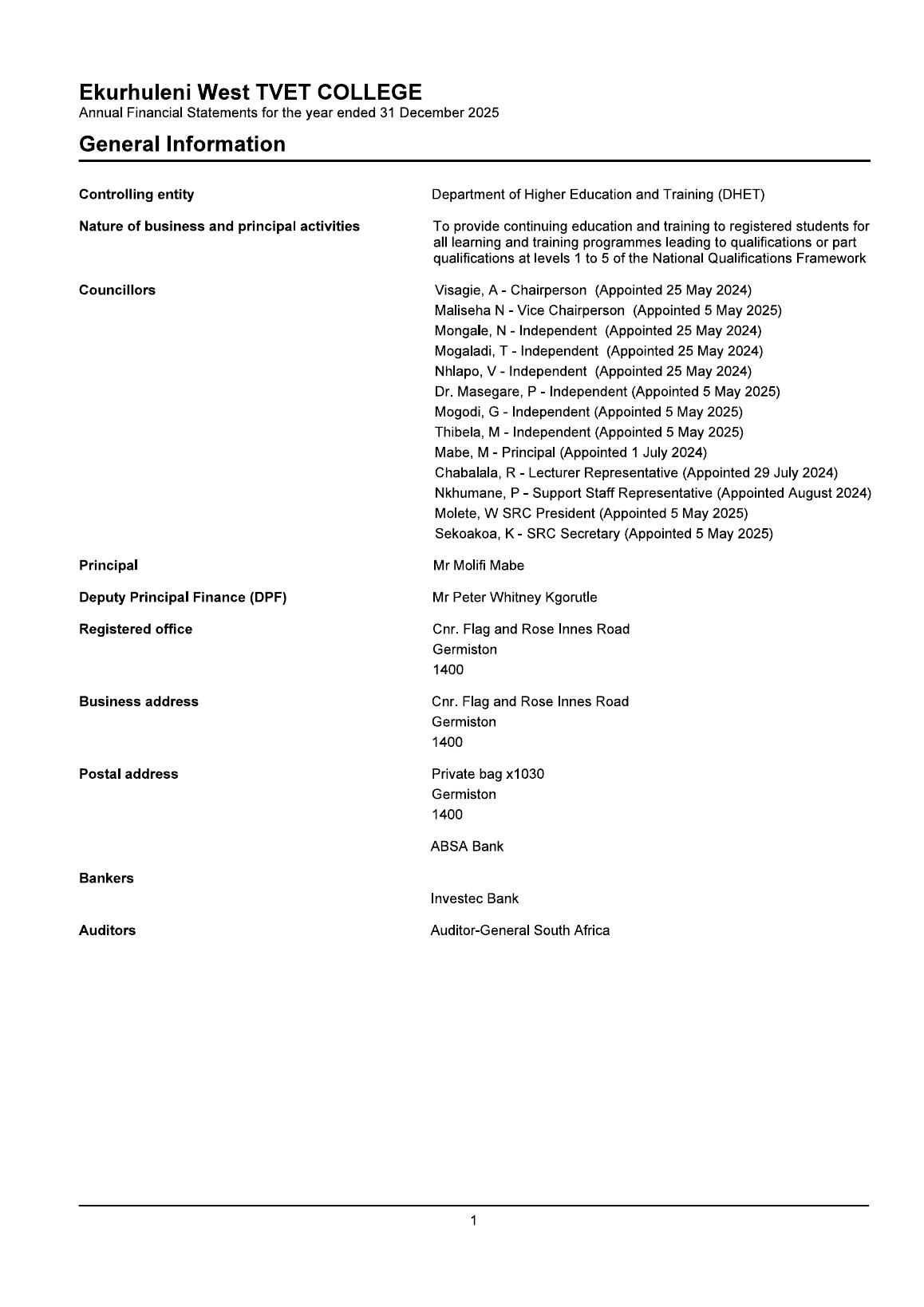
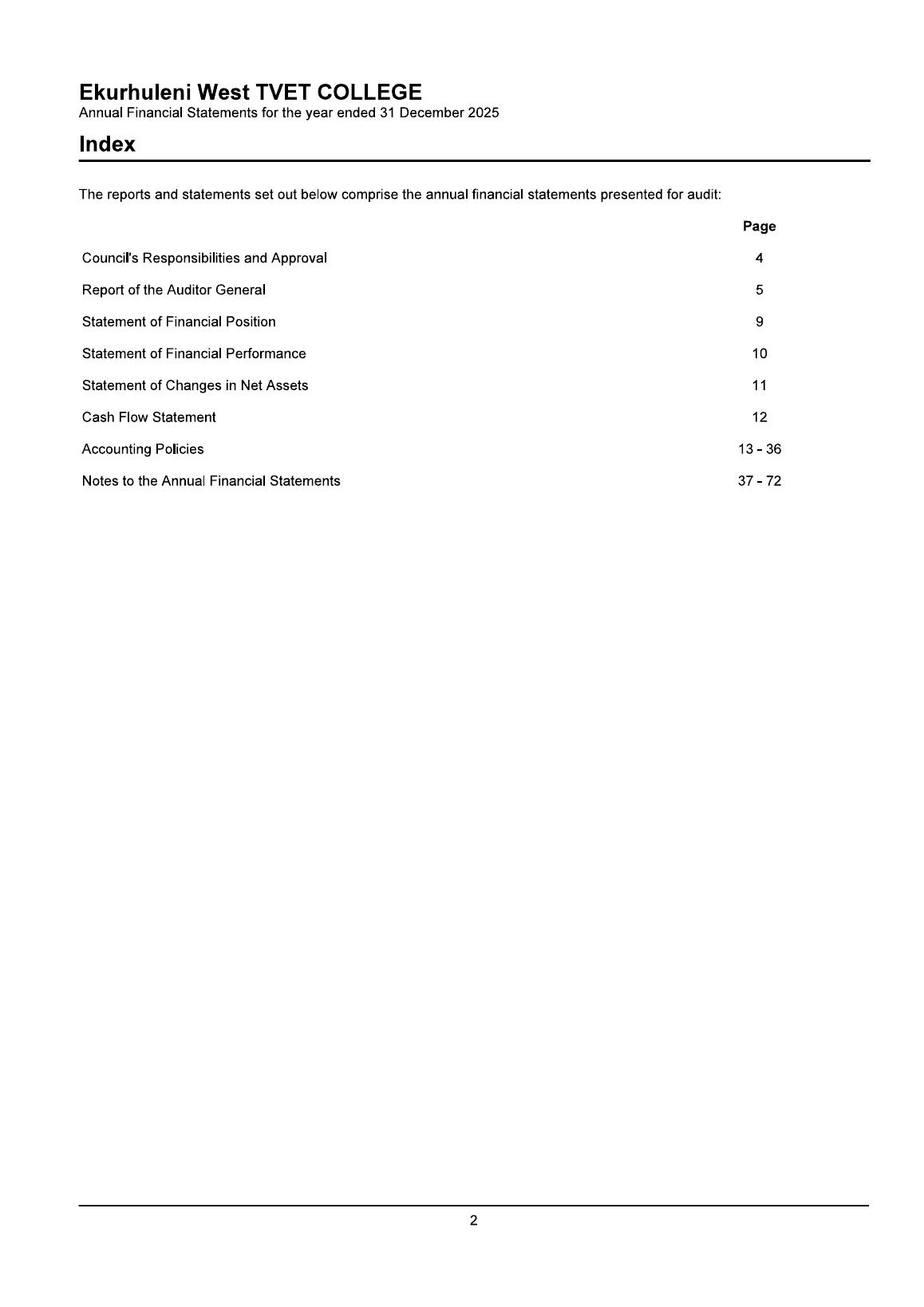
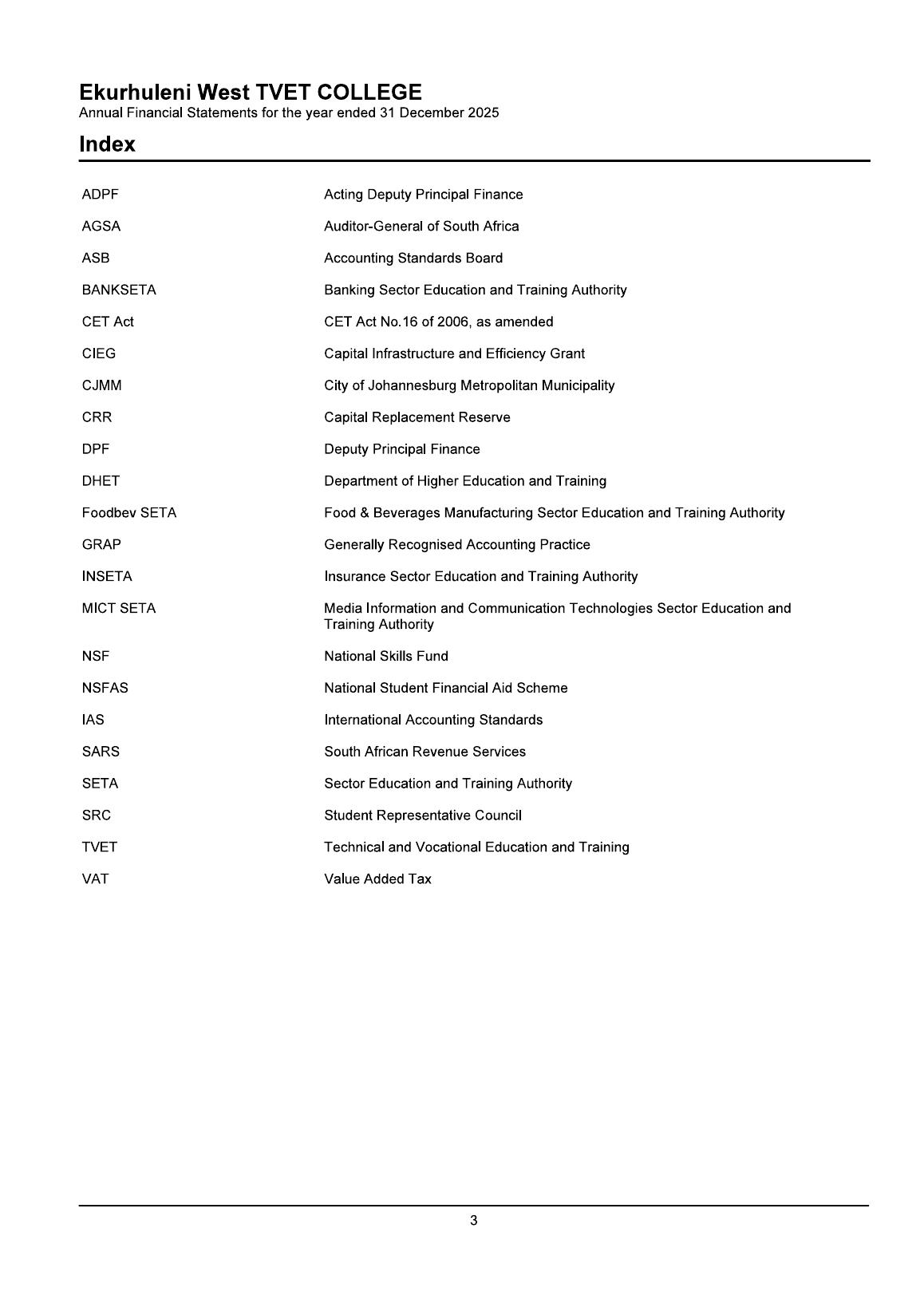
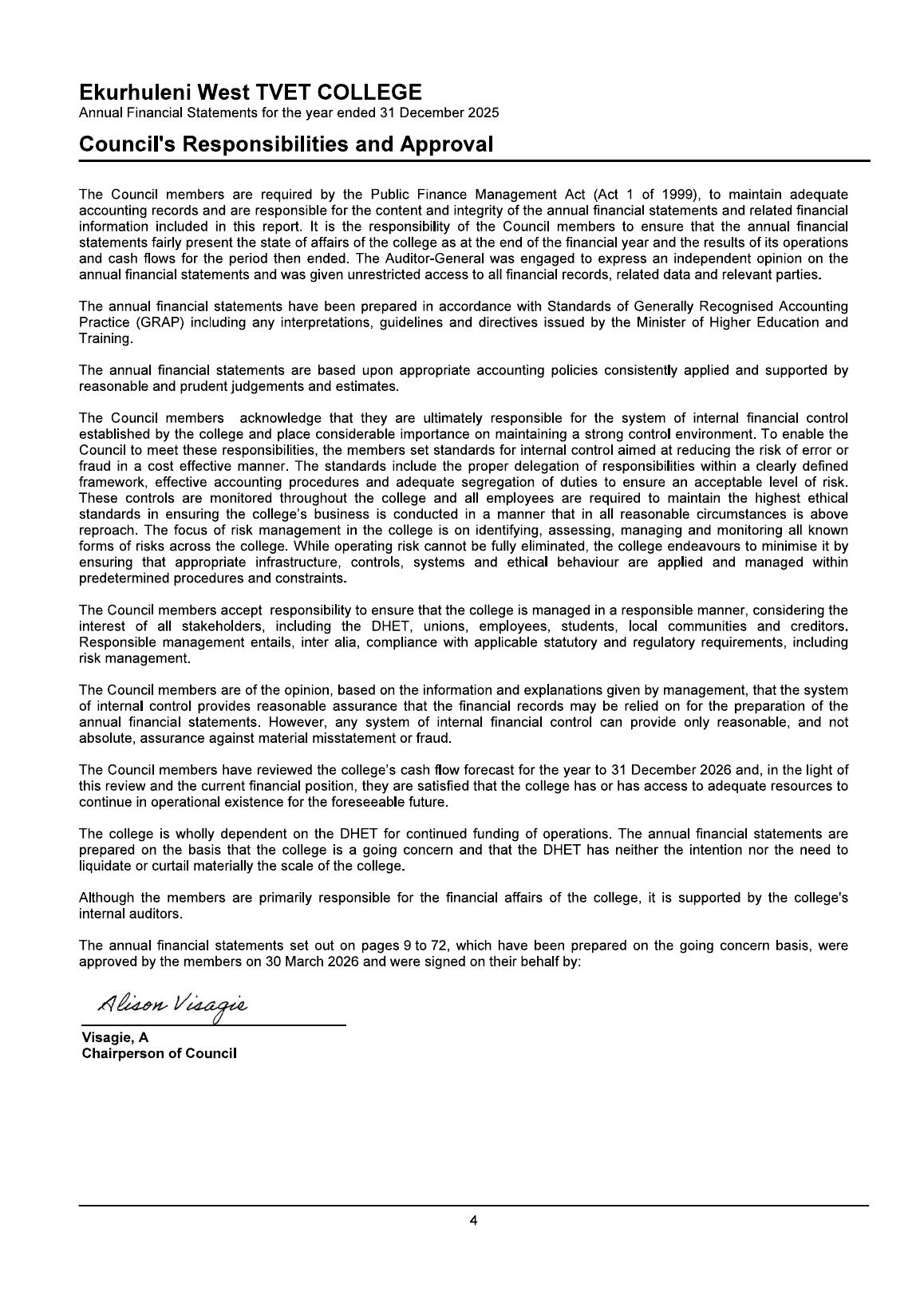
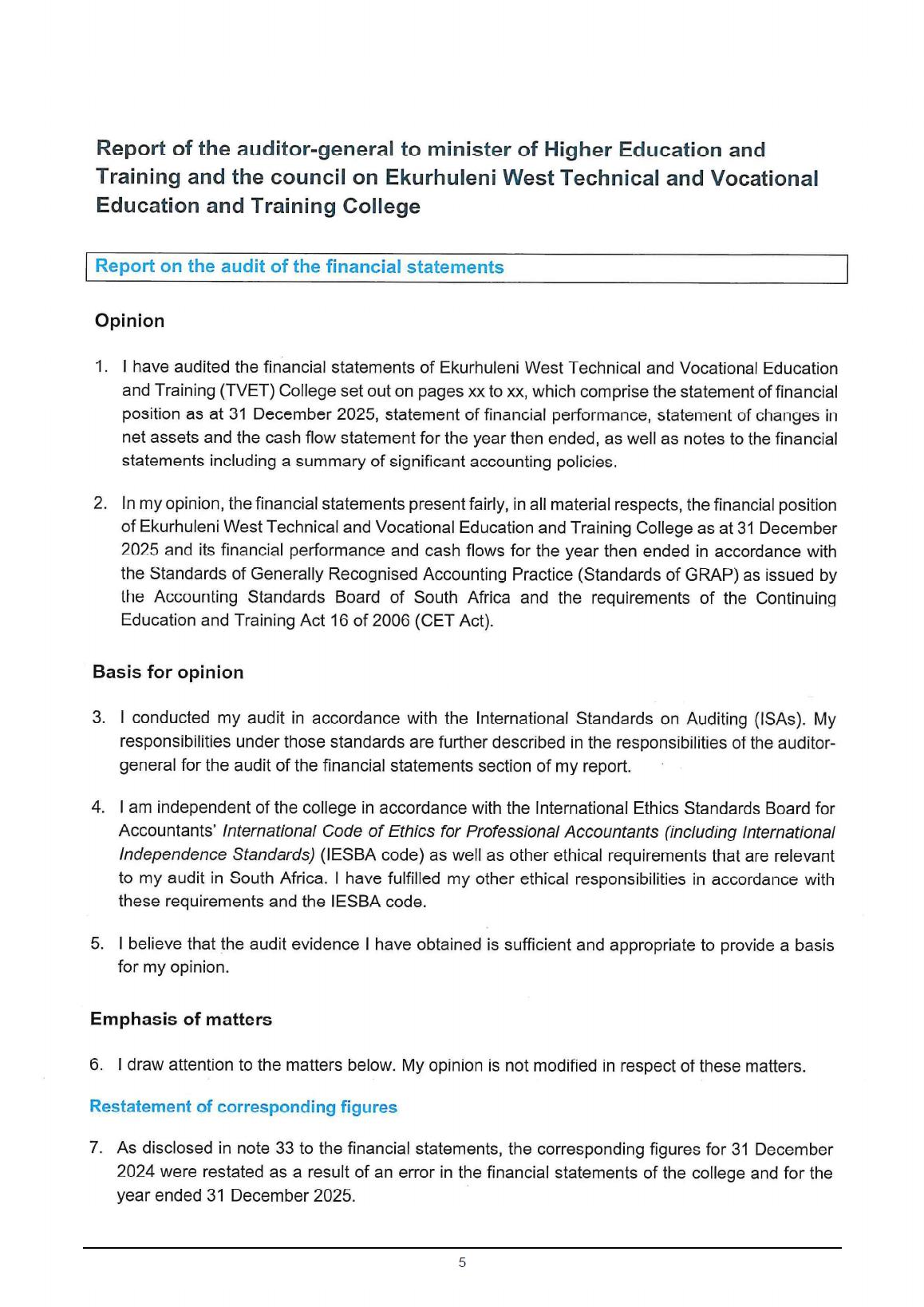
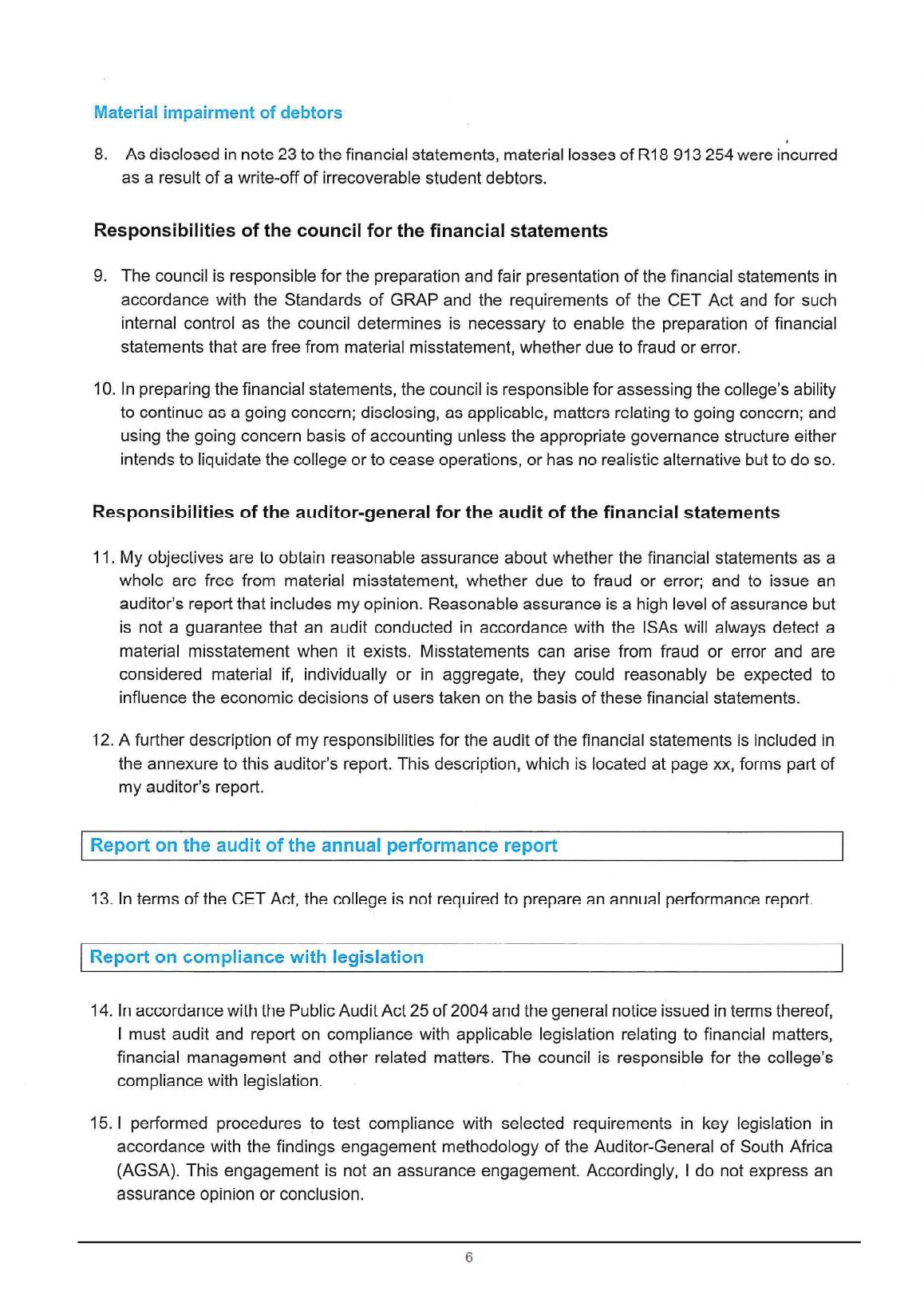
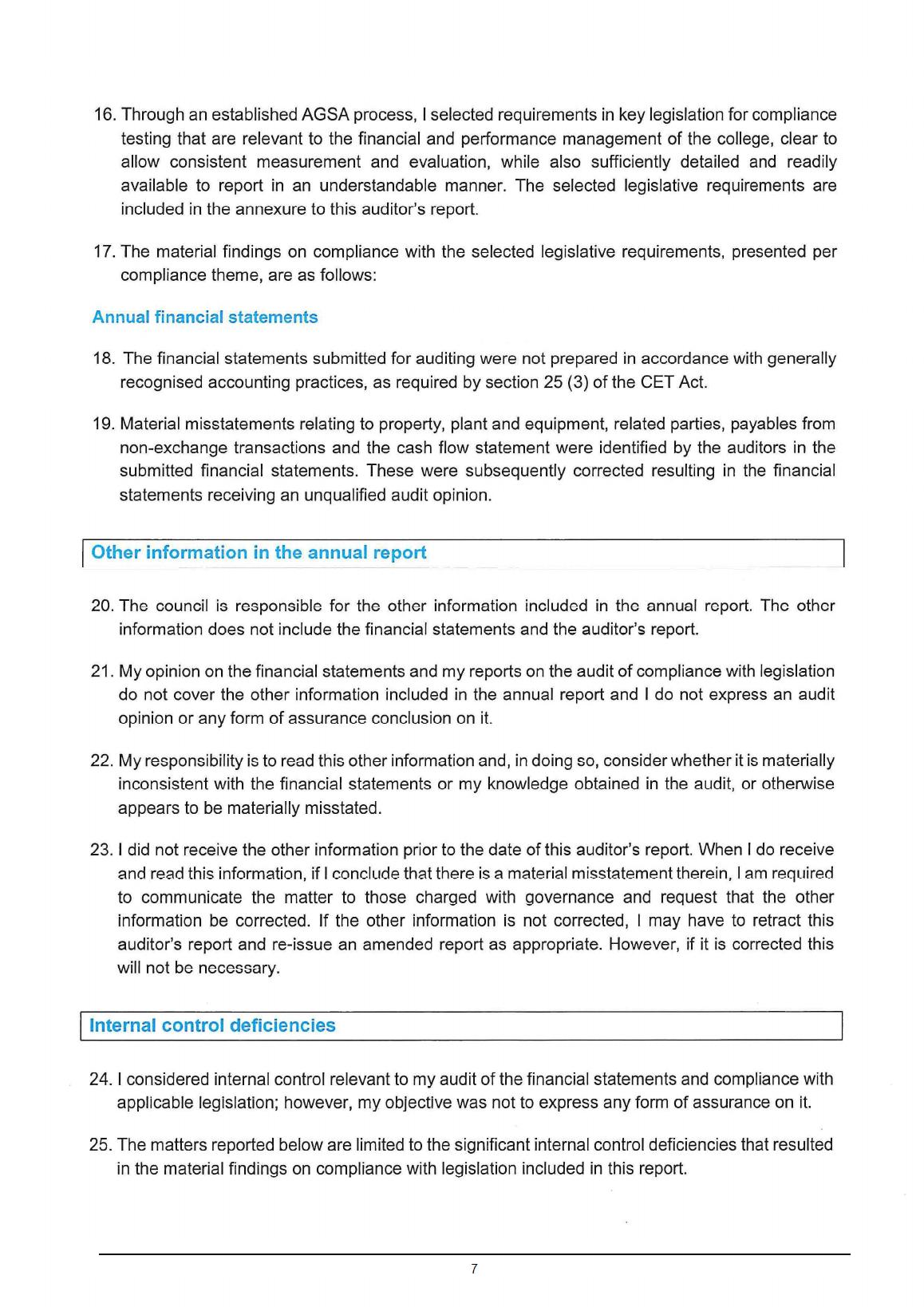
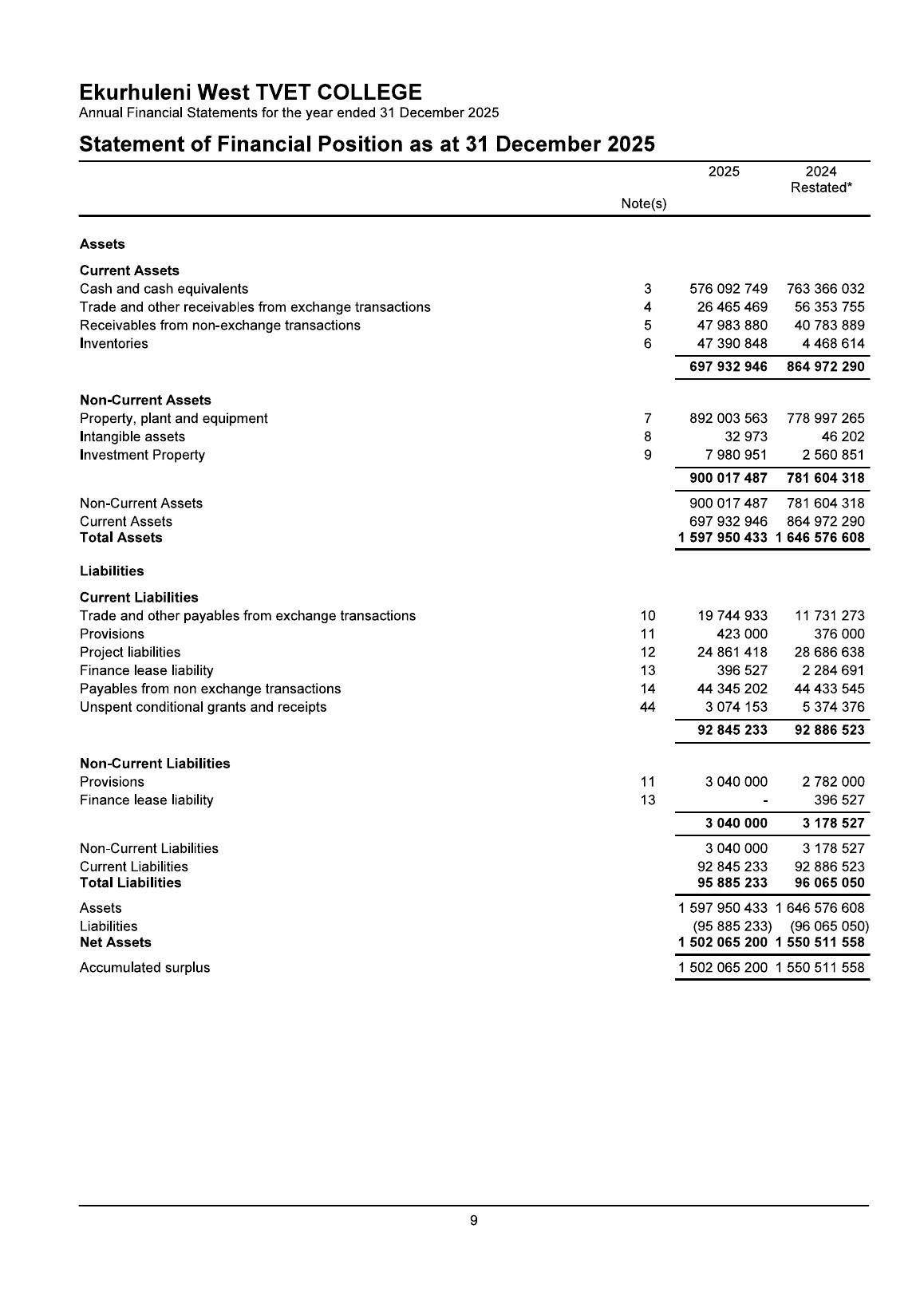
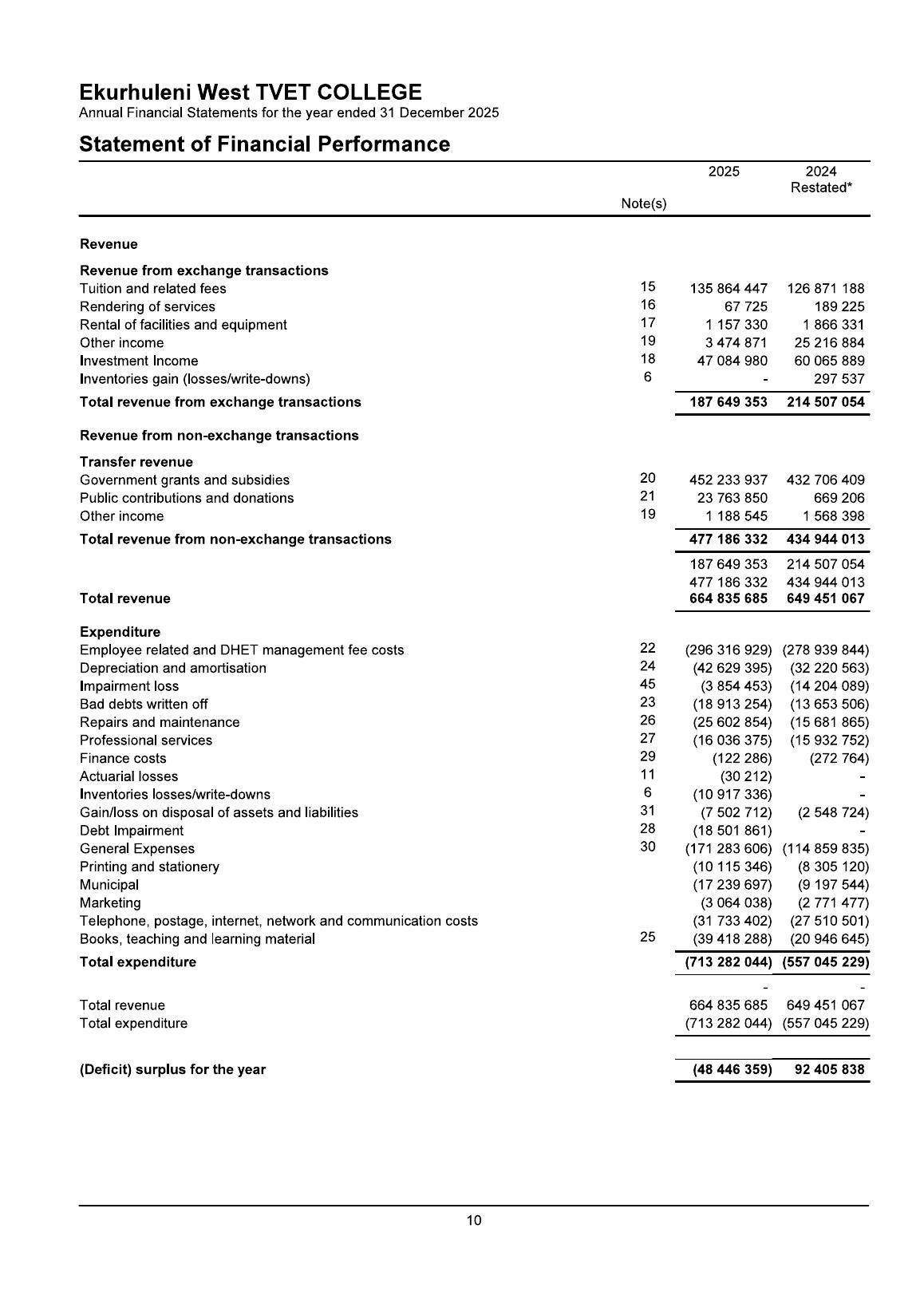
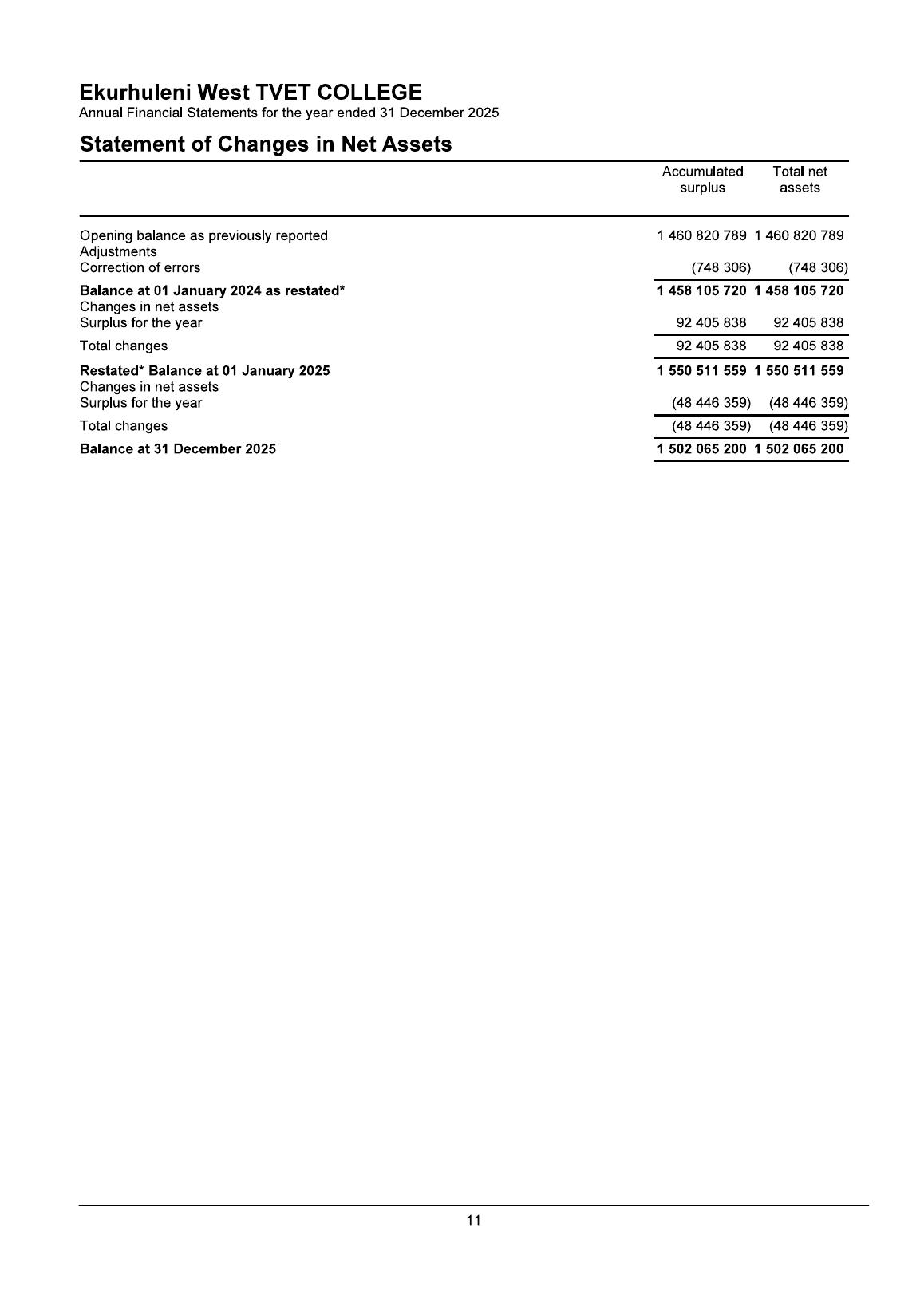
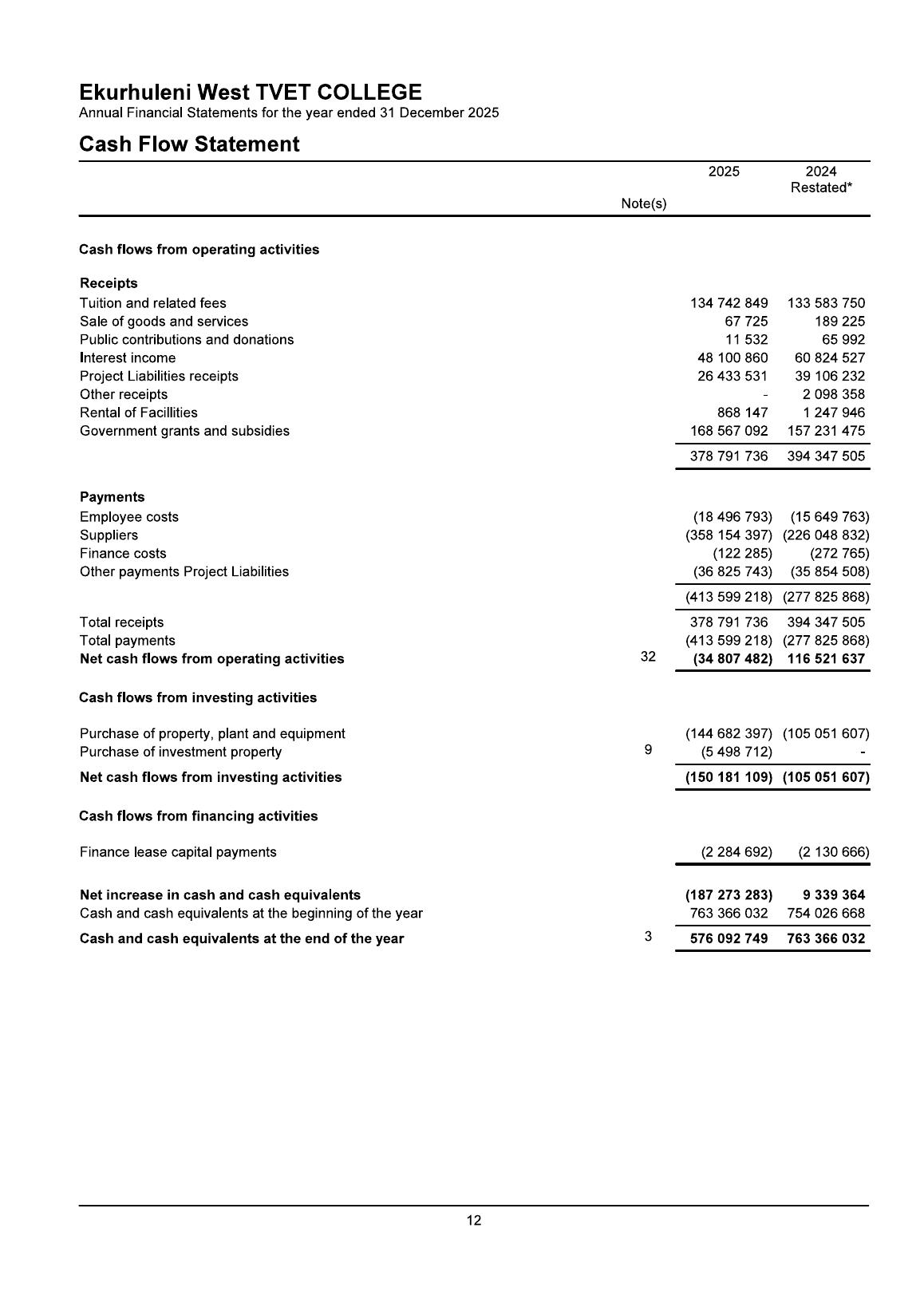
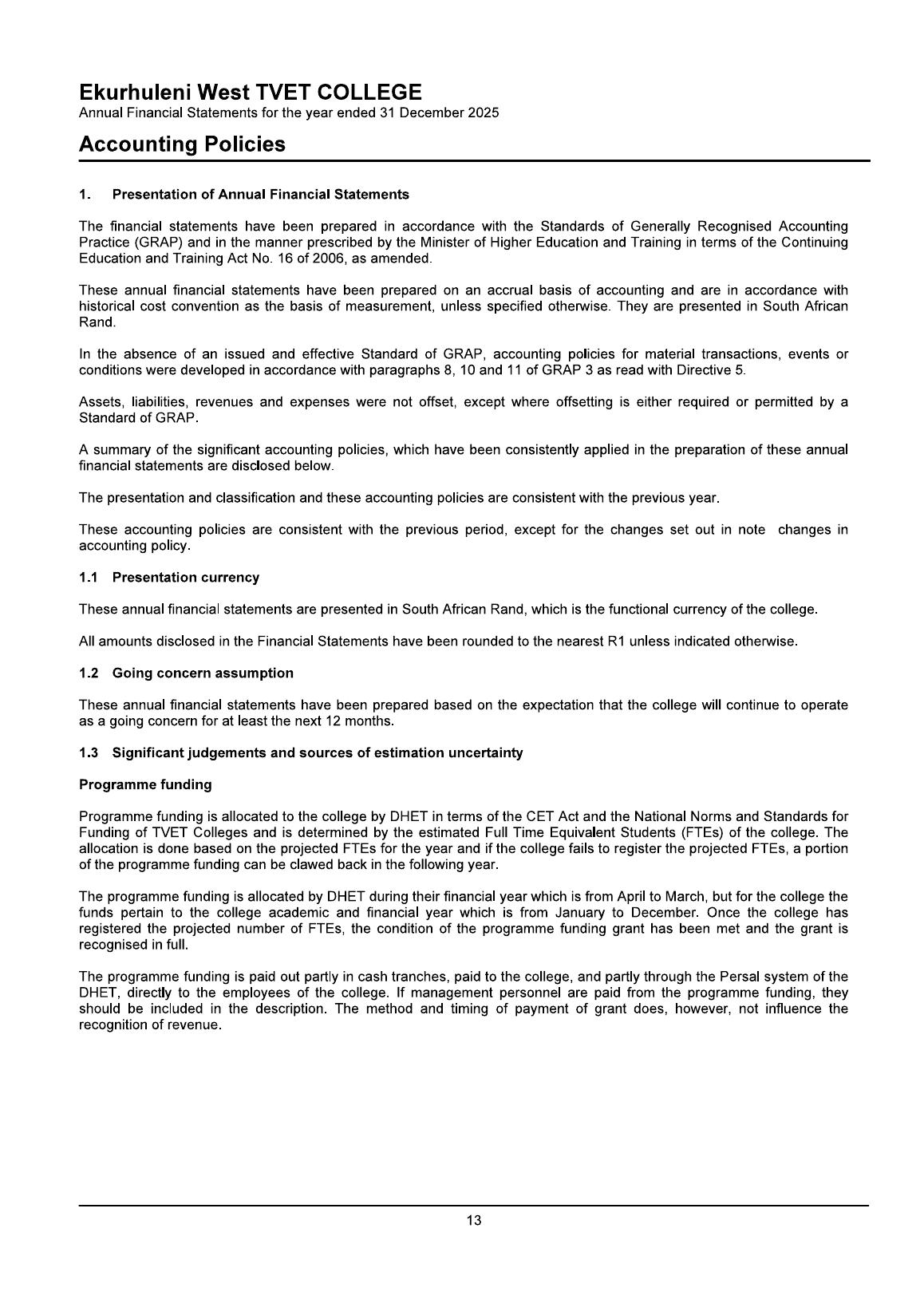
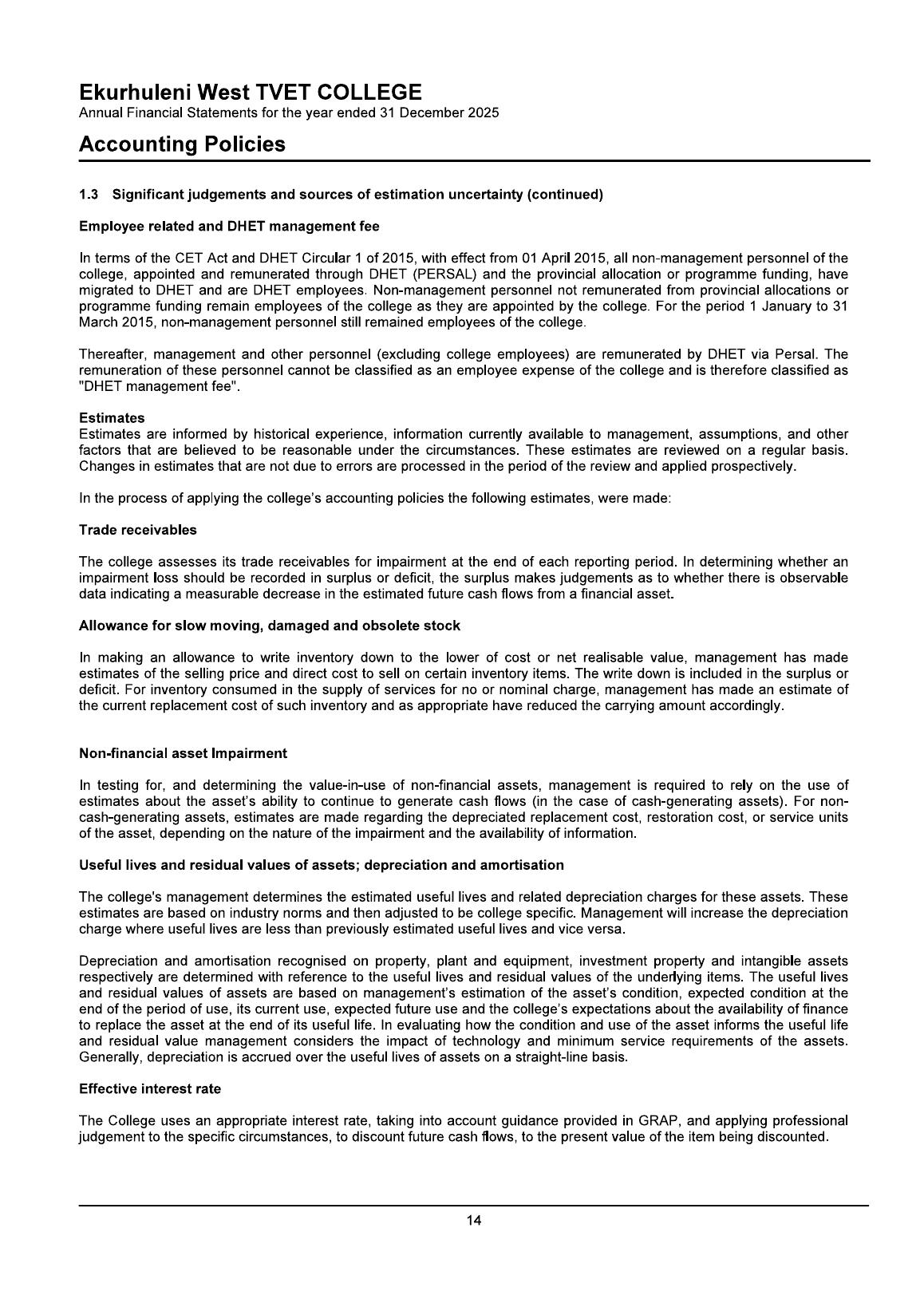
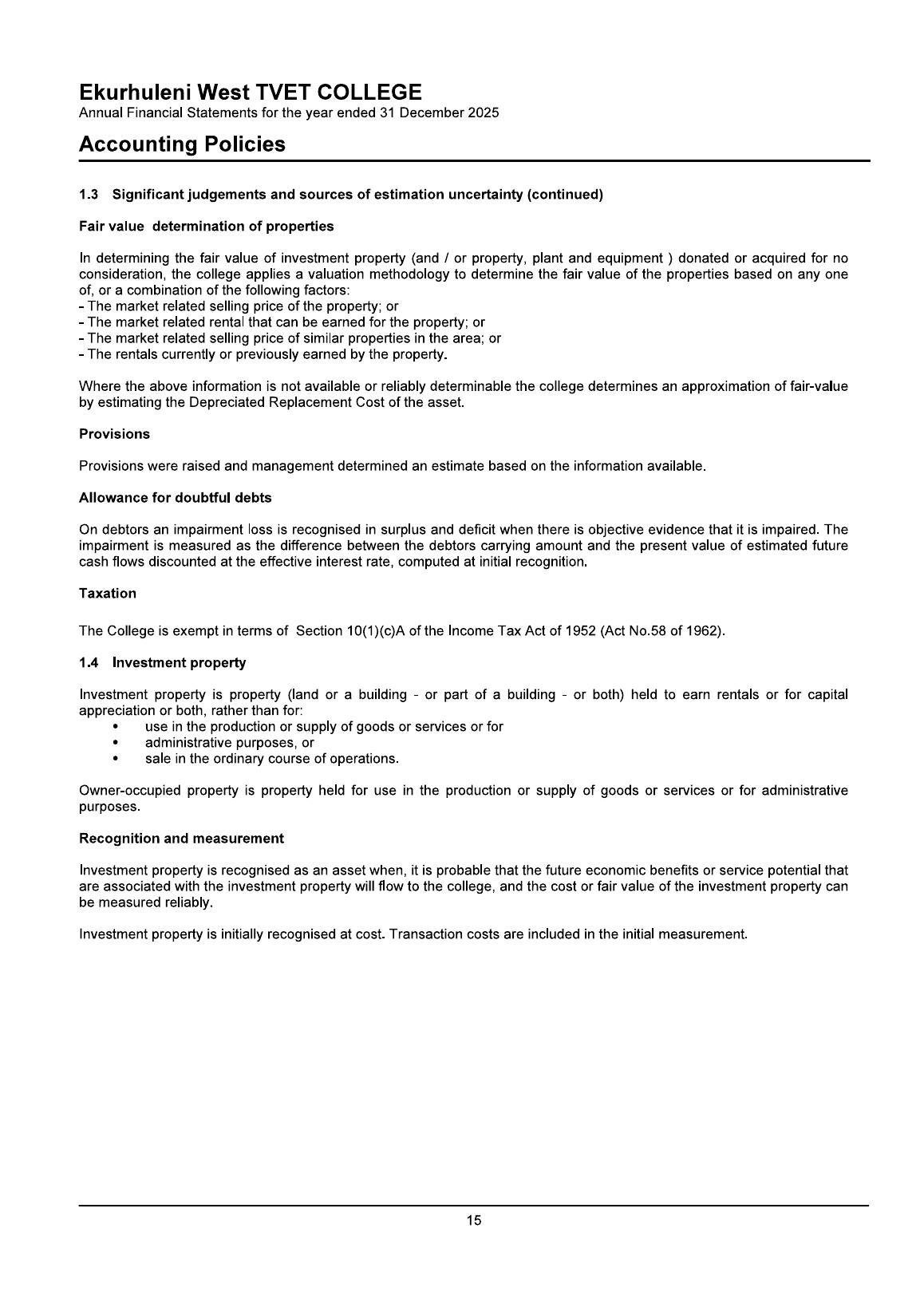
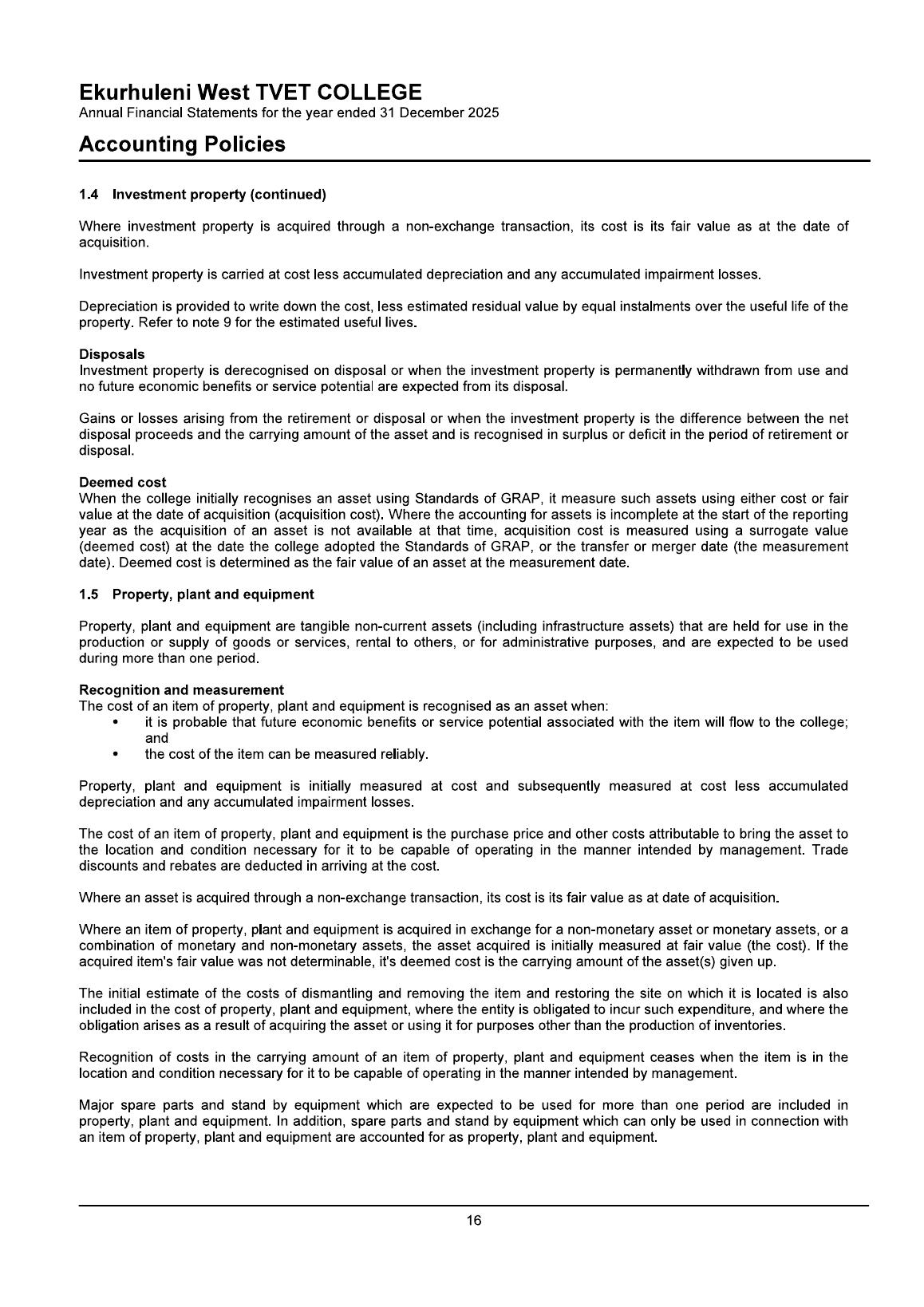
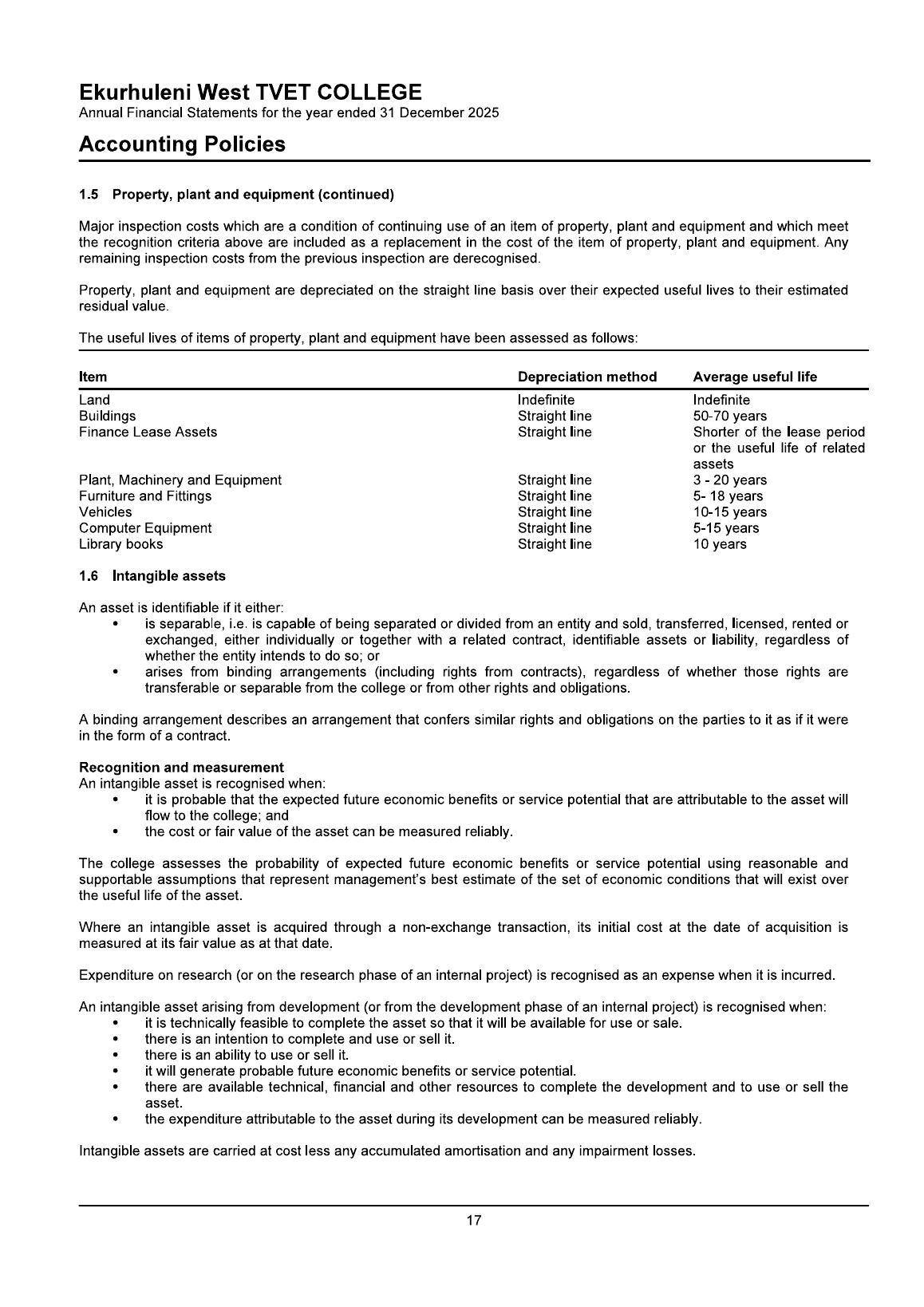
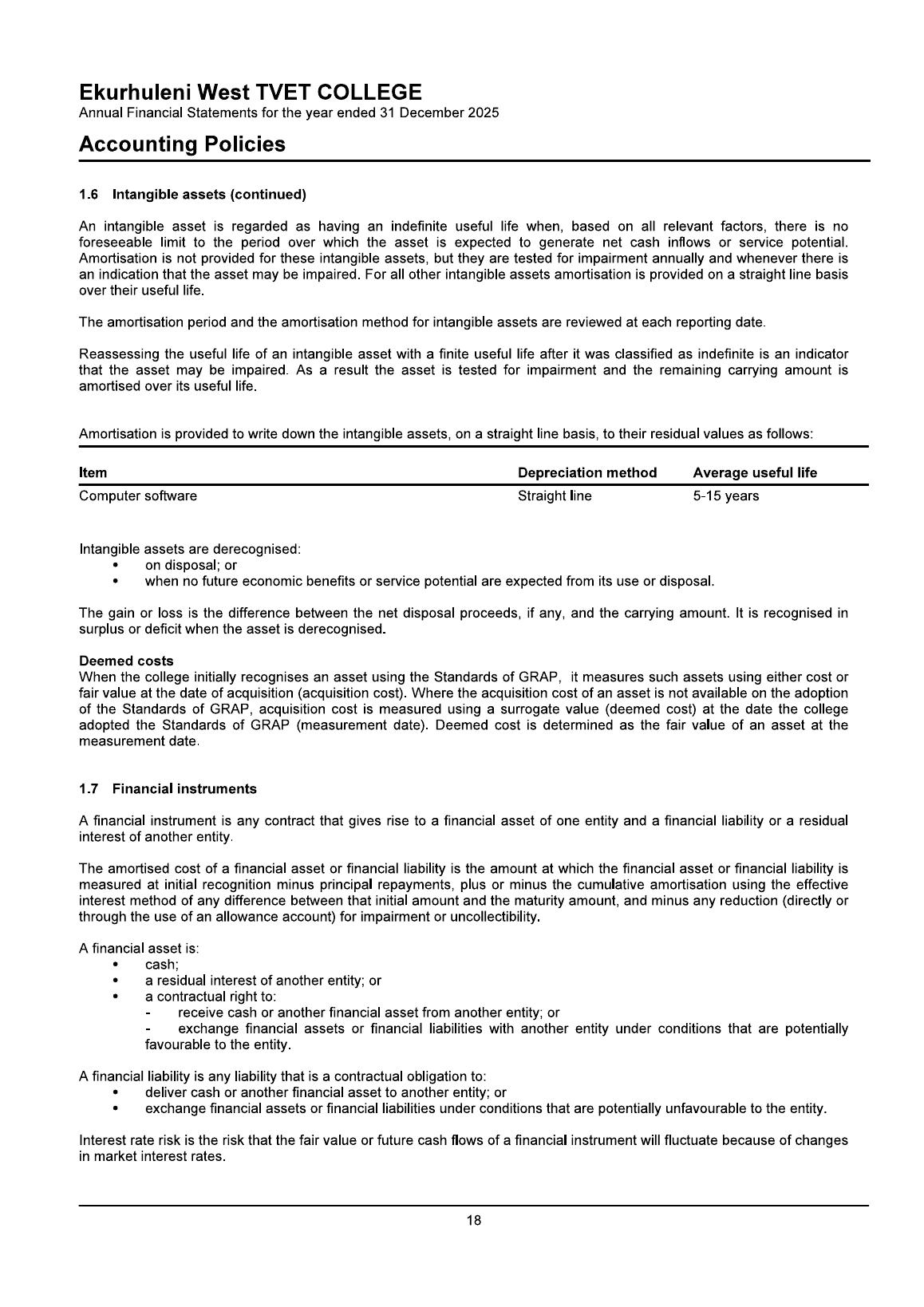
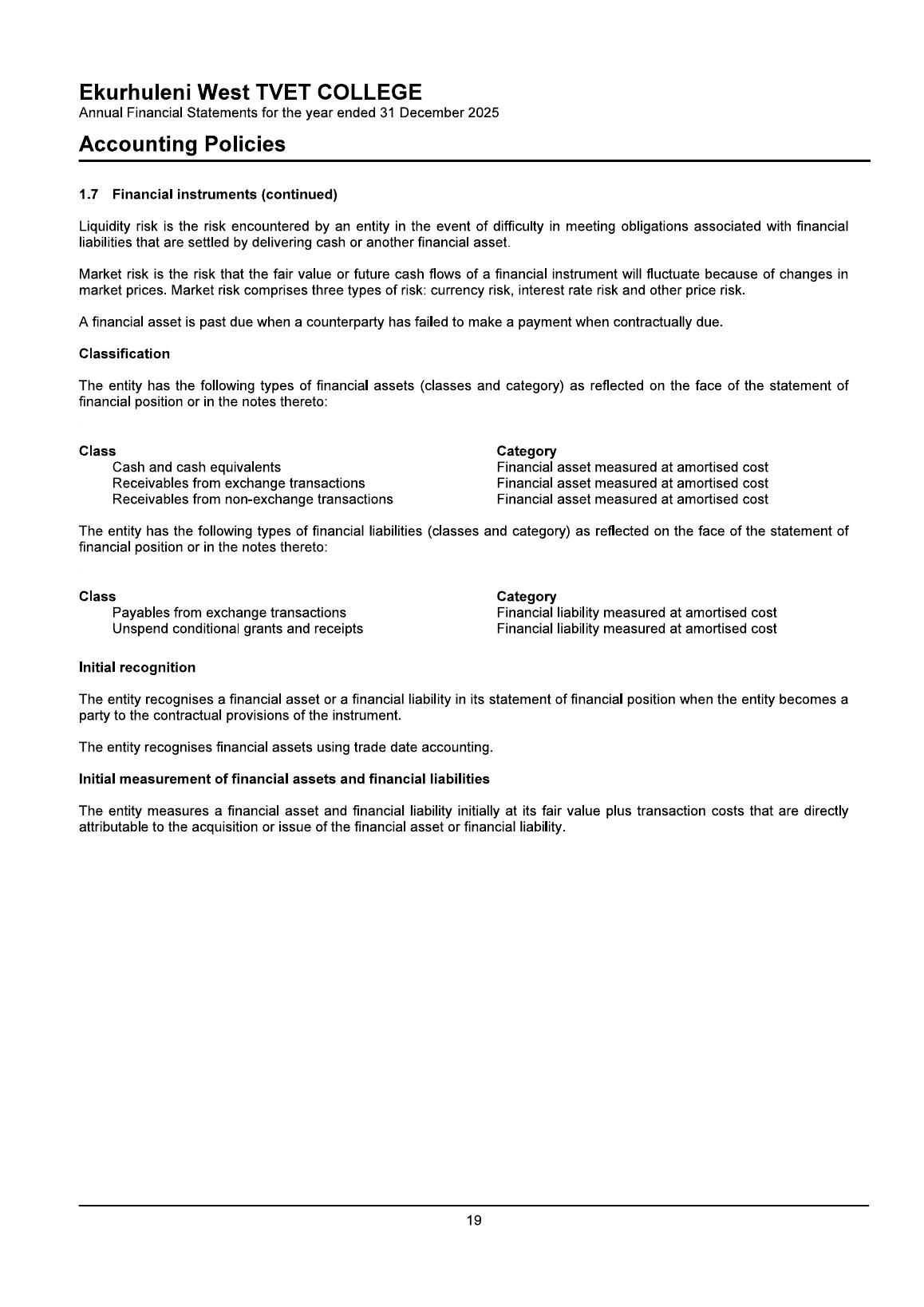
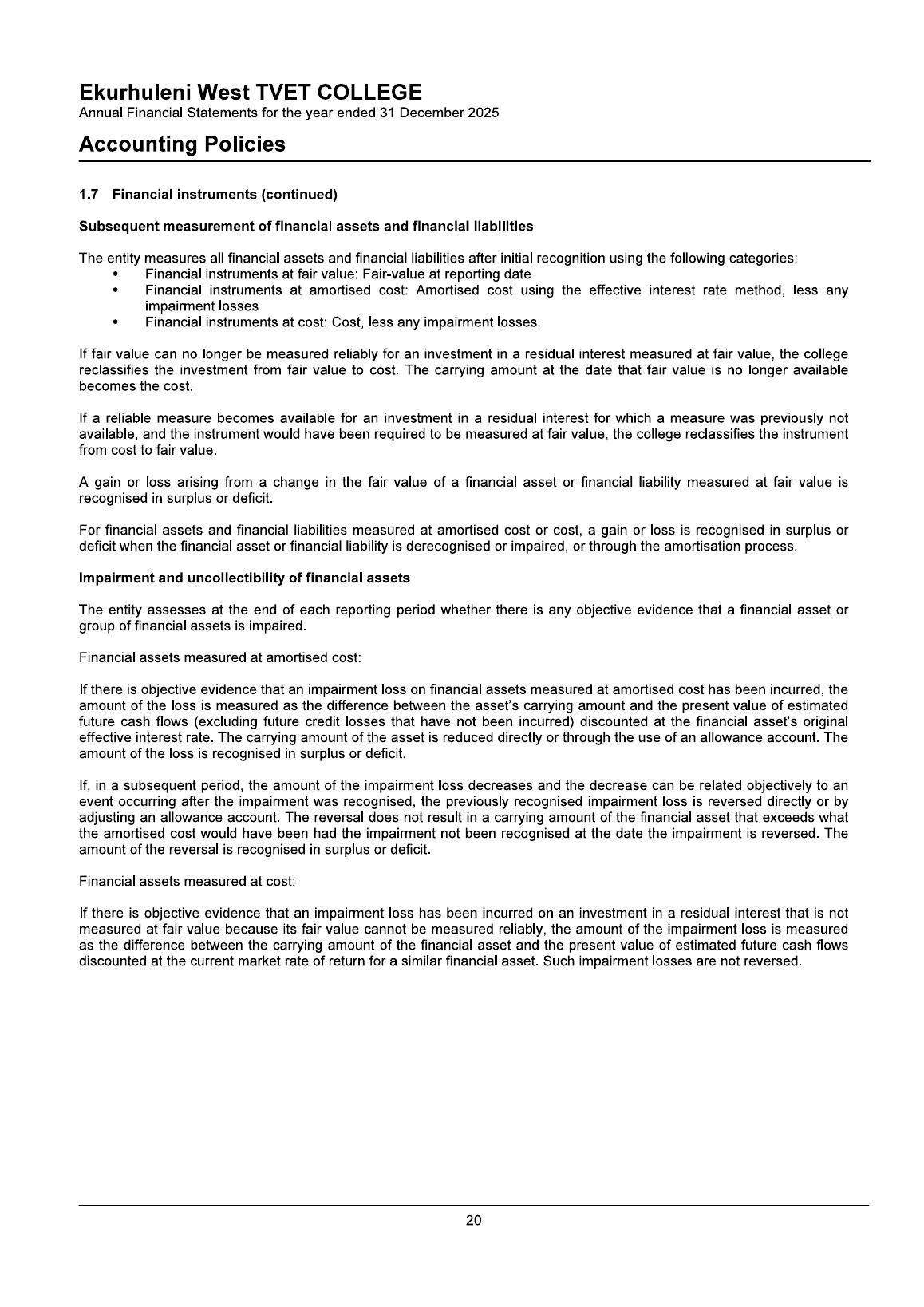
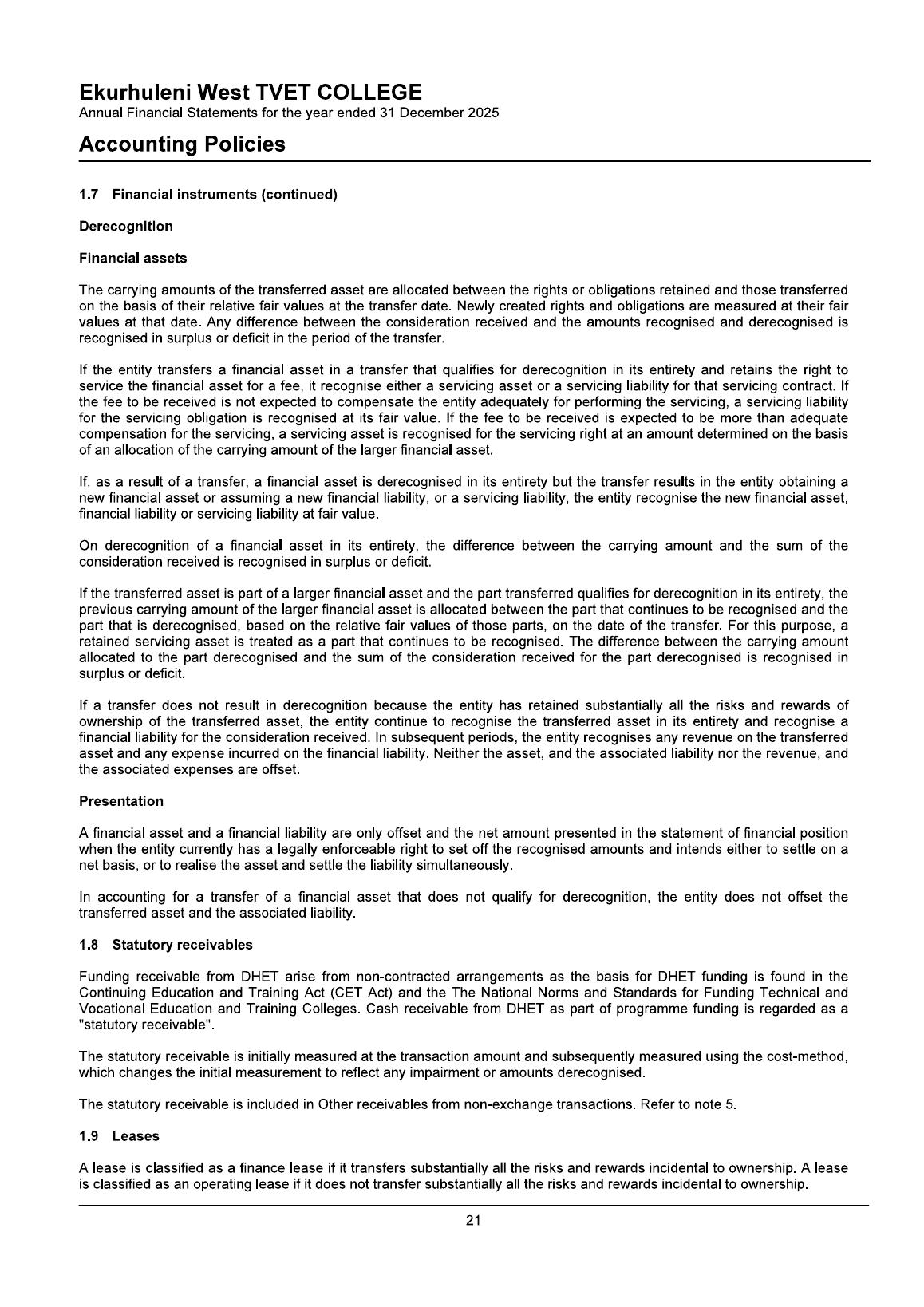
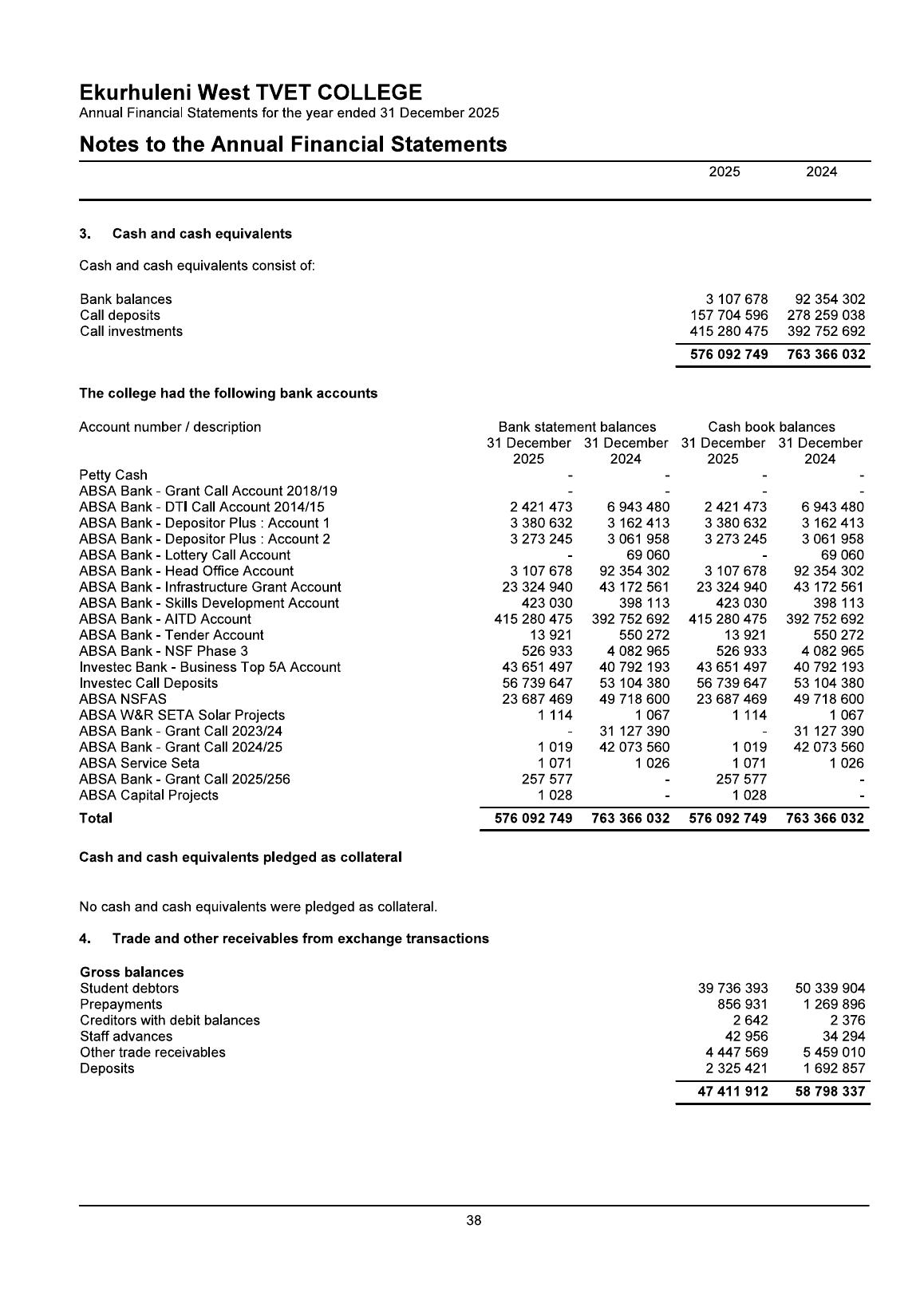
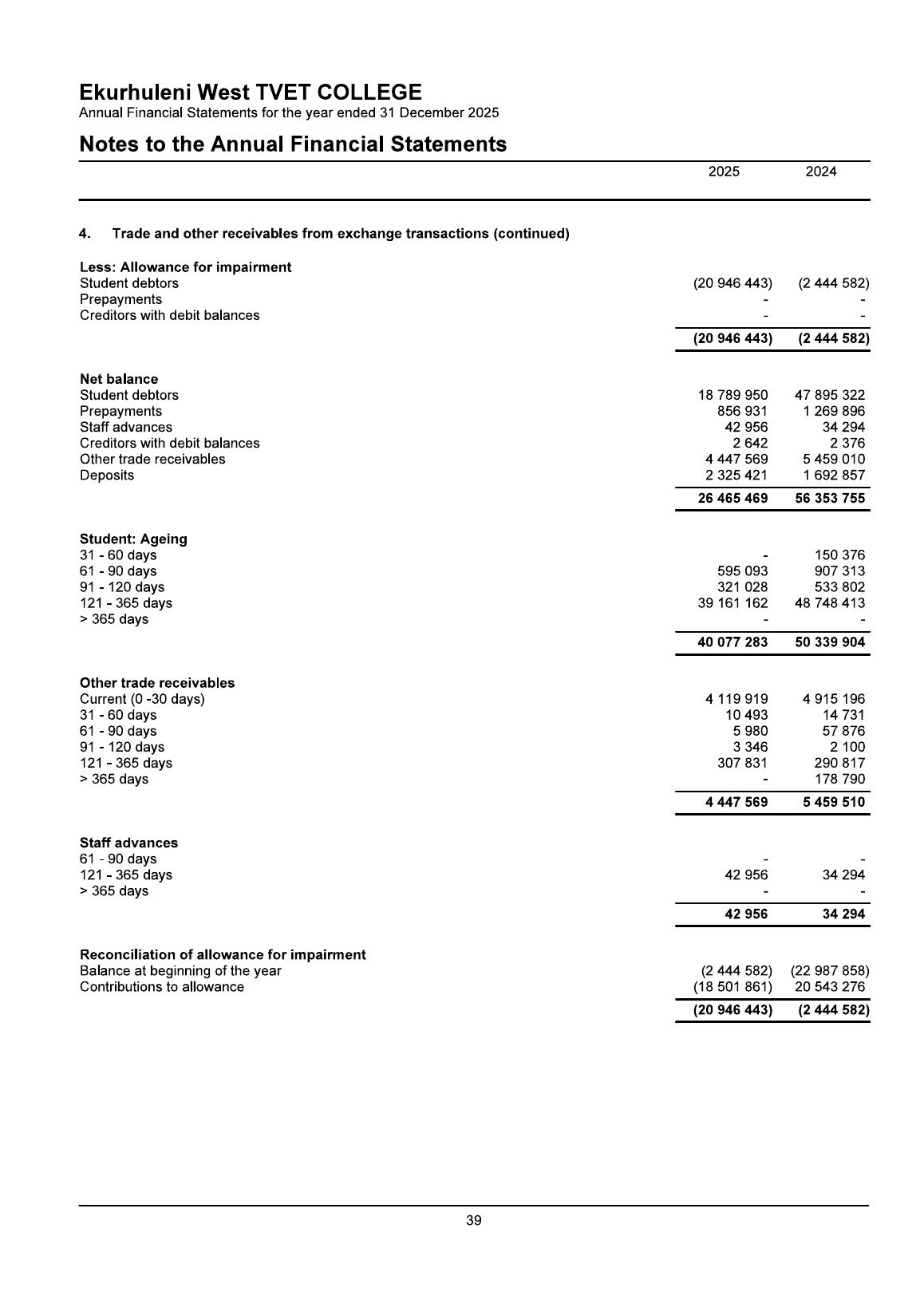
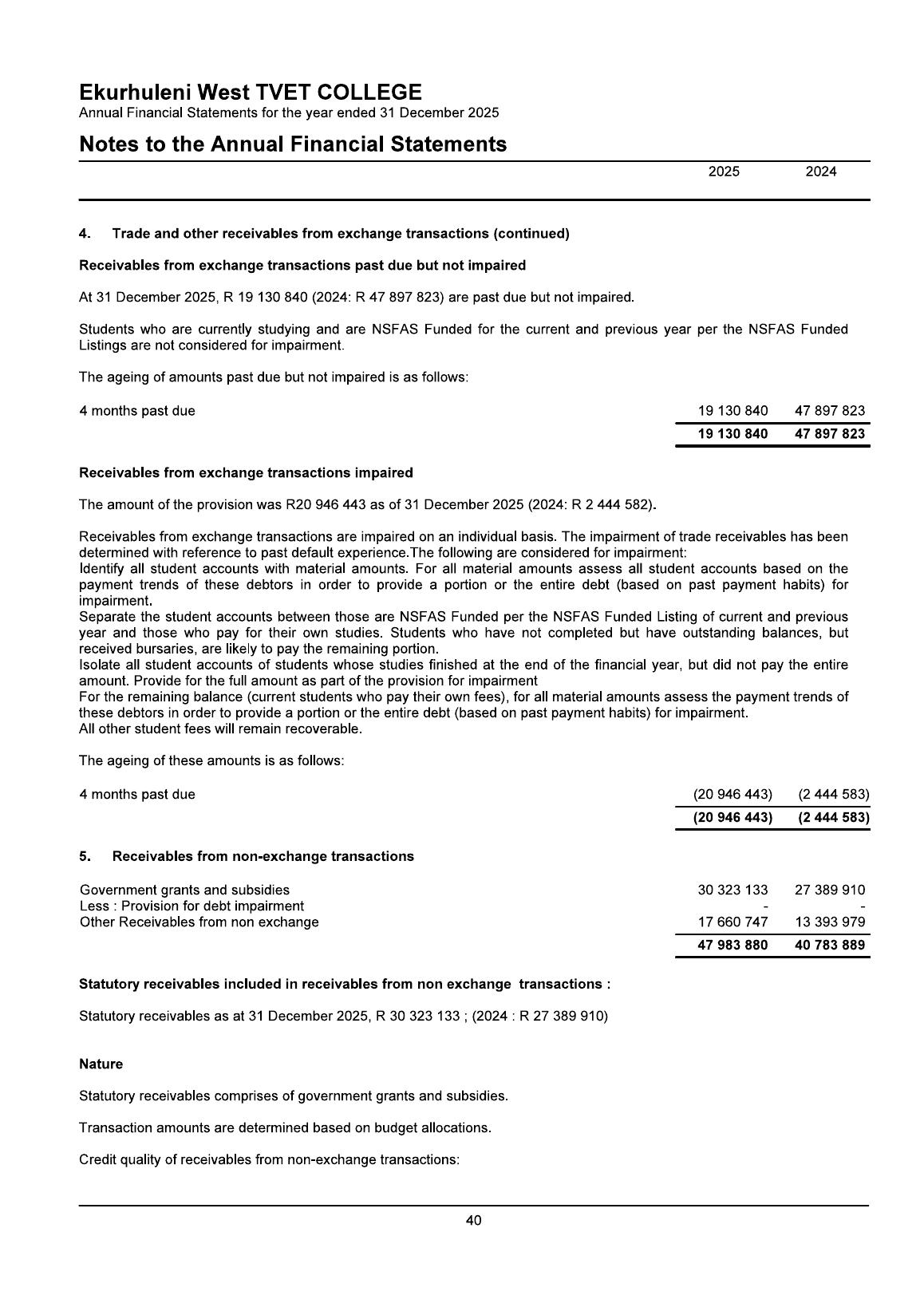
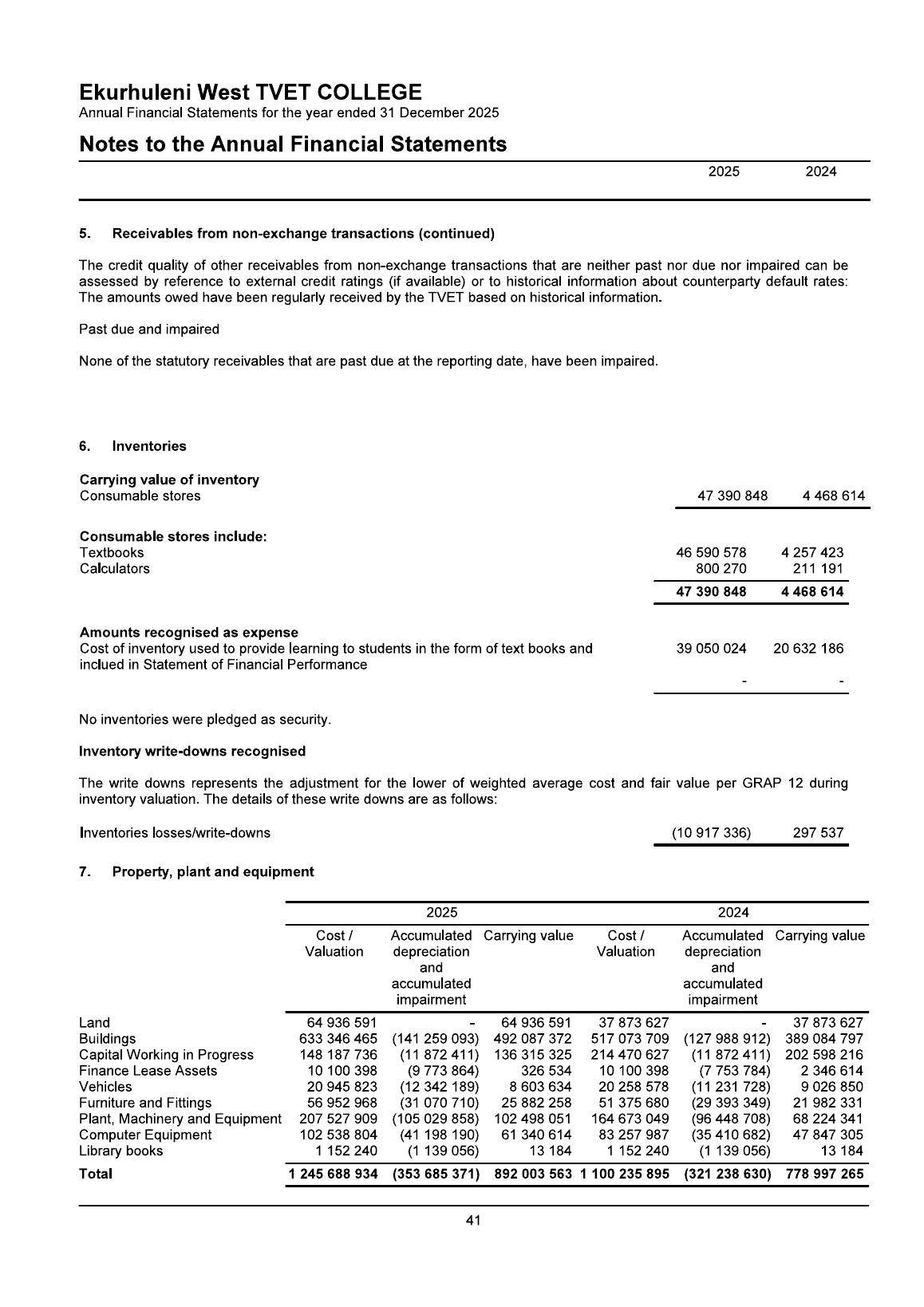
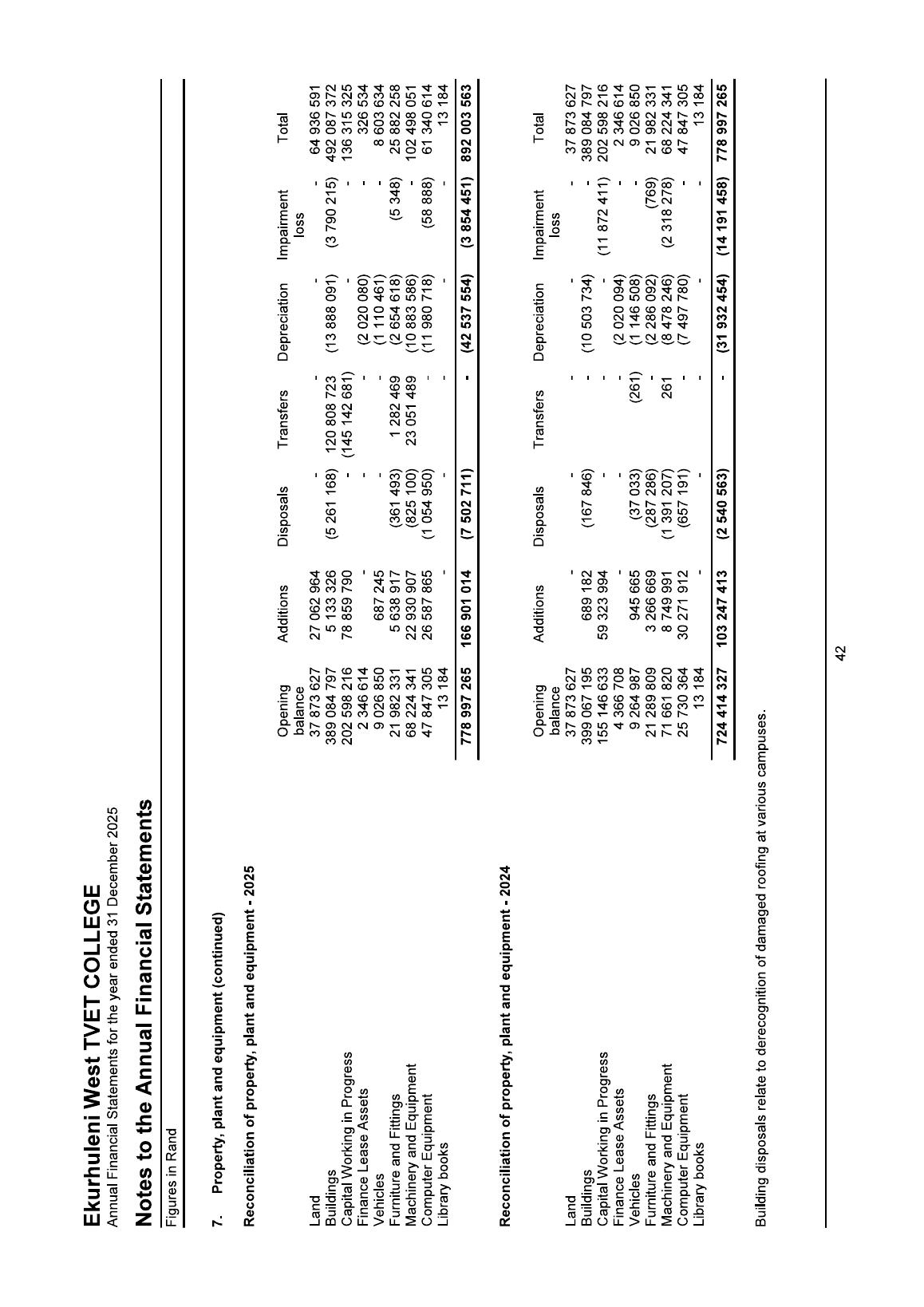
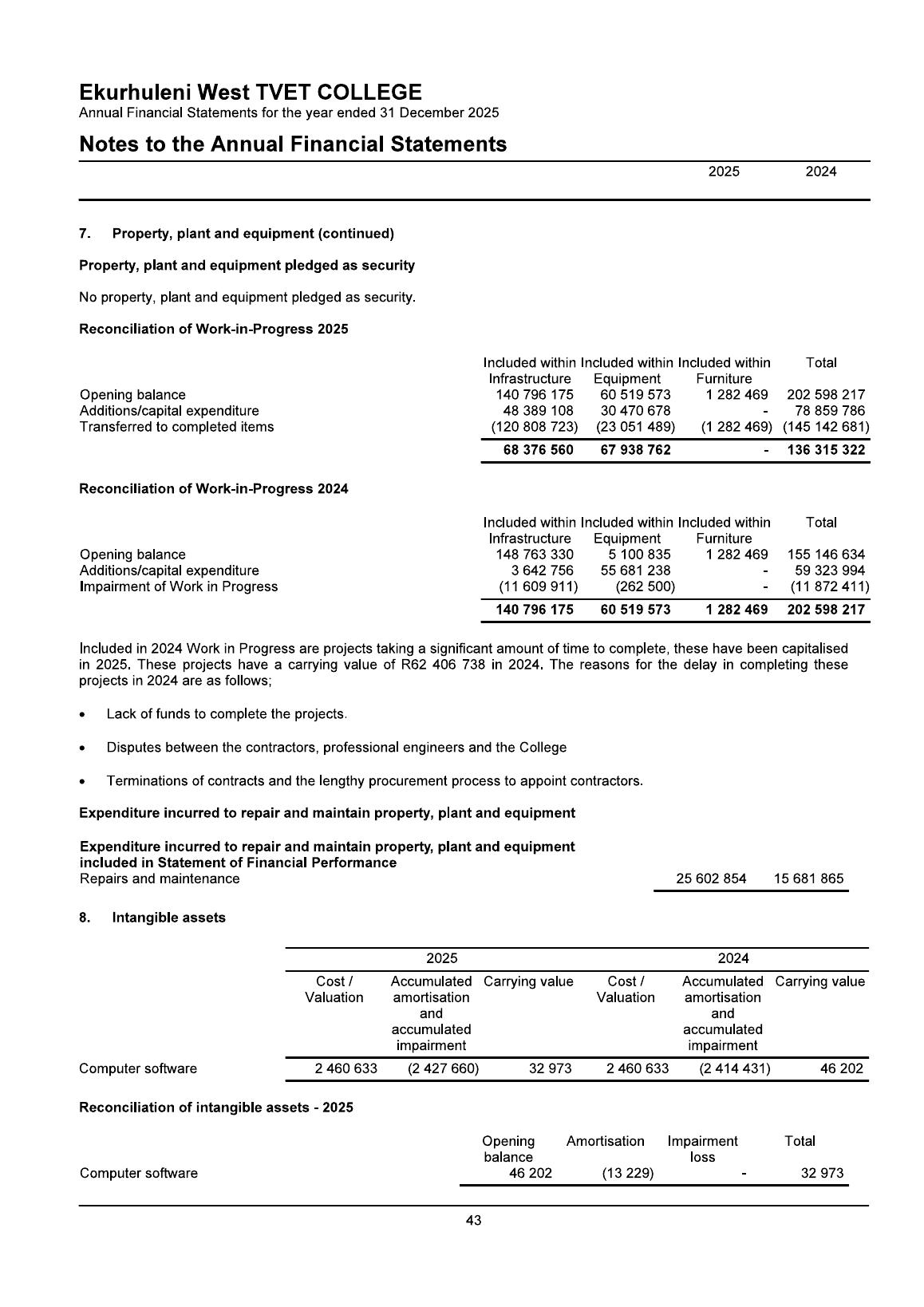
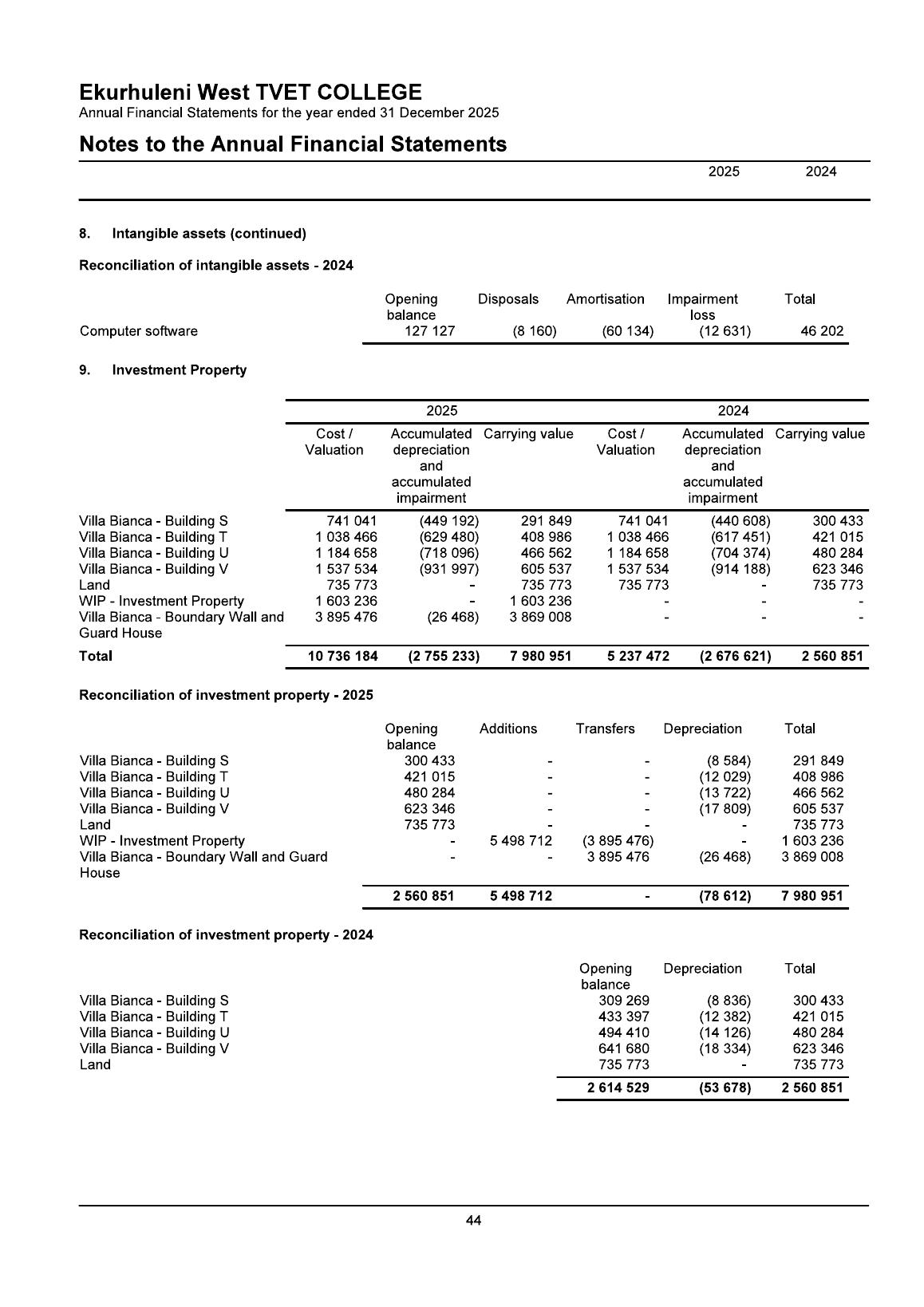
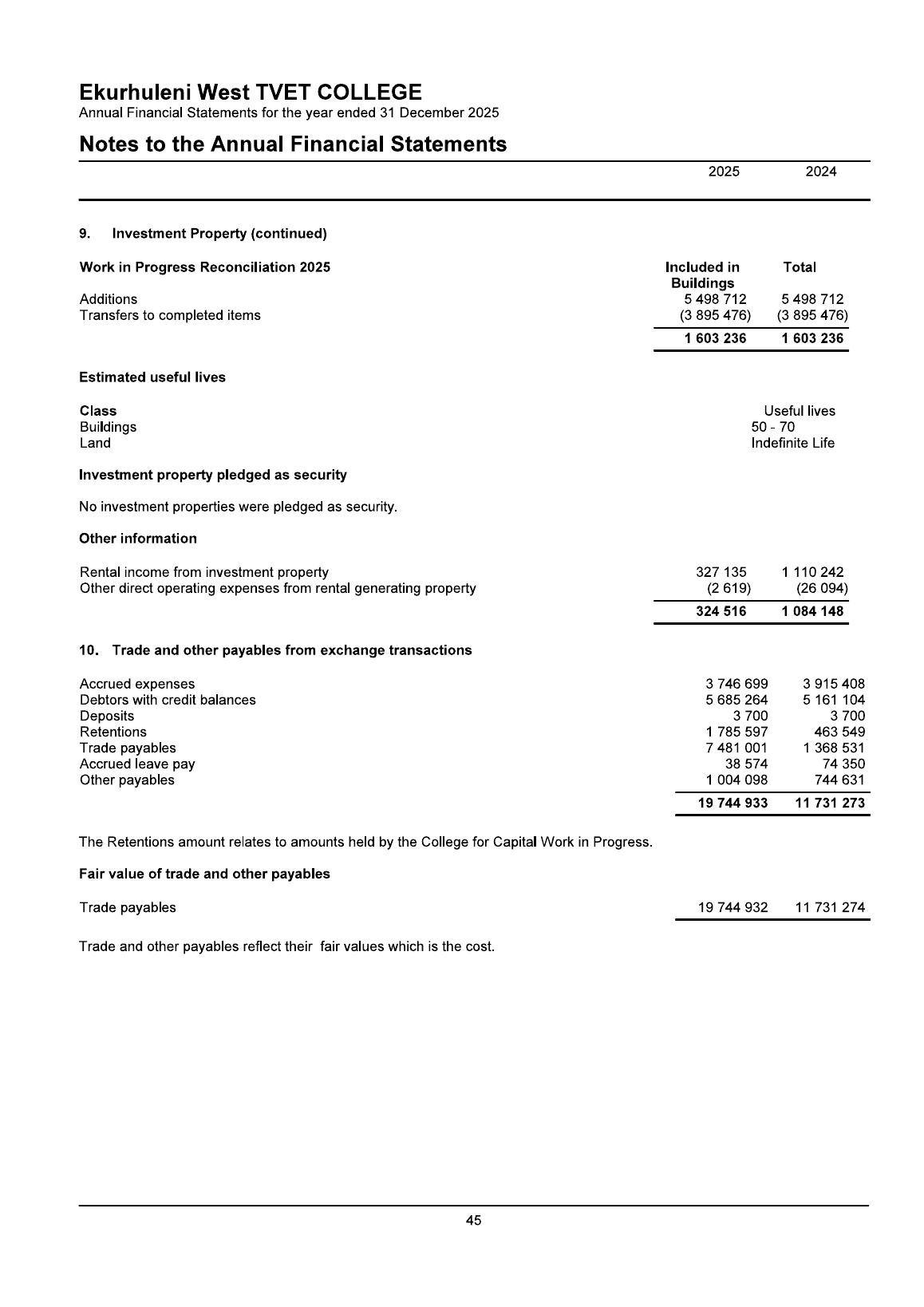
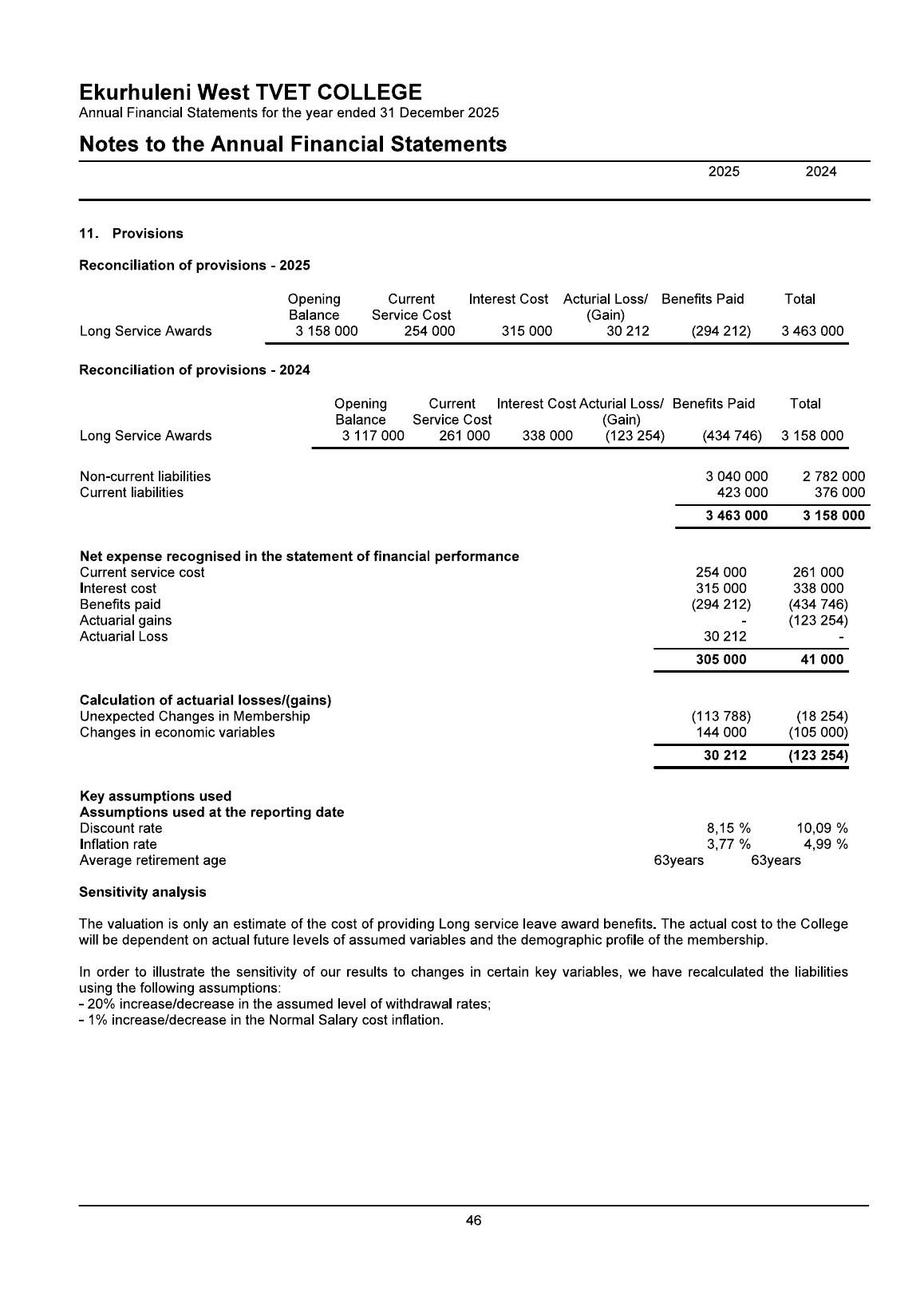
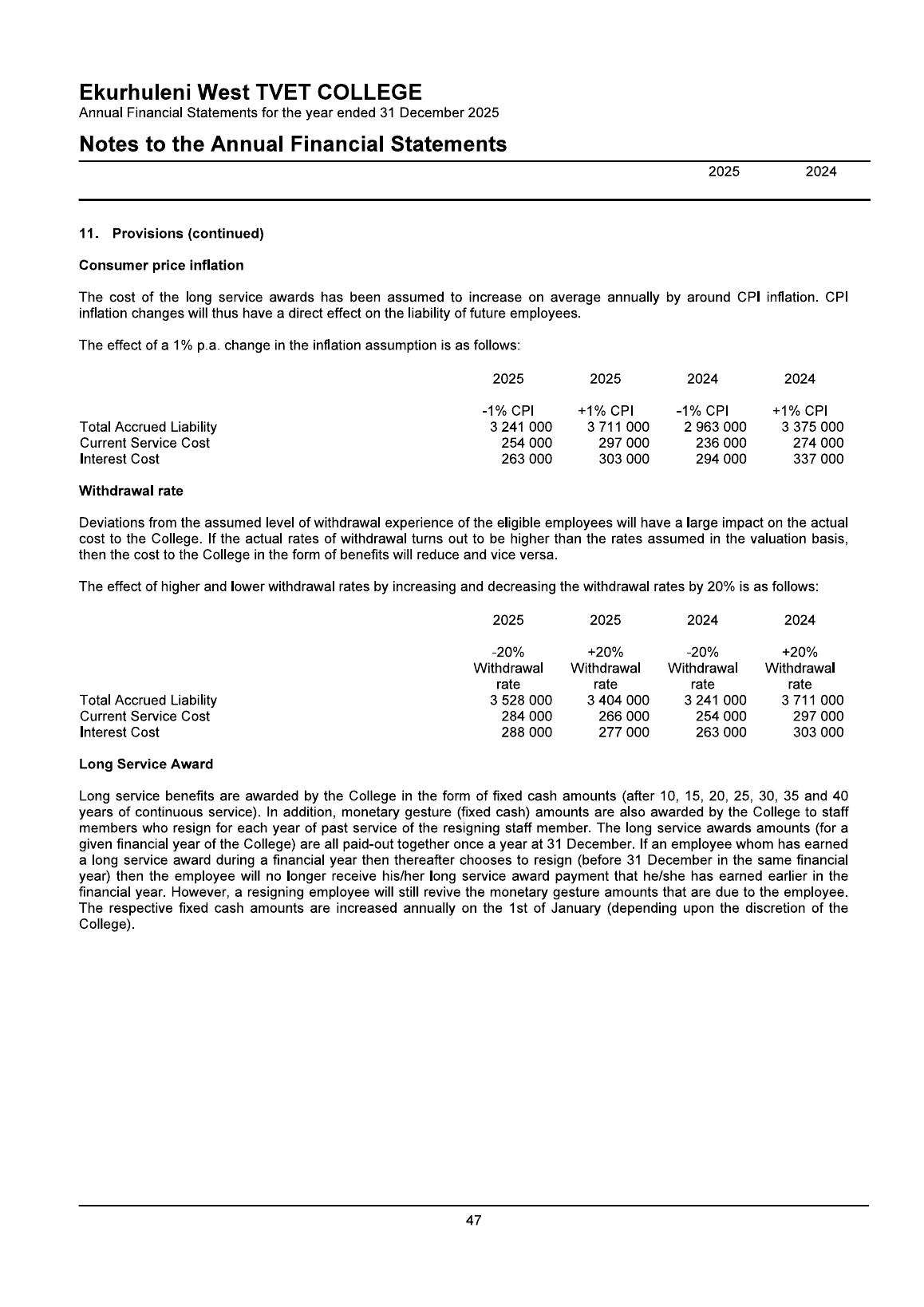
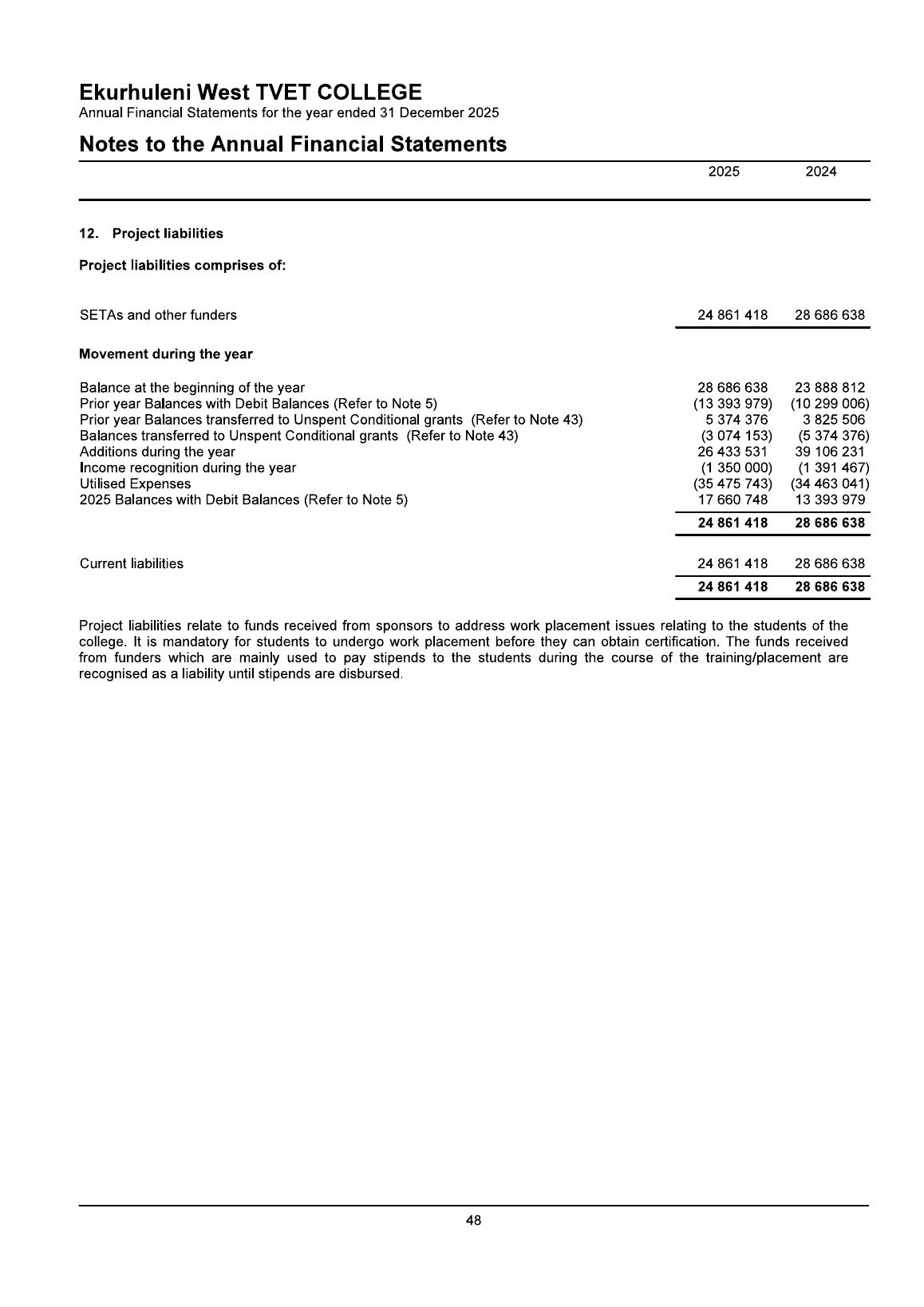
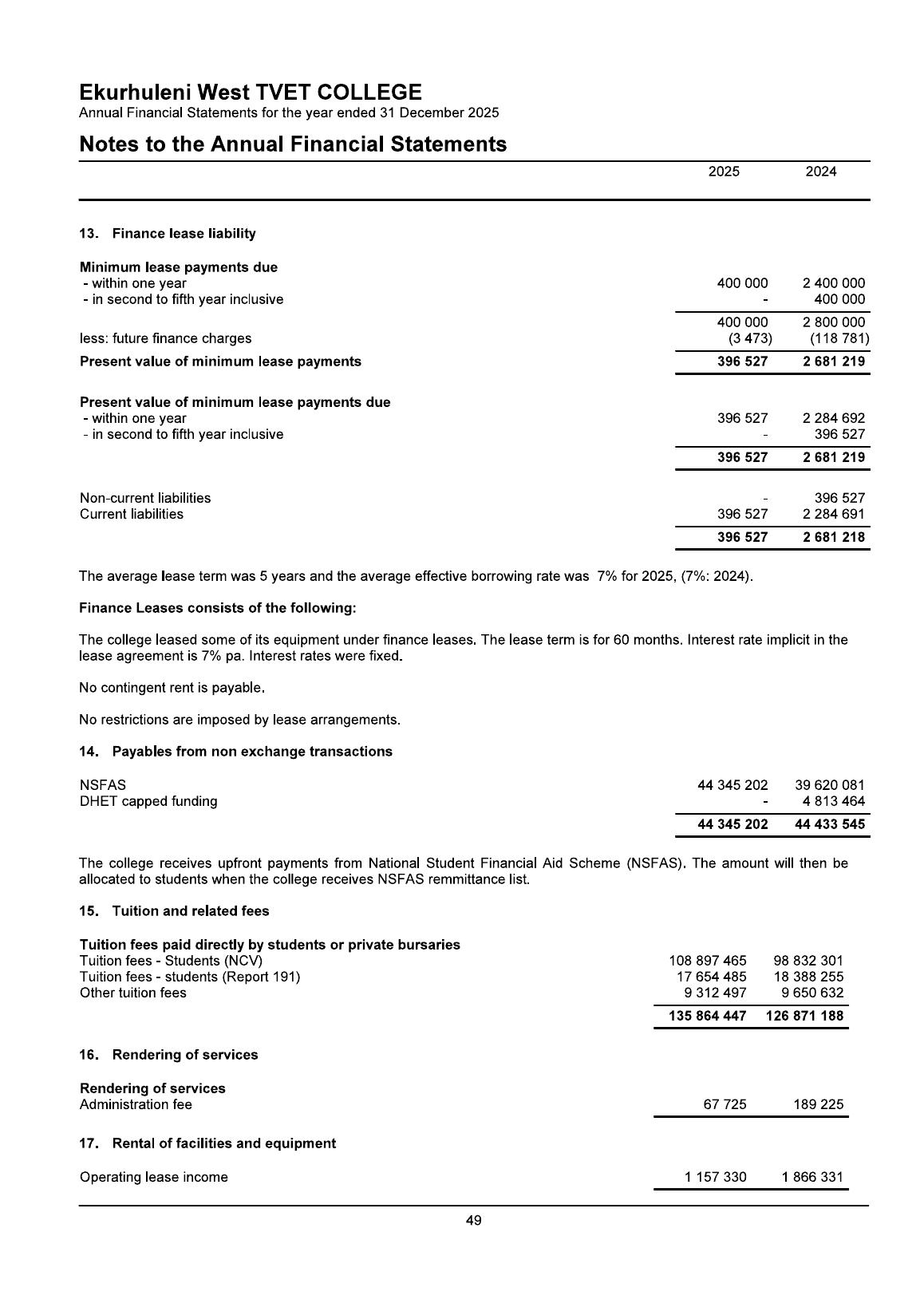
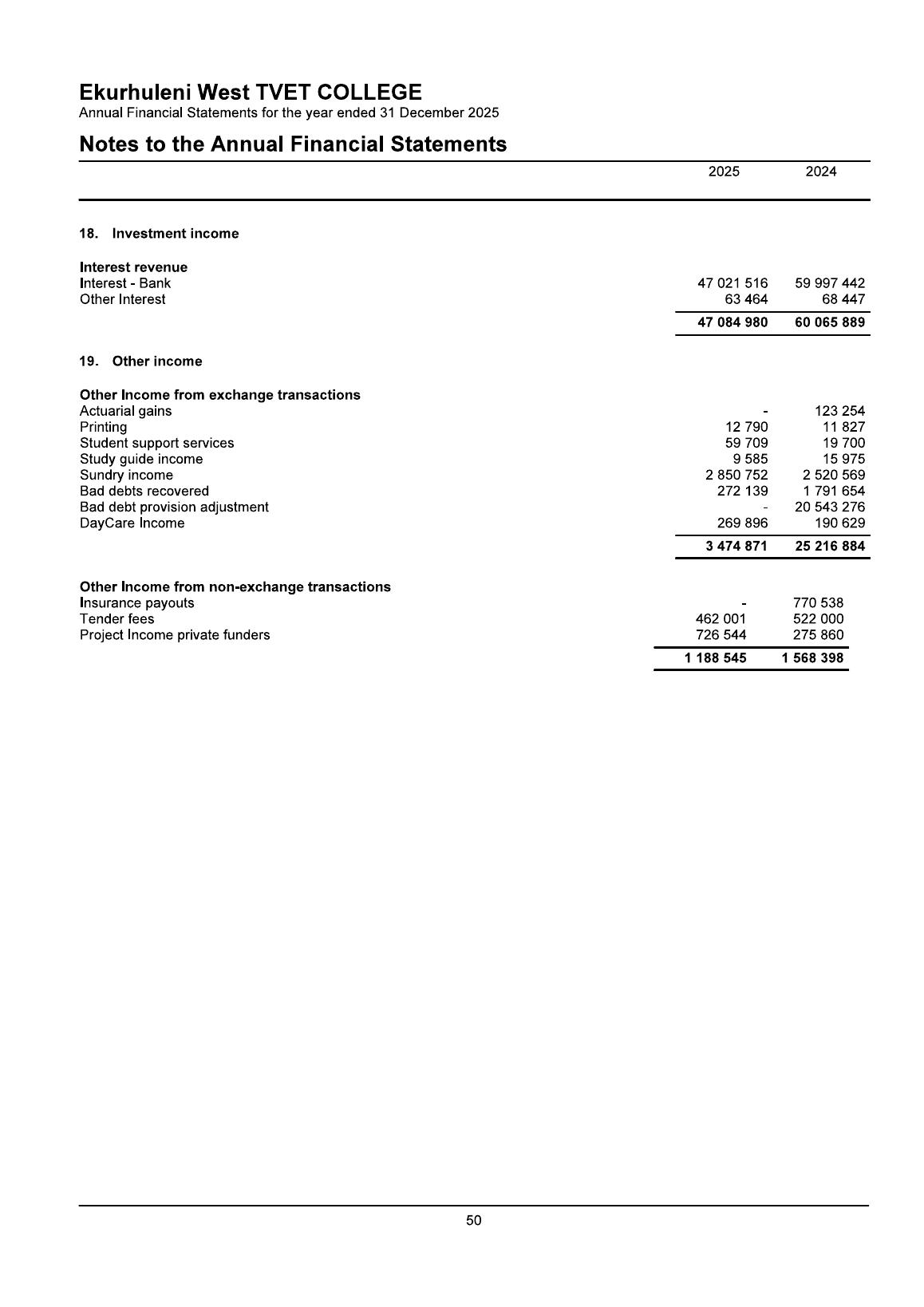
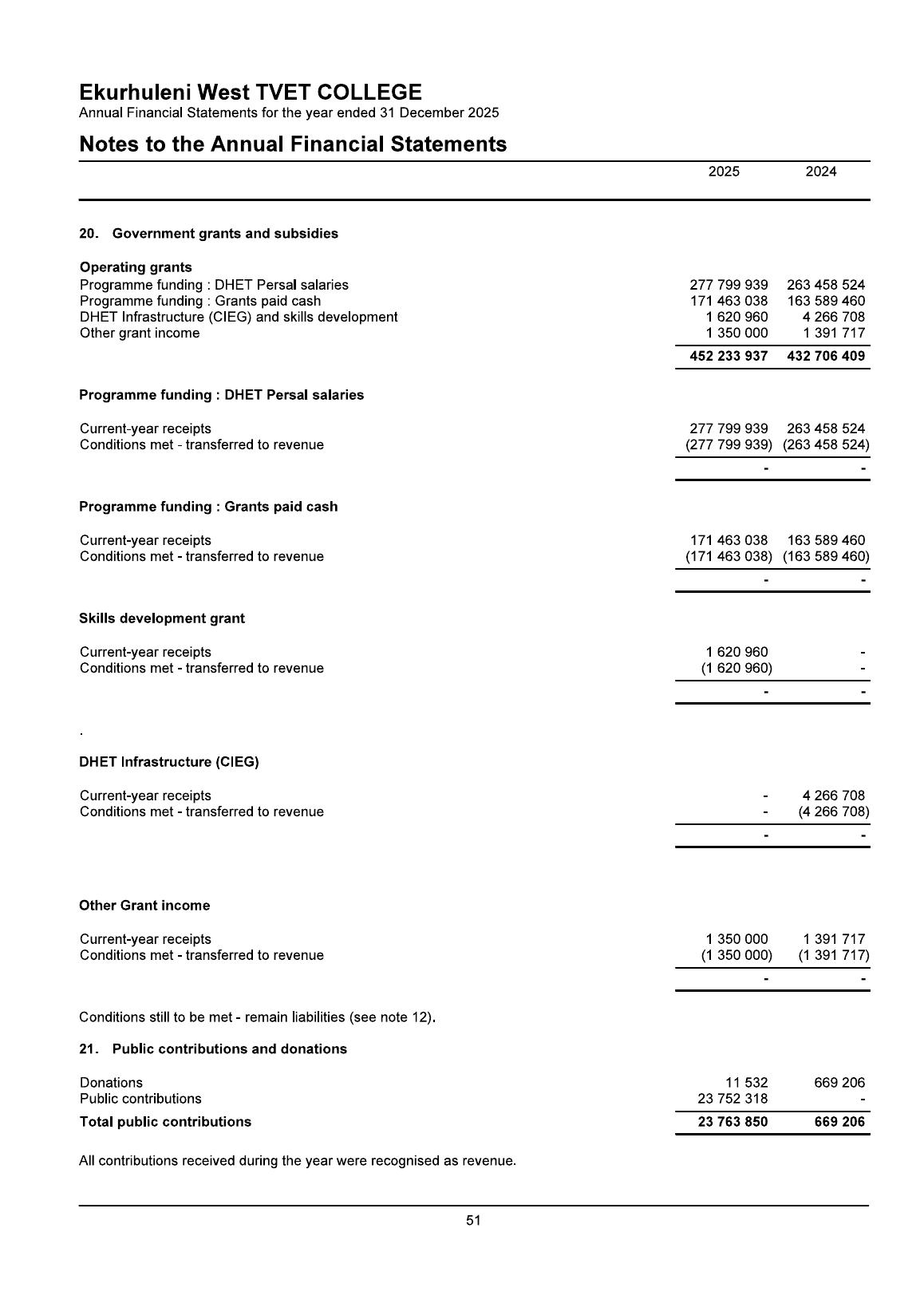
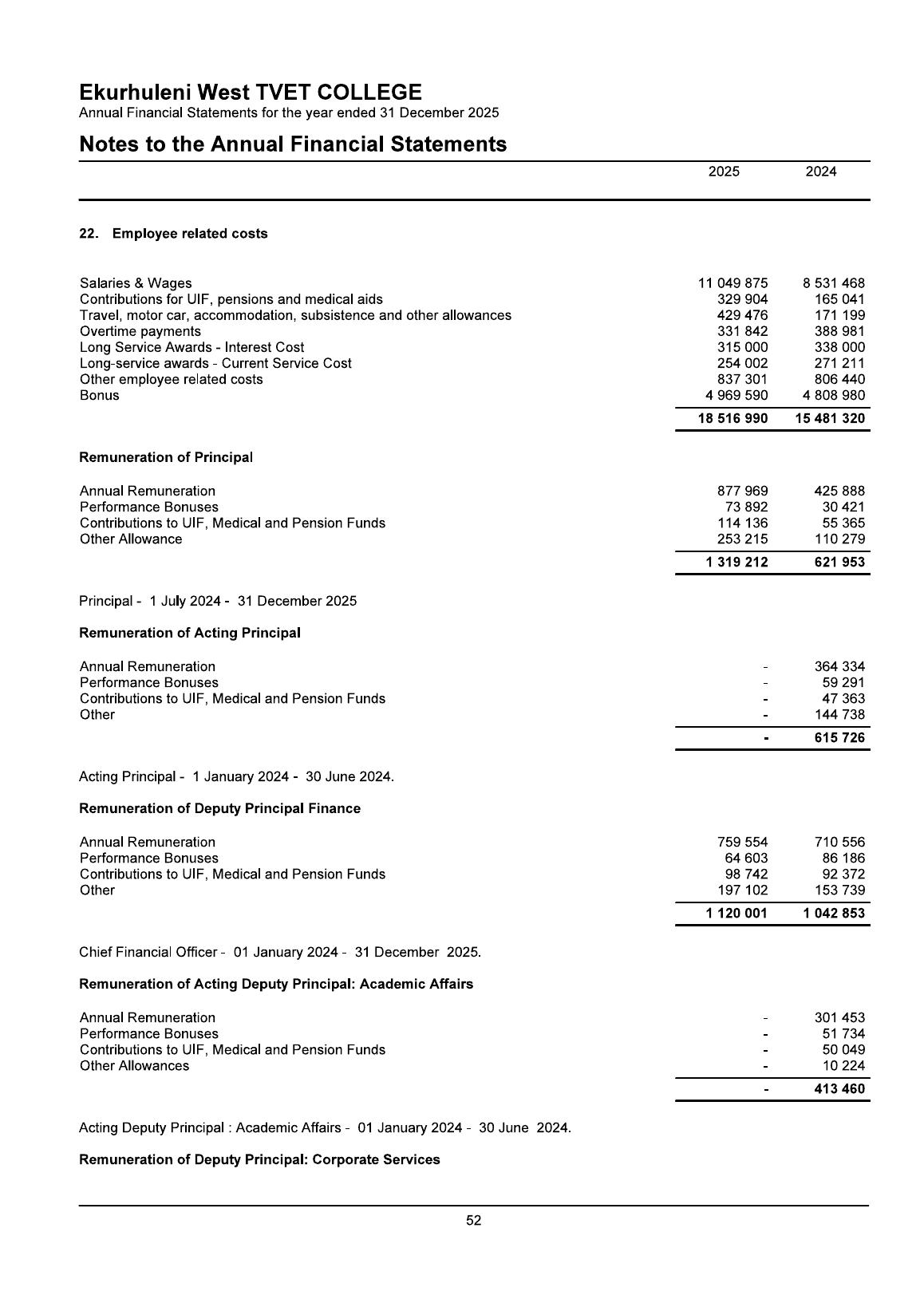
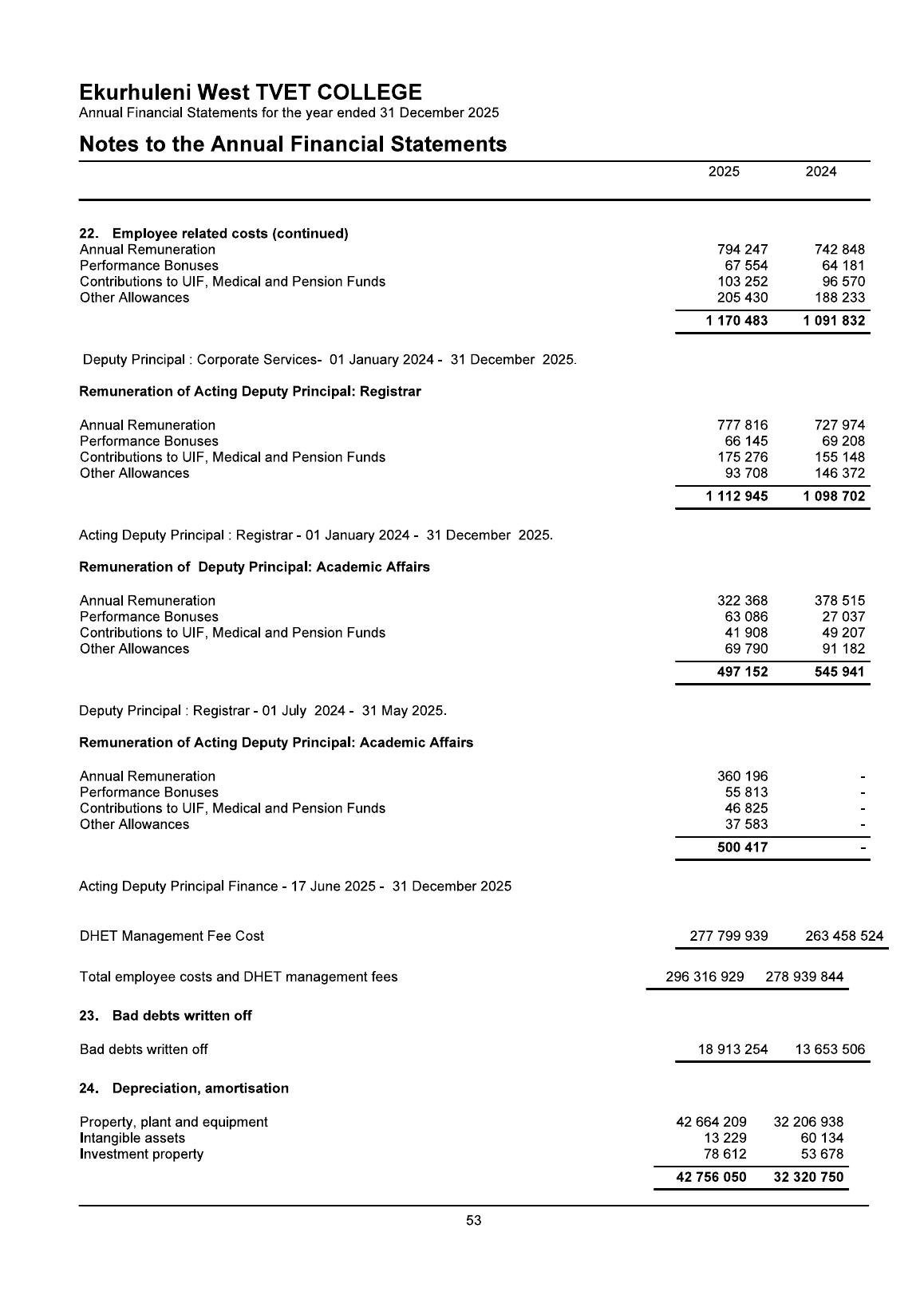
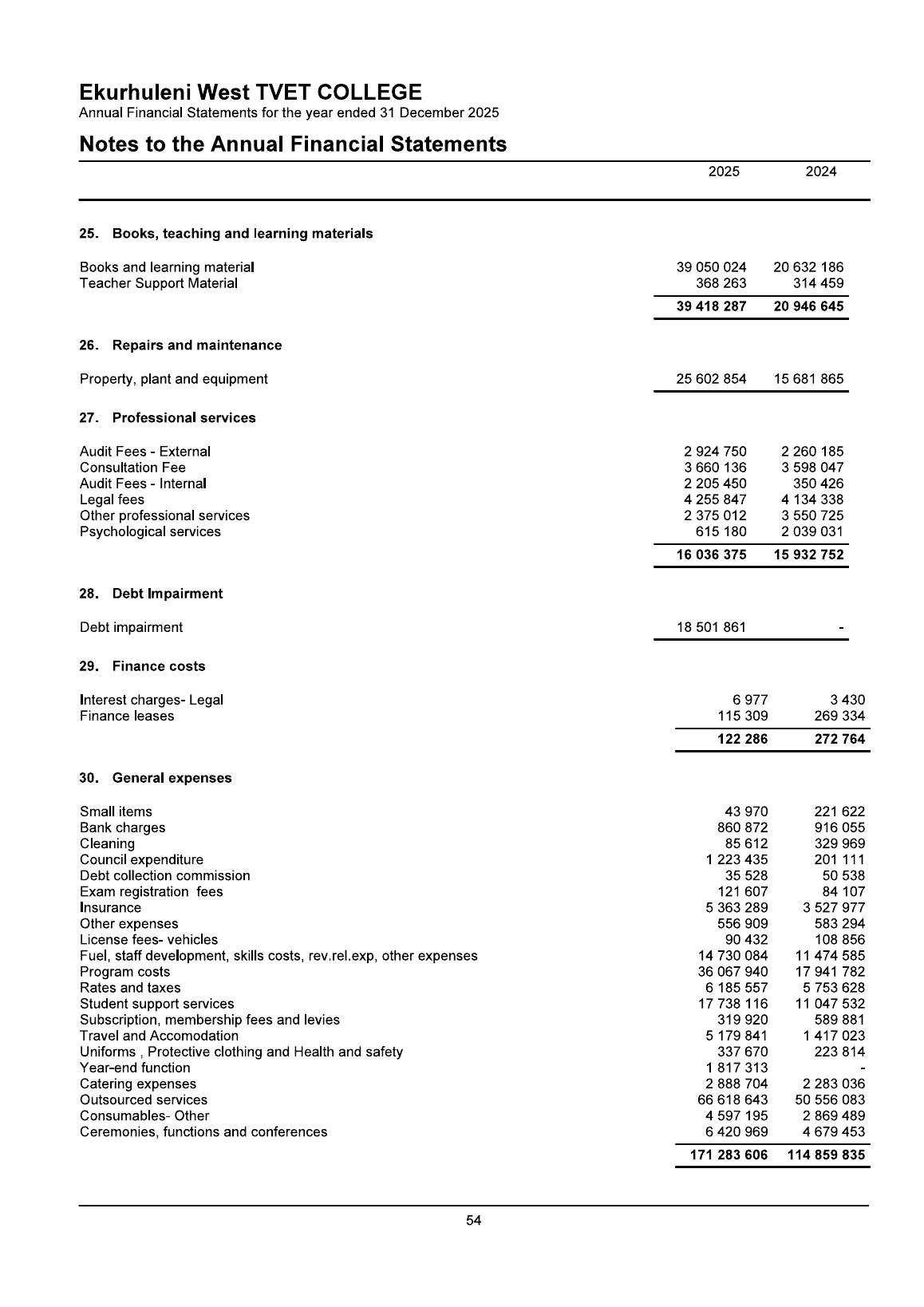
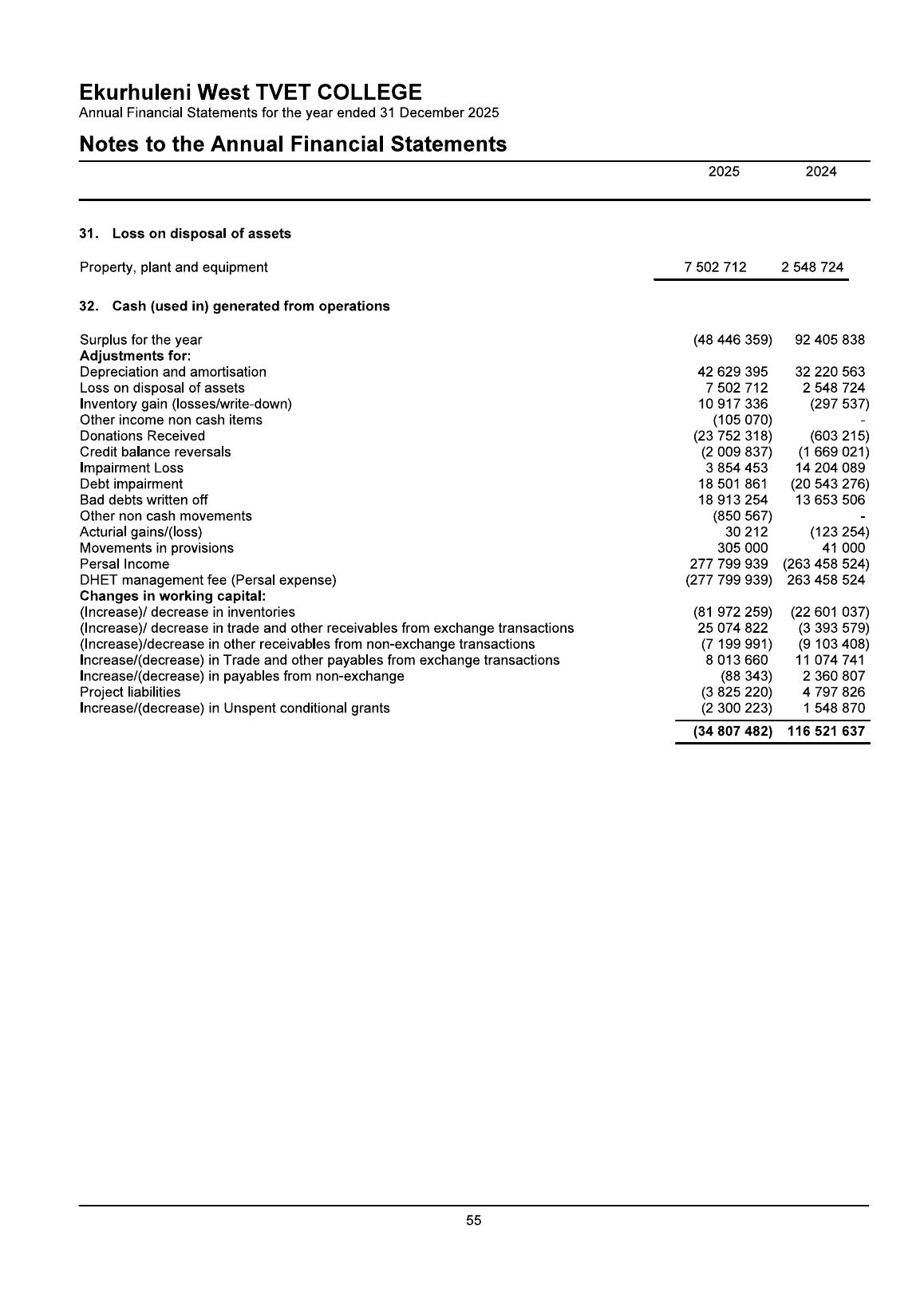
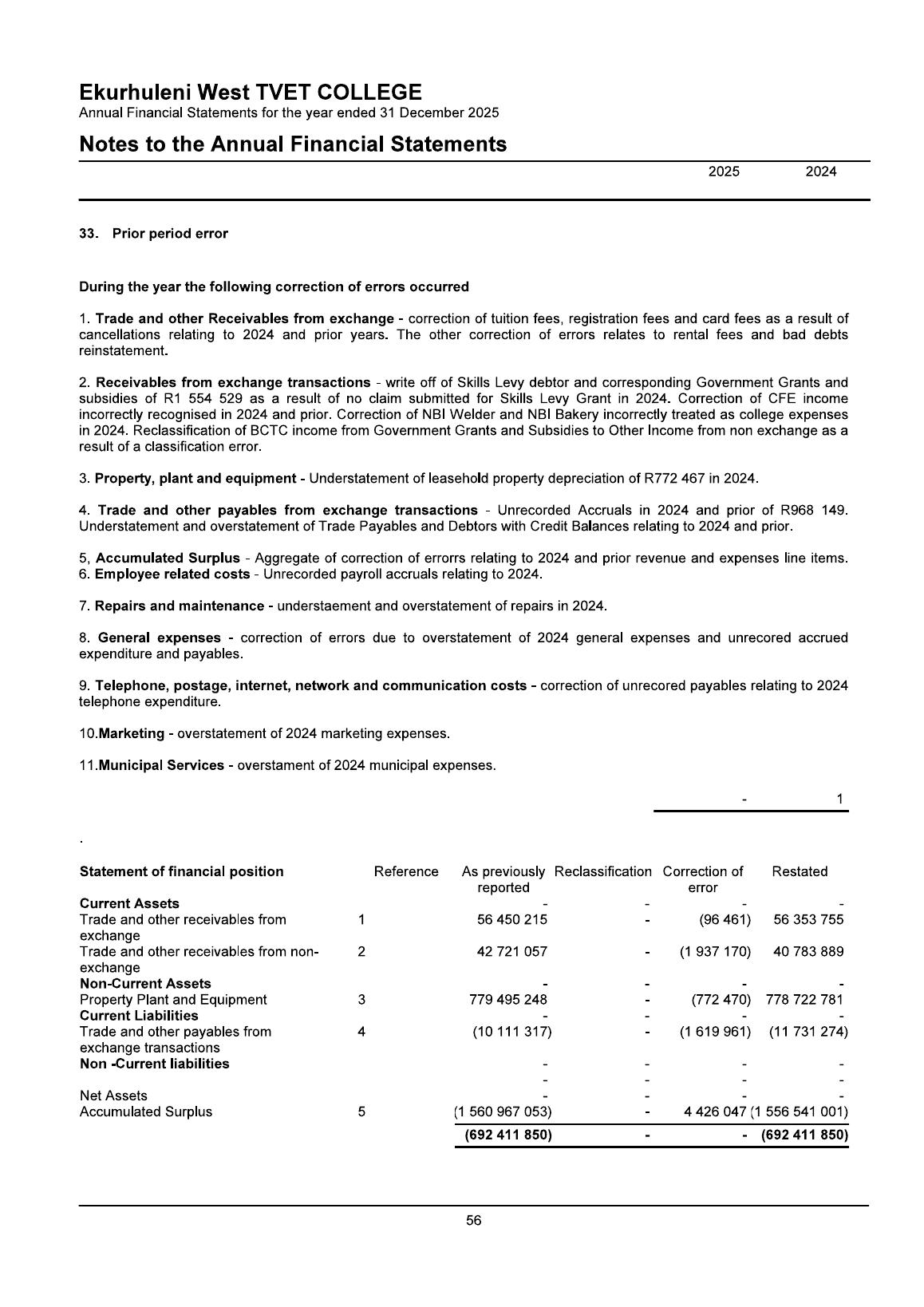
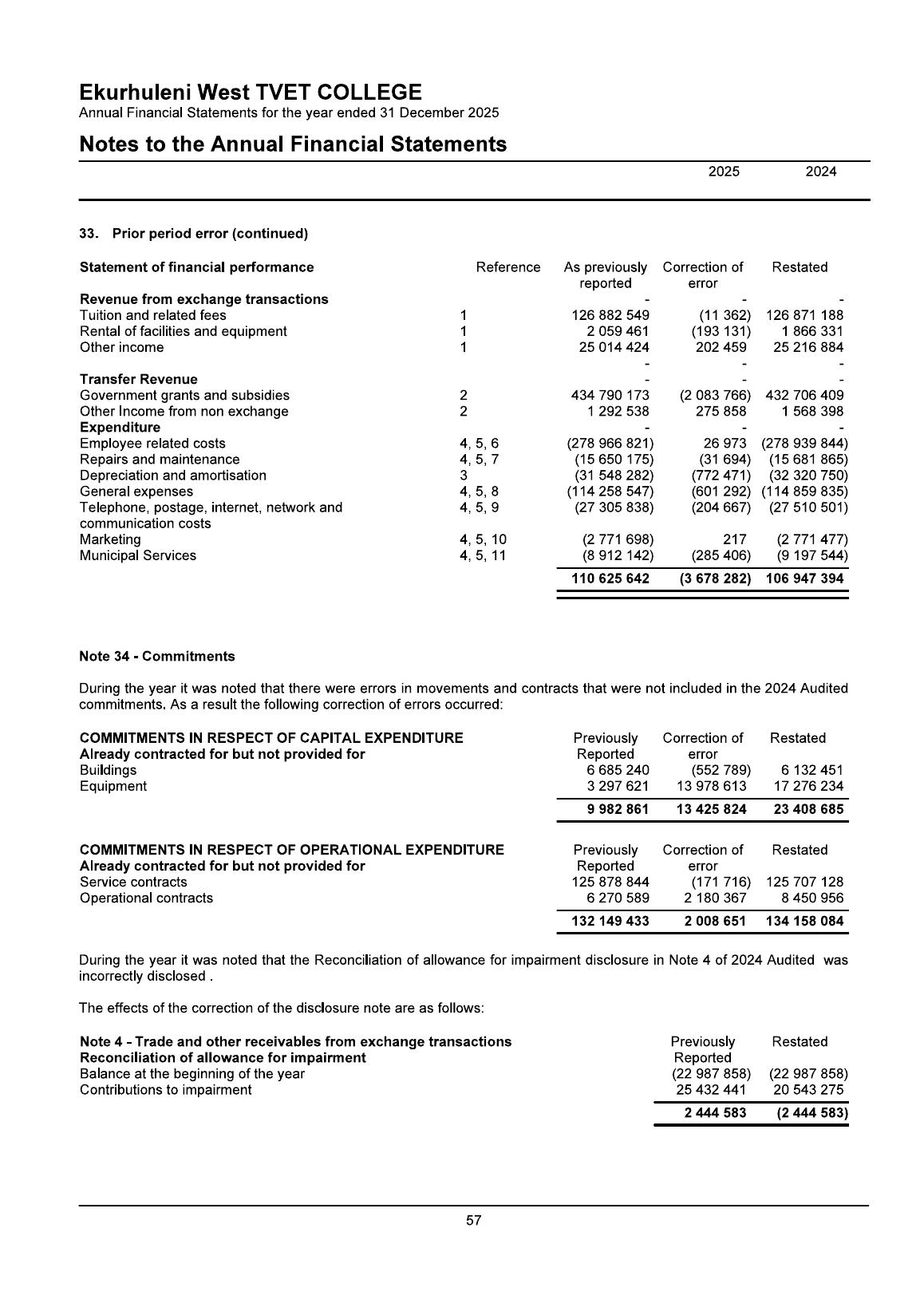

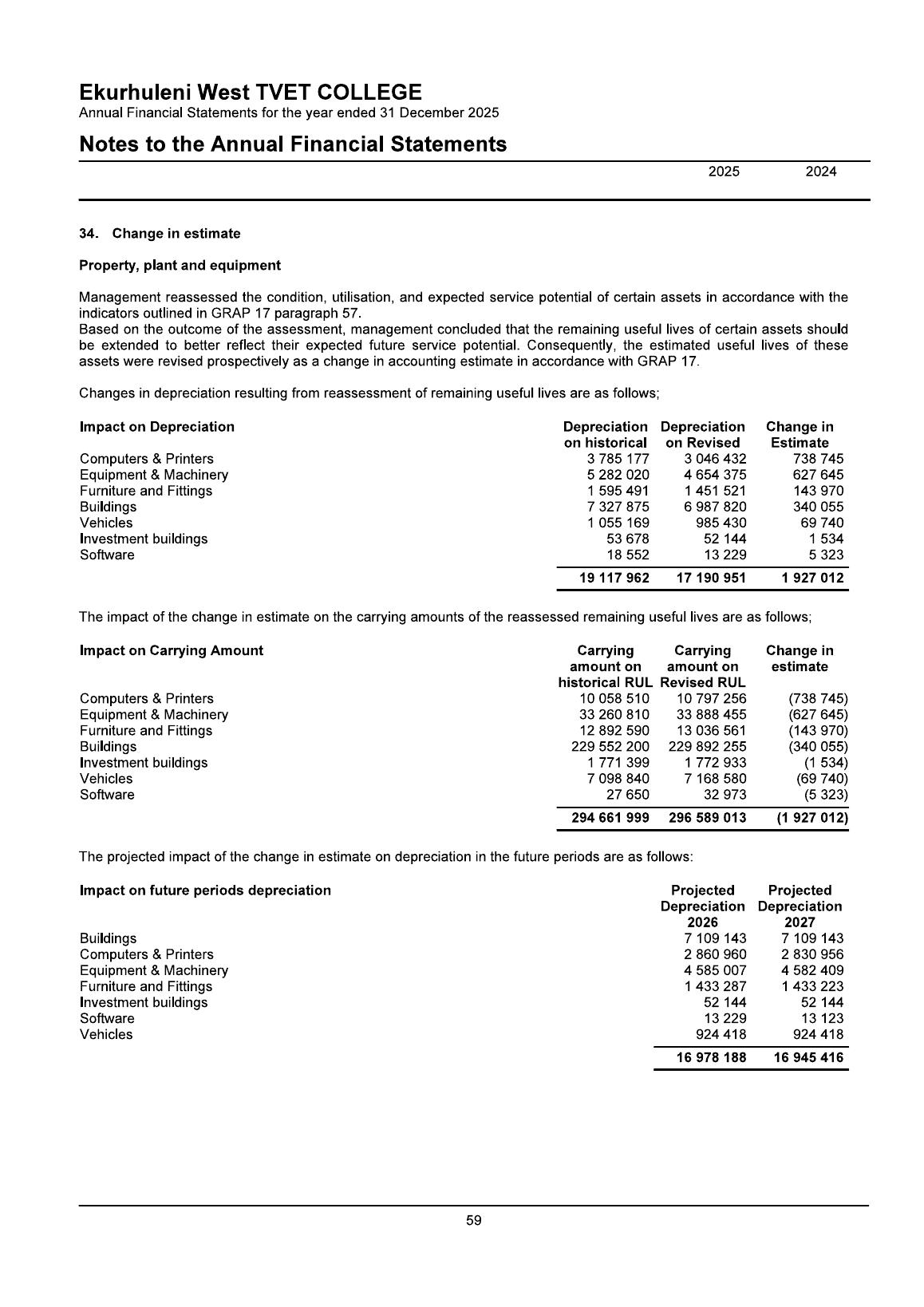
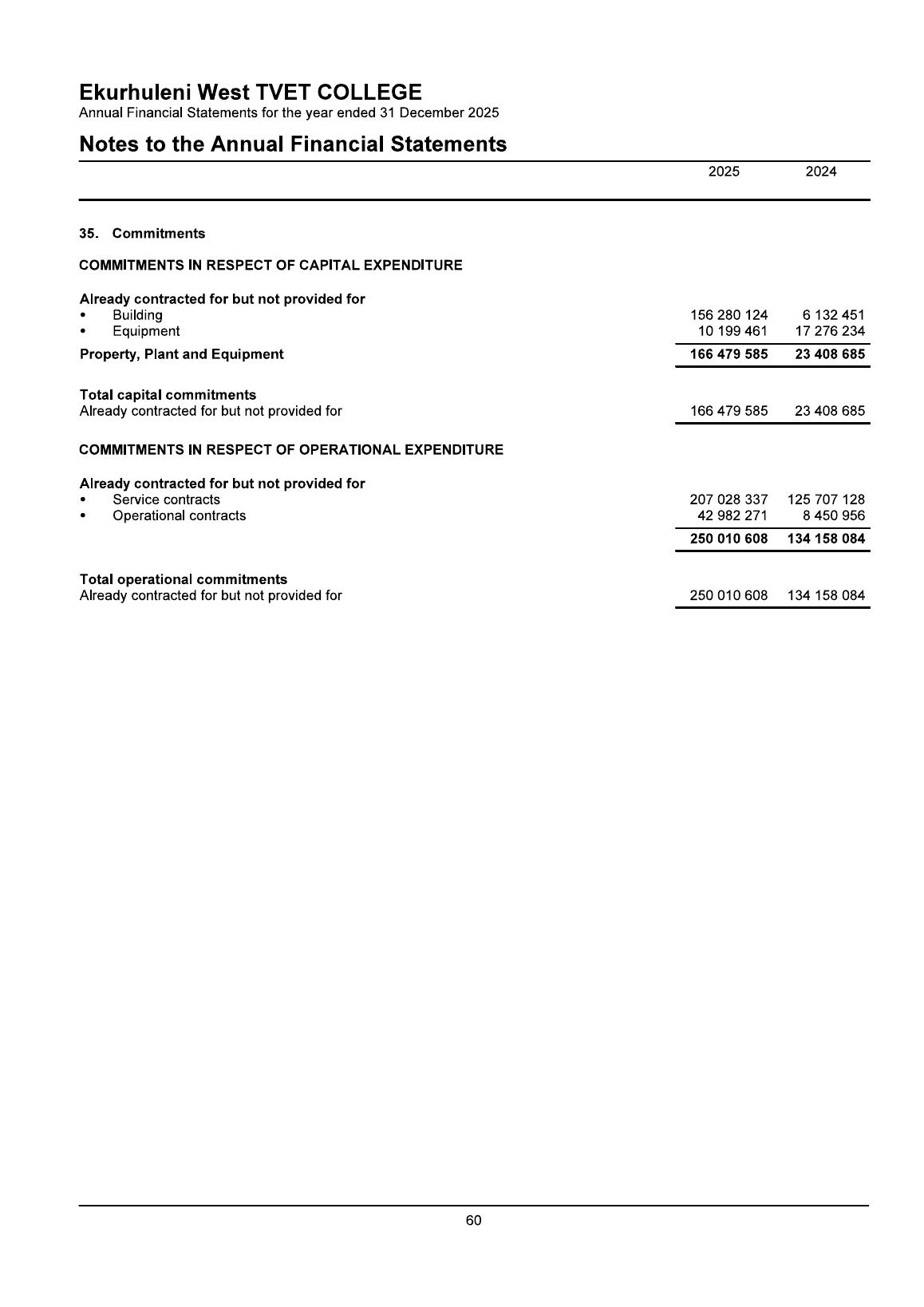
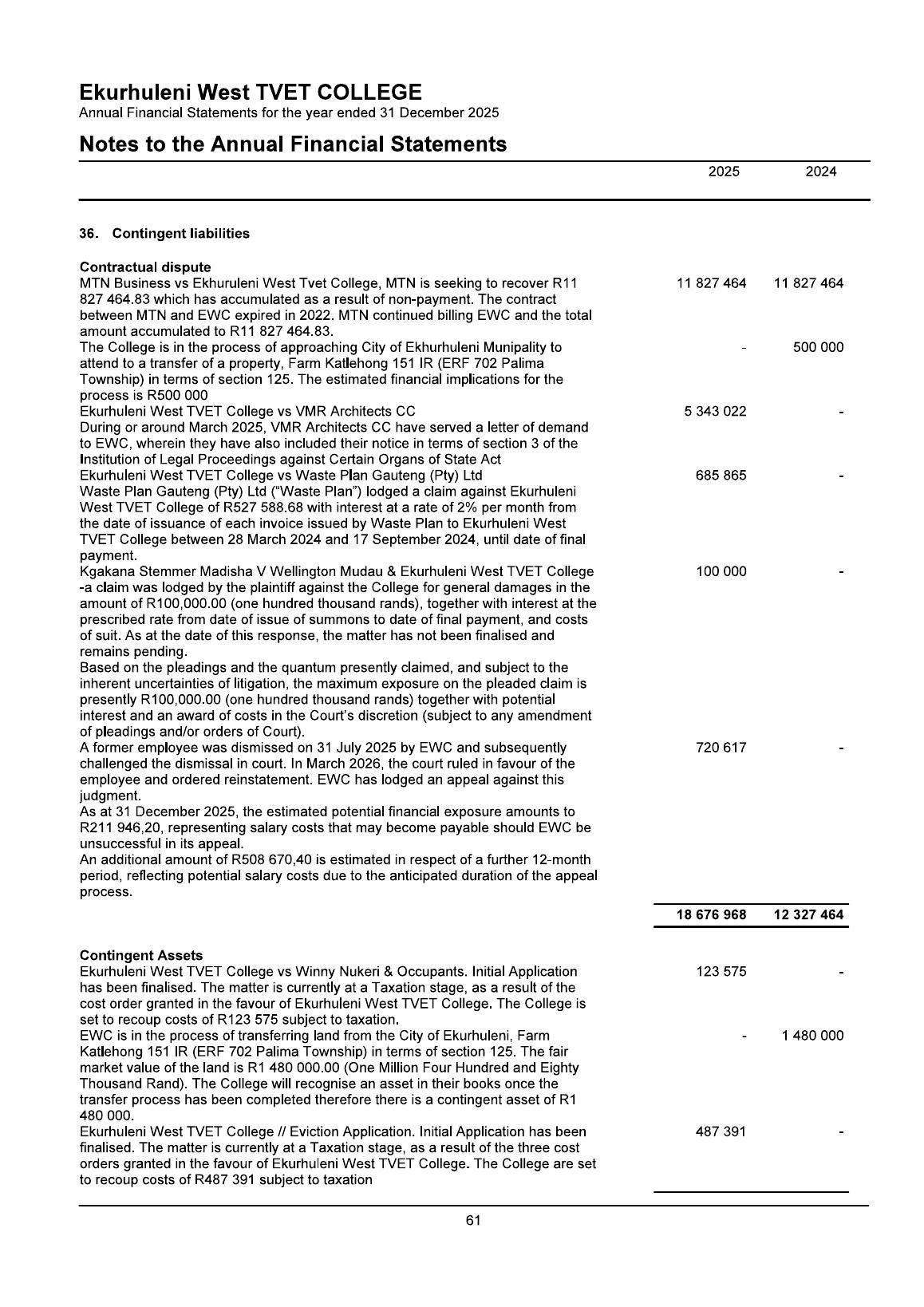

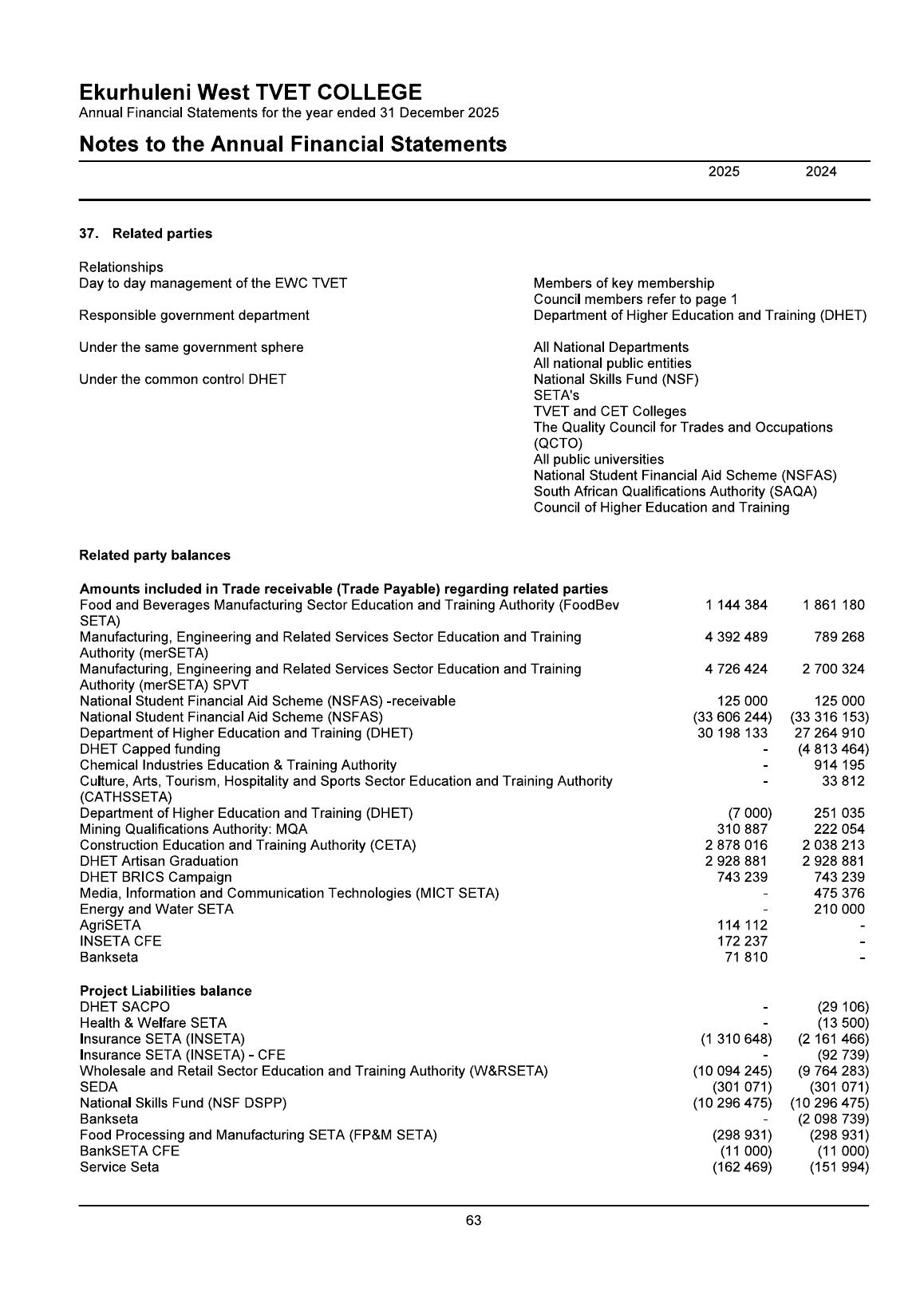
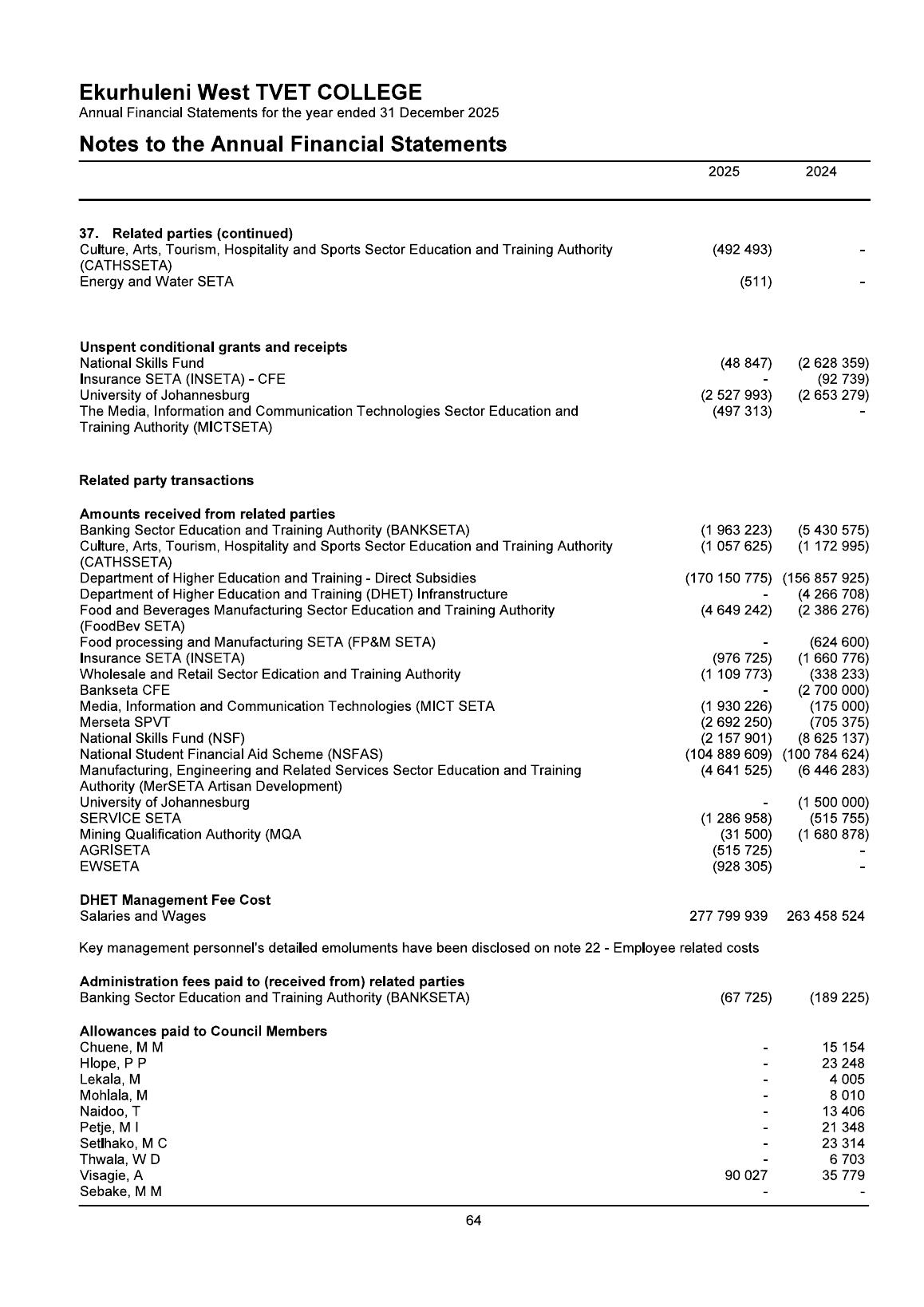
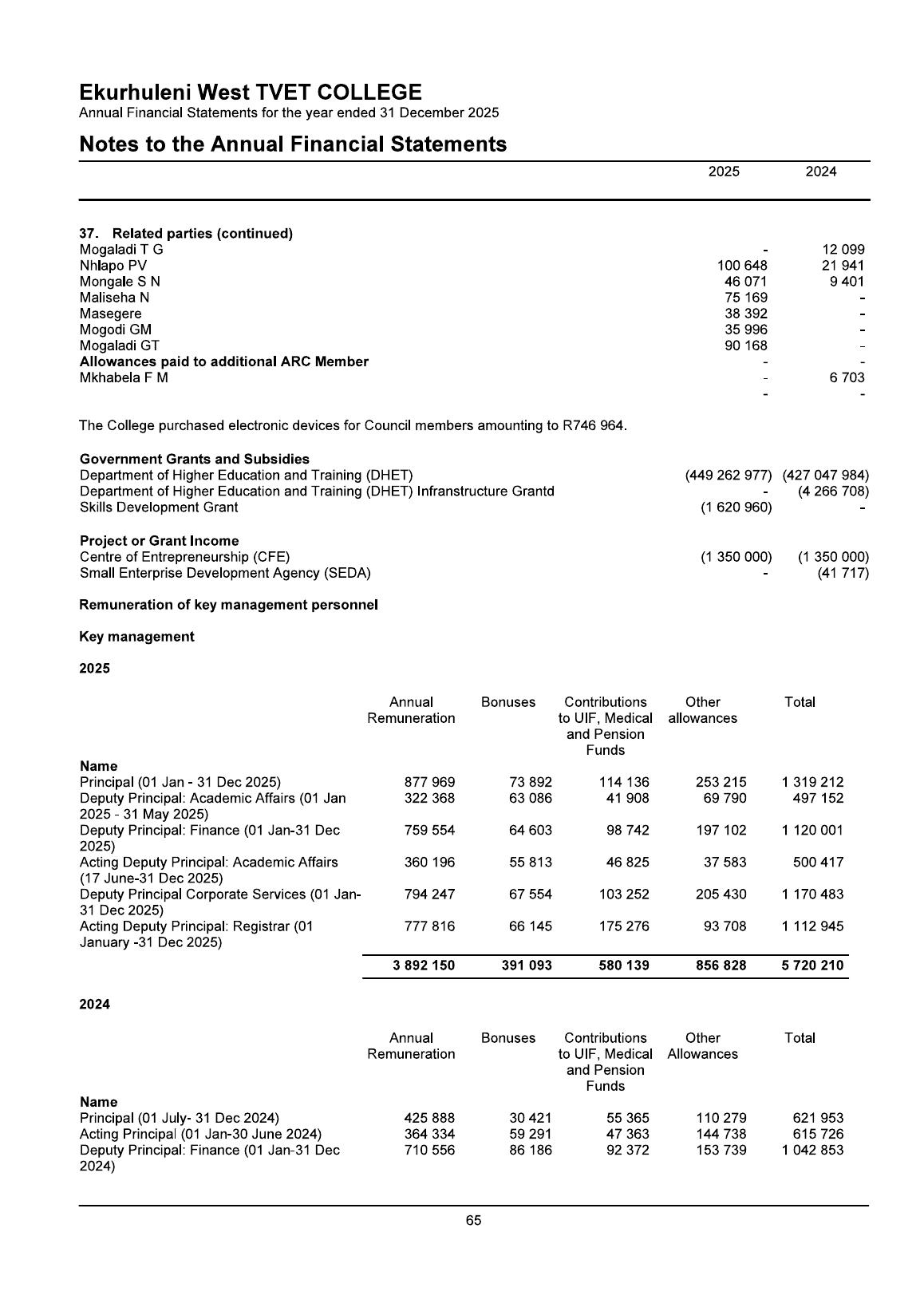
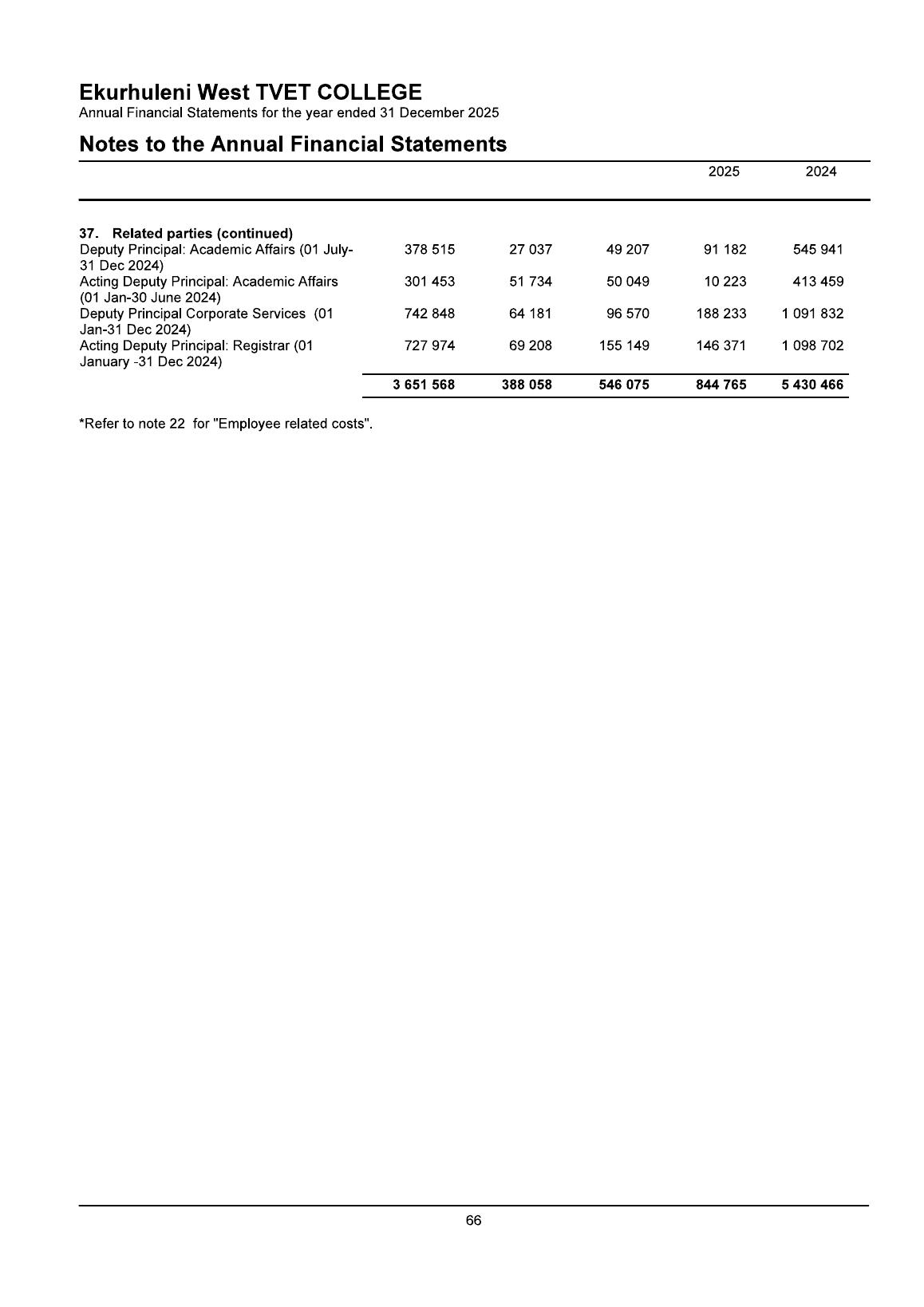
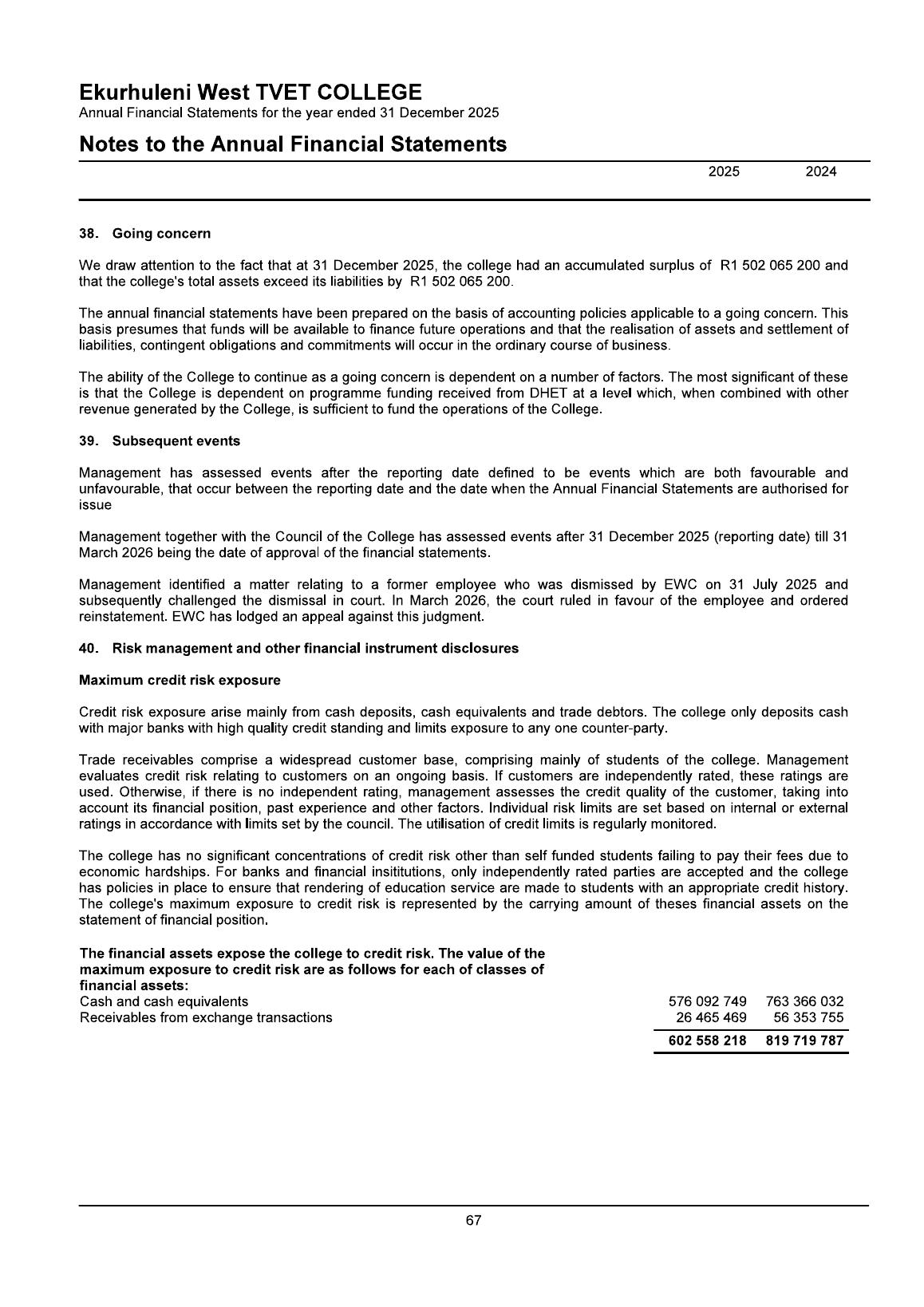
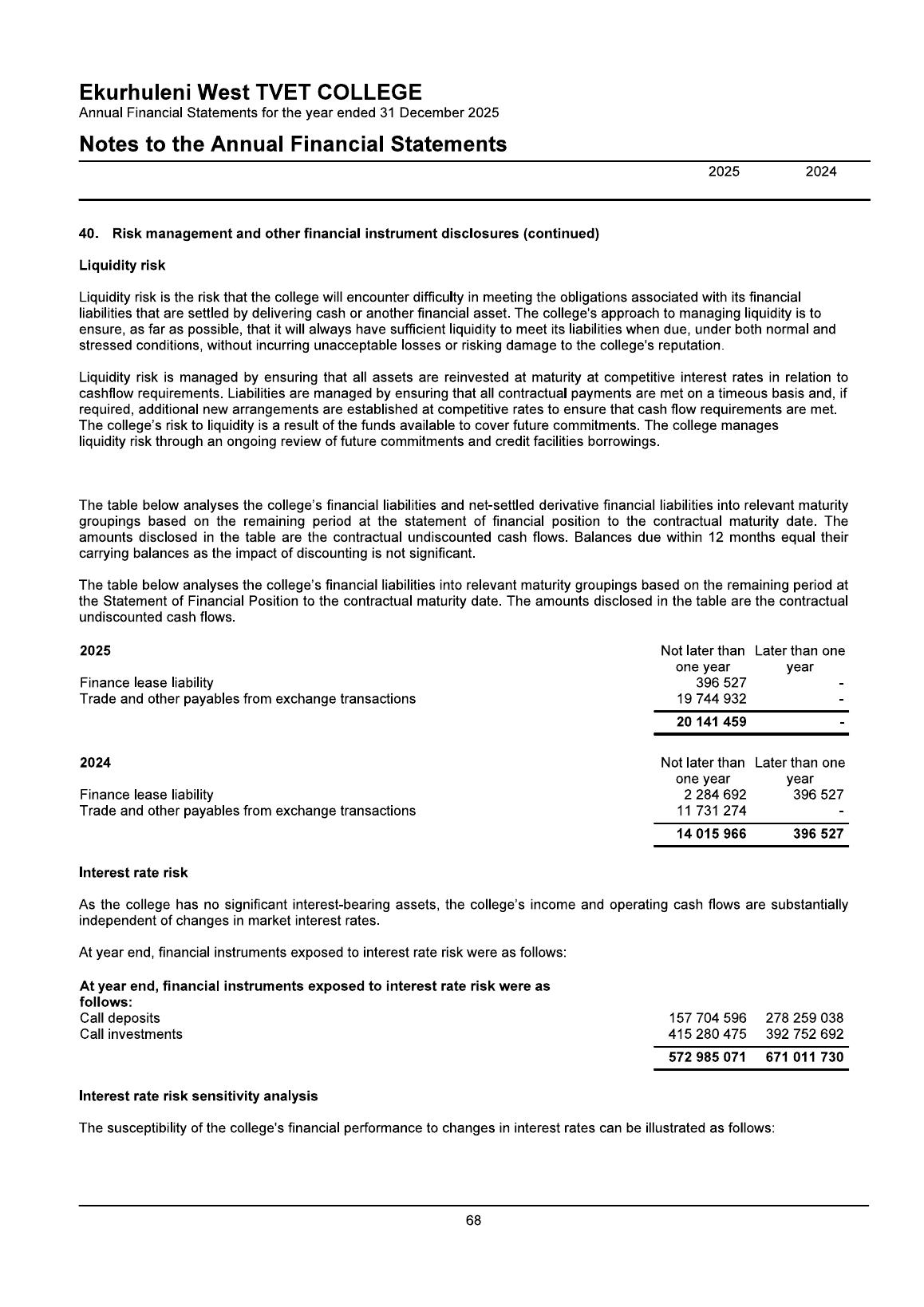
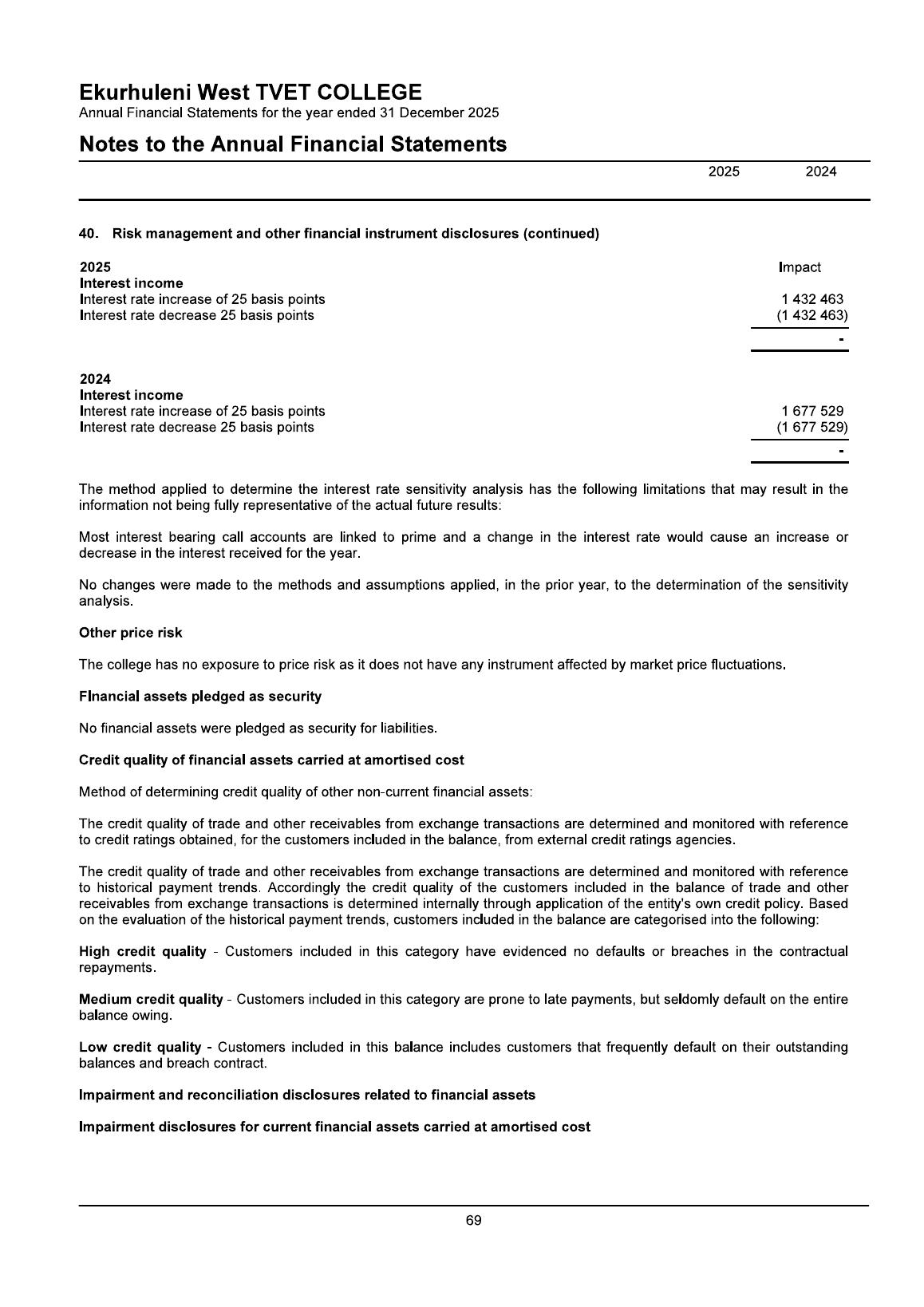
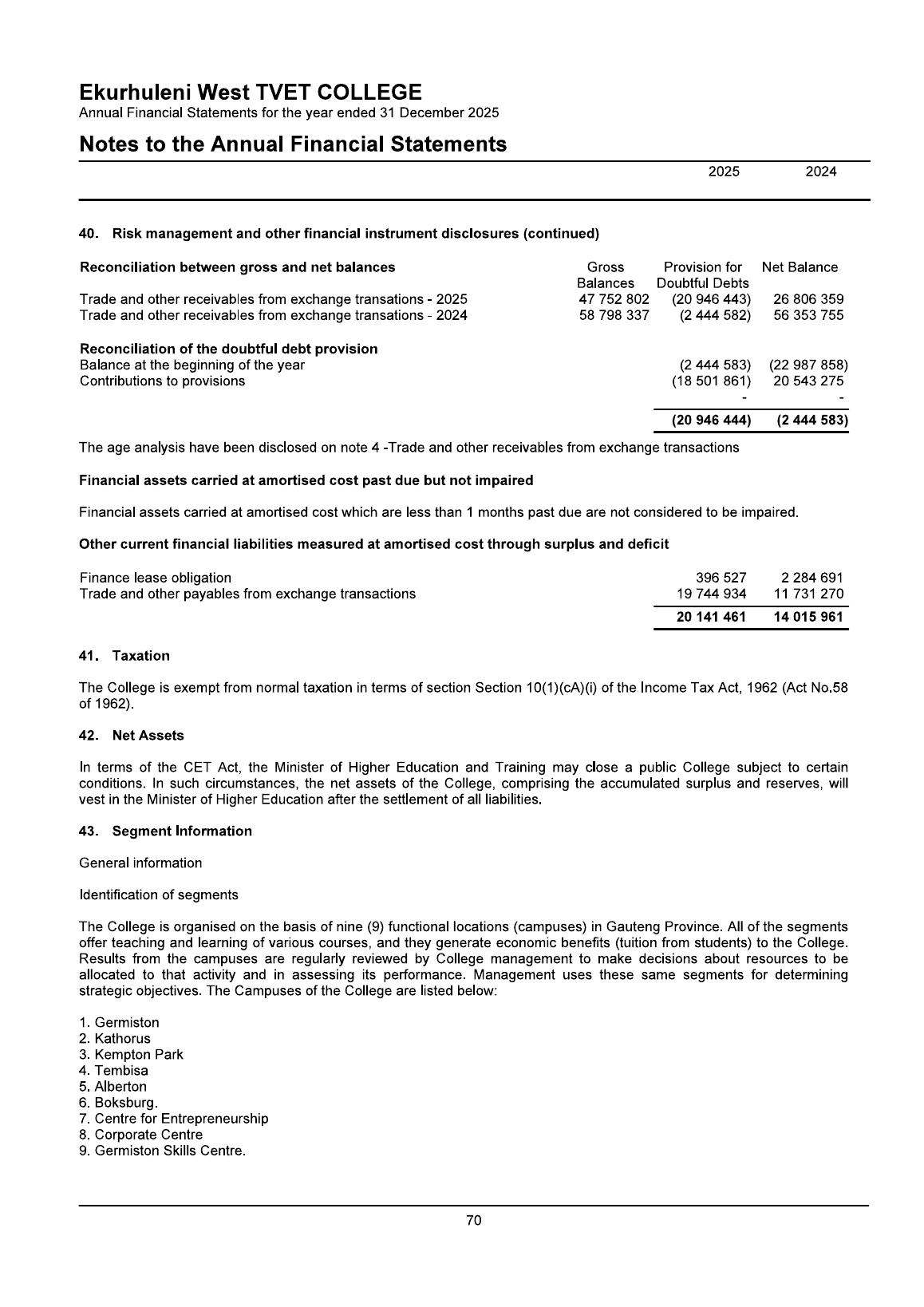
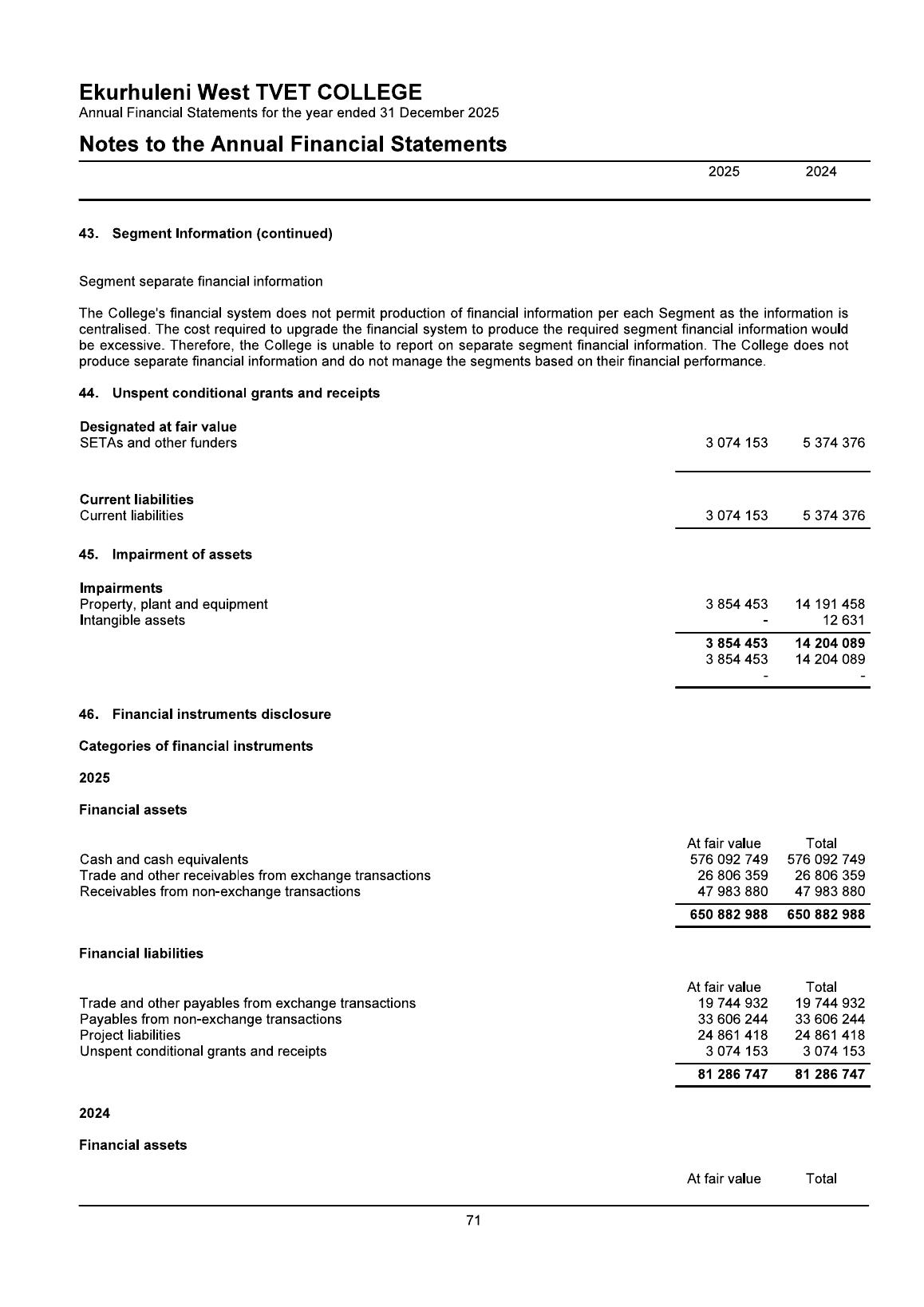
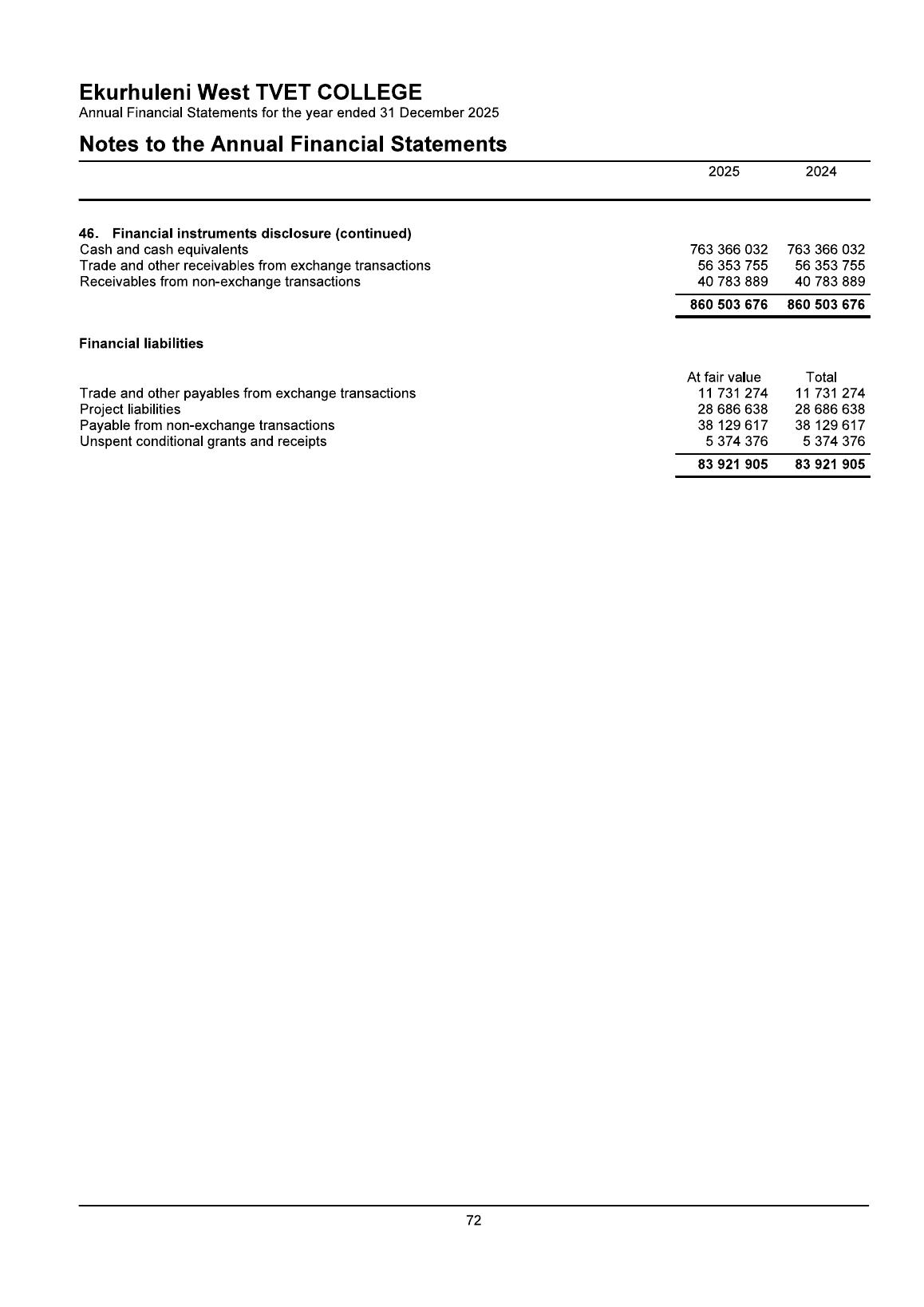
The embedded document above is the authoritative, unaltered Annual Financial Statements as issued. Should any figure or note differ between the summarised tables in Sections 11.2–11.7 and the full statements below, the full statements prevail.